



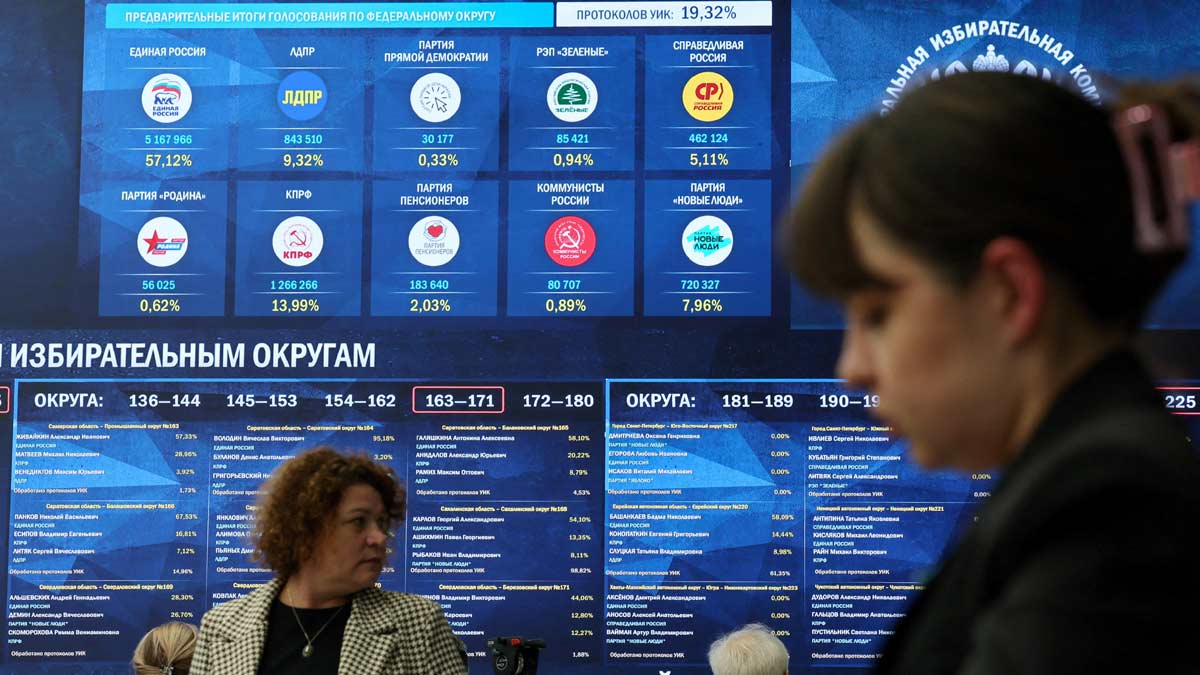
Russia's ruling party is heading for a landslide in the State Duma election in a vote that did not offer any clear alternatives to the Kremlin’s policies. With more than 60 per cent of precincts counted, United Russia led the party-list ballot with roughly 58 per cent. The Central Election Commission put turnout at 56.66 per cent as polls closed across 11 time zones.
The Duma has 450 seats, divided equally between party lists and 225 single-member constituencies, and United Russia is similarly placed to win a clear majority. Four smaller 'systemic opposition' parties, which consistently vote in step with President Vladimir Putin, are also expected to return.
This is Russia's first parliamentary vote since the invasion of Ukraine in 2022. As voting drew to a close, Ukraine launched a large wave of long-range drones at Moscow and surrounding regions, with some accounts putting the number above 1,000. An oil refinery near the capital was damaged, and at least five people were killed across the Moscow area and Russian-controlled territories. Officials pressed on regardless. Voting also took place in Crimea and in the annexed regions of Donetsk, Luhansk, Kherson and Zaporizhzhia. Kyiv called that vote an illegal 'farce' while the European Union called it a violation of international law.
The United Russian victory is clearly the result of the Kremlin’s active measures. Opposition figures have been barred, jailed or pushed into exile; the monitor OVD-Info counts more than 2,000 people imprisoned on political charges. Yabloko, the only registered party campaigning openly against the war, was struck off the federal list by the Supreme Court. A few dozen of its candidates were allowed to contest local seats, though they faced detentions and harassment. The OSCE was not invited to observe. Local monitors reported unsealed ballot boxes, polling stations left unsecured overnight and armed soldiers at stations in the annexed regions.
Online voting, expanded this year, drew its own controversy. Moscow encouraged digital ballots with prize points and gift schemes. The system then suffered glitches, registry errors and outages across the three days, which officials blamed on thousands of coordinated DDoS attacks. Exiled opposition figures, among them Leonid Volkov, alleged that paper ballots were withheld in some precincts to steer voters towards terminals that are harder to audit. Queues formed at several stations as voters insisted on paper.
Dissent was visible but symbolic. Exiled opposition figures, among them Yulia Navalnaya, widow of Alexei Navalny, promoted a 'Noon for a Peaceful Russia' protest. Thousands of Russians abroad queued at embassies in cities such as Yerevan and Berlin, some to display anti-war posters or to spoil their slips with messages demanding peace and freedom. Inside Russia, some voters spoiled ballots or wrote slogans across them.
The result, meanwhile, matters less in deciding Moscow’s future course of action. Russia's parliament already approves Kremlin initiatives without friction, so a fresh Duma changes little in daily lawmaking. Its value lies in the image: a wartime electorate, across 11 time zones and beyond them in occupied territory, apparently turning out in support.
The purpose is plain enough. Putin was not on the ballot, having secured a term to 2030 in 2024, yet he framed the vote as a test of public unity behind the armed forces. A commanding majority lets the Kremlin claim a renewed mandate for the war and for whatever policies follow, possibly economic adjustments or mobilisation. A turnout of just over half, waves of Ukrainian drone strikes and a faltering online system question the credibility of the entire process.
