



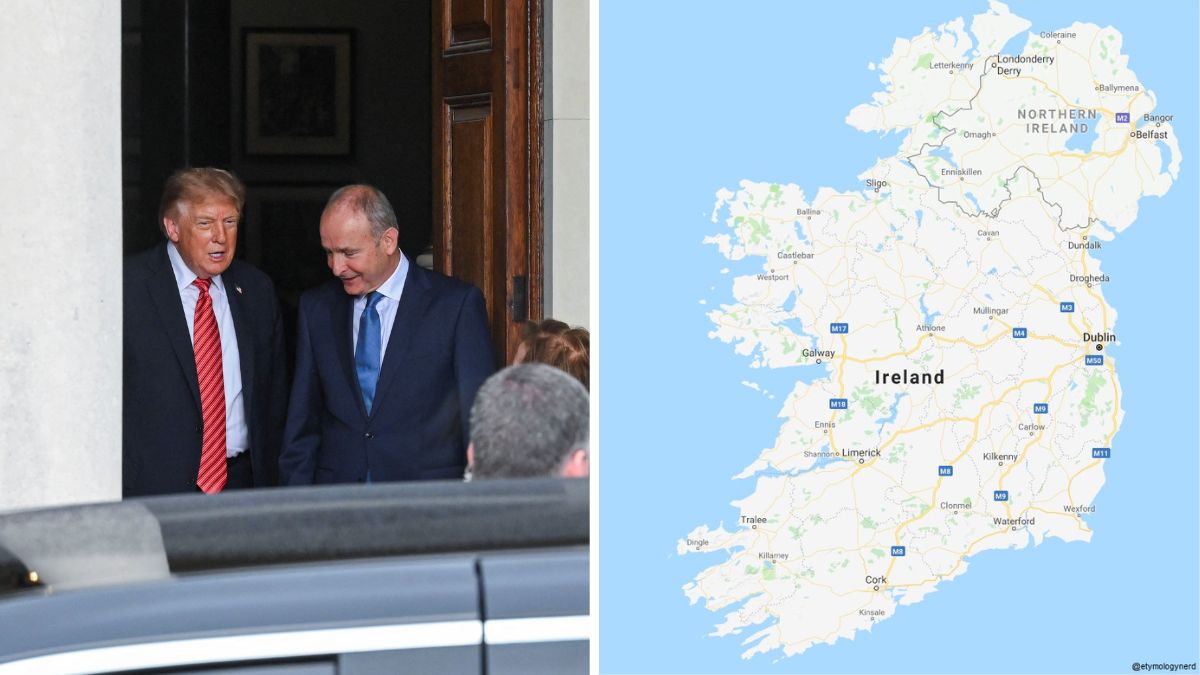
A recent comment from US President Donald Trump has reopened conversations about the partition of Ireland and whether Northern Ireland wants to be part of the Republic of Ireland.
Northern Ireland is currently a self-governing part of the UK. Its constitutional status came in 1998 under the Good Friday Agreement, under which both the Irish and British governments agreed to a power-sharing government in the region.
The agreement also said that the status of the region would not change without the consent of the majority of the population.
Northern Ireland is made up of six of the northeastern counties in the island. The region has a large number of Protestant Christians compared to the Republic of Ireland.
Prior to 1922, the entire island of Ireland was under British rule. There had been multiple efforts made to declare independence from Britain.
In 1918, Sinn Féin, the Irish nationalist party, emerged with a majority in the region. Instead of joining the rest of the MPs in Westminster in the UK, Sinn Féin’s MPs declared the entirety of the island an independent country.
The Irish War followed, and the island was partitioned by the British into Northern and Southern Ireland in 1921 under the Government of Ireland Act 1920.
The act, created by the UK, was intended to have both regions be part of the larger kingdom.
The southern Irish did not recognise the Act and rejected it completely. The northern Irish, meanwhile, formed a Northern Ireland government that wanted to block self-rule and wanted to stay part of the UK.
The conflict involved violence between the Ulster Unionists, largely made up of protestant christians in the north, and southern nationalists, largely made up of Catholics who wanted self-rule. The unionists feared being dominated by the Catholic majority in a Dublin parliament.
The Anglo-Irish war ended with the Anglo Irish Treaty in 1922 that recognised Ireland as an Irish Free State.
Northern Ireland meanwhile was given an option to opt out of the Free State. A border was drawn by a boundary commission. In 1949, Ireland left the British Commonwealth and became a republic.
Northern Ireland has a system of devolved government. It makes decisions on local matters while areas like defence, foreign policy and taxes are managed by the UK government.
Ireland meanwhile has a consulting role in the governance of Northern Ireland.
In Northern Ireland, the Republicans and Nationalists want a reunification while the unionists want to remain with the UK.
A reunification of Northern Ireland with Ireland would not be much different from the latter’s current system of governance. It would look more like a transfer of sovereignty from Britain to Ireland.
The Good Friday Agreement says that the unification may take place after a border poll is conducted.
A reunification would also mean that the region would become part of the EU, from which Britain exited in 2020. The region would have to make a slow transition from using the British pound (Sterling) as currency to the Euro. This would also mean having the EU on board with the transition.
According to surveys conducted by the Statista Research Department. The percentage of citizens in Northern Ireland who support reunification has risen slightly from 25 percent to 36 percent from 2019 to 2025. The percentage of citizens who oppose reunification, by contrast, is down to 45 per cent from 51 per cent in 2019.
A referendum, however, can be held only at the discretion of the British government. The UK government is only obligated to hold the referendum if there appears to be a majority support for the reunification.
A majority in Northern Ireland, as of now, still favours remaining with the UK according to polls.
The leader of the Democratic Unionist Party, Northern Ireland's largest party advocating continued union with Britain, said that unification with Ireland would lead to "the destruction of our country."
Gavin Robinson, who has publicly supported Trump in the past, wrote on X: "Northern Ireland's constitutional future will be decided by the people of Northern Ireland, not by commentary in London, Dublin or Washington."
