



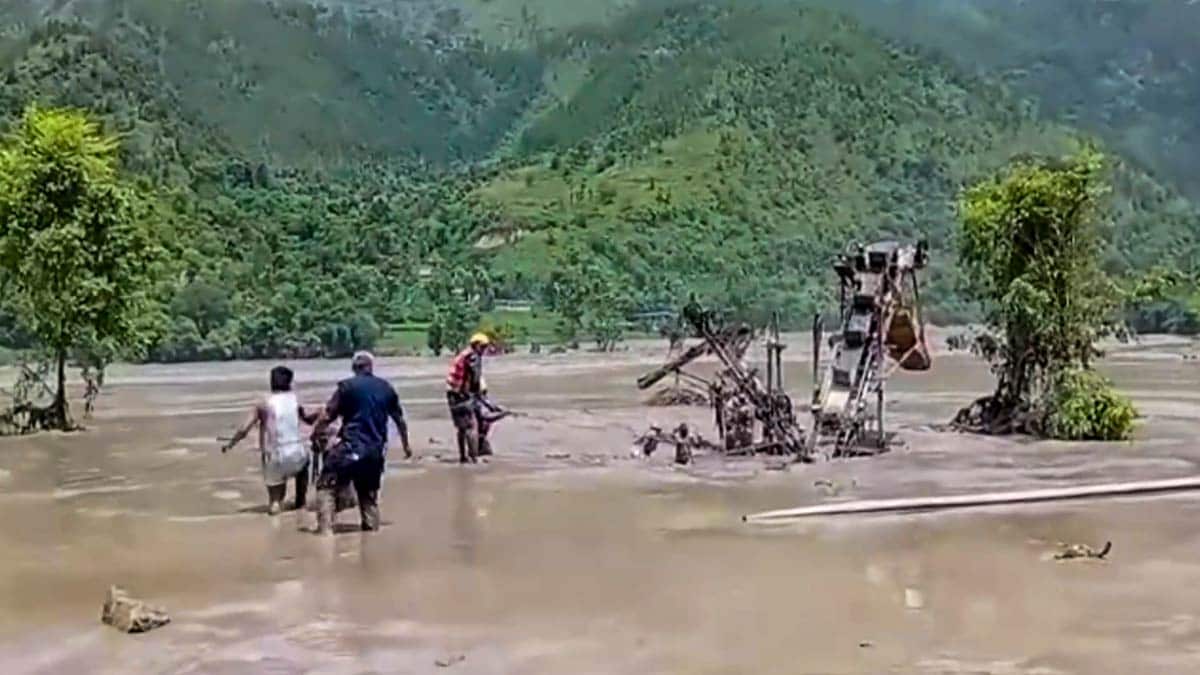
Here in Nepal, a week after the catastrophic flash floods tore through communities, I have witnessed both hope and despair.
The longest wait
Overhead, the constant sound of the helicopters fills the air – we have to shout to each other to be heard. Every time a search-and-rescue helicopter lands at Maithili Barracks in Bidur, Nuwakot, families behind the barriers watch without blinking. For some, each helicopter carries the possibility of a miracle, a loved one rescued, finally coming home. For others, the waiting is darker—they are searching for a name, a face, any news to end agonising uncertainty.
Since the Bhote Koshi River surged on August 26, families have searched army camps, hospitals and police stations daily. More than 11,000 people have been rescued, but 4,000 people remain missing; more than 1,000 have died, and 1.6 million are affected by the devastation.
In 2015, I was here during the Nepal’s ‘Gorkha’ earthquake, where it felt as though a thousand hammers were striking all at once across the country. The recent flash flood felt like those same hammers falling again and again, but in a more concentrated area.
From the mountains to the valleys, the landscape along the Northern border has been distorted. Homes, schools, roads, bridges and local markets have been swept away or buried beneath mud and debris. Places where children’s singing and laughter echoed in the valleys now stand silent. Entire communities were washed away in an instant.
In Bidur, I visited a relief centre where 56 children were sheltering with families and volunteers. Some had lost their parents. Some were still waiting for news on their family. All of them had been separated from the people, places and routines that made their world feel safe.
Their fear was impossible to miss. They had witnessed the flood come with a force they could neither comprehend nor withstand. Now, every rumble of water, every darkening sky, carries the question: Will it happen again?
Some children asked us how bad the next flood might be. Others said nothing. Their silence was perhaps the hardest thing to witness; it spoke volumes about the shock they were carrying.
For these children, their homes are gone, their friends and parents are missing – their childhoods brutally swept away by the floods.
The floodwaters are beginning to recede, but thousands of families remain suspended between hope and heartbreak, waiting for news of loved ones, waiting for somewhere safe to sleep, waiting for life to make sense again.
Road ahead: Dignity must be the starting point
When everything you own has been swept away, where do you begin?
At a relief centre in Bidur, local volunteers told us that many children arrived wearing nothing but the clothes on their backs. No school bags, books or toys. Families who had lost everything were trying to work out how to make a simple meal to feed their children.
In a disaster, there are a hundred things people need. But the first question should not be: What do we have to give? It should be: What do people need most?
That distinction matters.
Humanitarian aid is not about emptying warehouses or distributing whatever is available. It is about listening, understanding and providing assistance that is useful, appropriate and dignified.
Disasters may be indiscriminate, but their consequences are not. Poverty, age, gender and disability can determine who suffers most and who finds it hardest to recover.
There are calls for clean water to drink and sanitation facilities to avoid the risk of disease, alongside dignity kits for women and girls.
Children face particular risks, especially those who are unaccompanied and do not have a guardian to keep them safe.
Displaced women and girls can become more vulnerable to exploitation, trafficking, abuse and gender-based violence after a disaster. There are currently no reports of such incidents in the flood-affected areas here, but experience from other disasters offers a stark warning: when families are uprooted and protective systems collapse, risks rise.
For the children I met, the psychological scars may outlast the physical destruction. They have watched floodwaters swallow homes and, in some cases, people they love. Most are living with the constant fear that the water could return.
Psychological first aid cannot wait. Neither can safe and child-friendly spaces, temporary learning spaces. These are important to enable them to play and socialise, process together the journey they have been through, and to offer them a sense of normalcy, to feel like children again.
We know how important it is to ensure that they do not miss too much of their schooling. Education provides more than learning. It offers routine, stability and hope. It is imperative for their futures that their education continues.
Nepal will need sustained support from donors and the international community. Local communities and volunteers, who are invariably the first responders, must be supported as partners, not treated simply as recipients of help.
This disaster is also a warning. As climate-related hazards intensify, preparedness is no longer optional. Early warning and anticipatory action save lives. One teacher, after receiving an early warning, moved more than 1,000 children to higher ground in time. That is the power of preparedness.
Humanitarian assistance is built on key principles; the principle of impartiality tells us that assistance must be guided by need. But dignity demands something more: people must have a voice in decisions that shape their lives; this includes children.
The question here is not simply whether we help; it is how we help. Are we also ensuring we help the Nepali people here regain a sense of control, safety and hope?
Dignity is not something relief delivers at the end. It is where every response must begin.
One humanity
I am back in Nepal with some of the colleagues I worked alongside in 2015 following the earthquake. We supported each other through the long days and nights just as we did back then. But much like in 2015, I am reminded of the extraordinary resilience and solidarity of the Nepali people.
Local volunteers, community organisations, the army, police, government agencies and international humanitarian organisations have worked side by side—rescuing people, pushing through obstacles to reach isolated communities, delivering essential supplies and helping families begin to rebuild.
Almost everyone here has someone impacted by the floods, but amid the darkness, this collective response is a powerful light. And that spirit of solidarity extends far beyond Nepal. I was deeply moved by the story of children finding ways to help those affected by the floods. In Nepal, schoolchildren have collected and donated money to the Prime Minister’s Relief Fund.
Thousands of miles away, a six-year-old girl in London, set up a pop-up fundraiser and raised more than £230 in just 24 hours - enough to provide around ten dignity kits (which contain vital supplies for young girls) in flood areas.
These children remind us you are never too young or too far away to make a difference.
In a disaster, compassion can feel like oxygen. It sustains people when almost everything else has been taken away. It reassures survivors that someone, somewhere, cares. Most importantly, it reminds those s living through unimaginable loss and those responding to it that they are not alone.
The floods have separated communities, destroyed homes and taken lives. But they have also revealed something powerful: the extraordinary human capacity to stand together when everything else is falling apart.
Perhaps that is what disasters teach us. That beneath our borders, languages and differences, we are bound by the same fragile hopes—to be safe, to live with dignity, to protect those we love, and to have the chance to begin again.
When the waters rise, humanity has a choice: to turn away, or to reach across the distance and hold one another up.
That is our common humanity. And in the darkest moments, it is what carries us through.
(The writer is Global Humanitarian Director, Plan International)
