



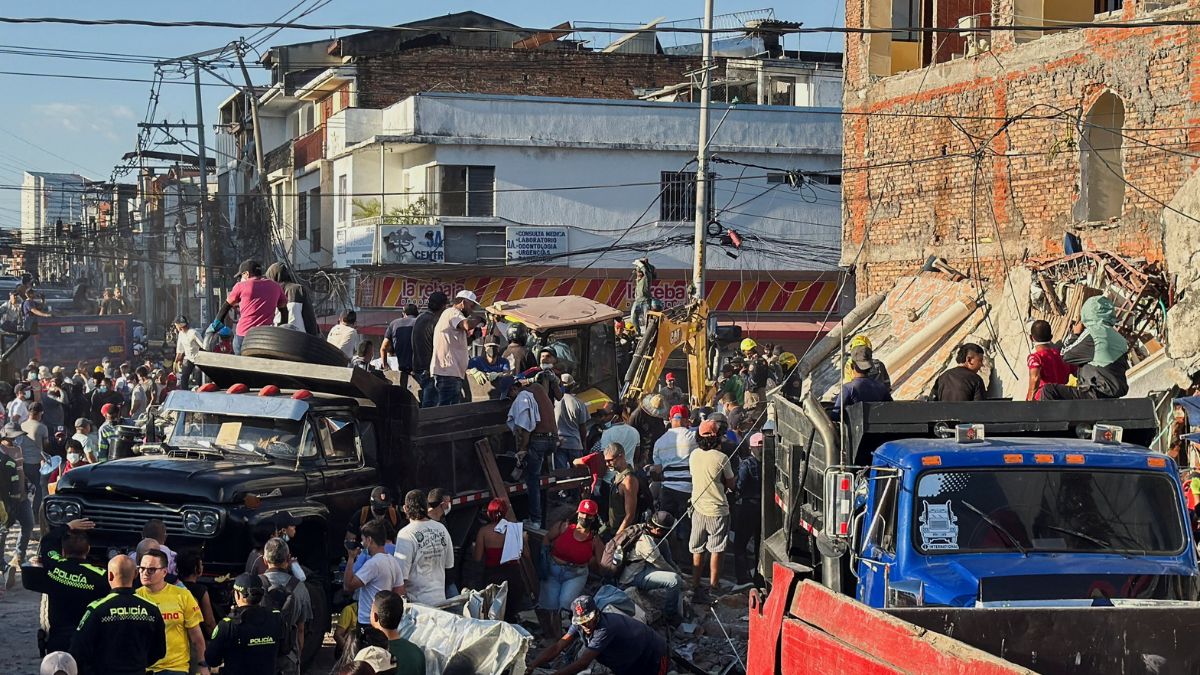
About 132 people are reported dead, and 570 were injured after the 7.4 magnitude earthquake struck Colombia on Monday.
Several parts of the country, including Risaralda, Quindío, Chocó, Valle del Cauca and Cali, were affected.
The epicentre of the quake was about five kilometres east of San José del Palmar, Chocó.
The quake occurred at a depth of approximately 107 kilometres within the Nazca Plate. The tremors lasted about 90 seconds to 2 minutes and had a magnitude of 7.4, according to the Colombian Geological Survey. The impacts of the massive quake were felt in a large area, with impacts reported from Bogotá and Medellín to Cali, which is about 280 kilometres away, and the Coffee Region and Buenaventura.
The Nazca Plate extends beneath the Earth’s crust. Shallow earthquakes that occur closer to the surface, about 60 kilometres below the Earth's outer surface, are typically known to be more destructive than deep earthquakes.
The earthquake in Colombia, however, was caused in a different manner in an event known as a deep intraplate or intraslab earthquake.
Colombia is located in a tectonically complex region.
Three different plates- the Nazca Plate, the South American Plate, and the Caribbean Plate interact in the western part of the country, along with the minor crustal North Andean Block
The Nazca plate is subducting or sinking beneath the South American plate about 55 to 60 millimetres per year.
The quake on Monday was not caused by plates sliding against each other.
The most accepted explanation for the tremors originating from within the Nazca plate is that it was caused by the subduction. As the pressure and temperatures increase, water-bearing minerals can release fluid within the plate. The process increases the pressure in the pores of rocks, which inturn rupture the materials.
Civil engineer and seismologist Gina Villalobos clarified to Cambio Colombia that the earthquake "is part of the normal behaviour of the tectonic plates in the region" and its occurrence does not depend in any way on human activities, the time of year or changes in the climate.
Because the quake happened at an intermediate depth, its waves can travel greater distances before reaching the surface.
If the same quake had occurred at a shallower depth, its damage would have been greater but would have impacted a smaller region.
In 1999, the Coffee Region earthquake had a magnitude of 6.2, but it occurred only a few kilometres deep, beneath a densely populated area. The quake resulted in the deaths of 1,200 people in Armenia and surrounding regions.
The US Geological Survey's (USGS) pager system estimated that about 1.6 million people felt very strong shaking and up to 8.9 million were exposed to severe seismic activity in Colombia, Ecuador, and Panama after the quake on Monday.
The earthquake has reportedly damaged 1,575 homes and destroyed 37, in addition to causing the collapse of 61 residential and commercial buildings, according to government figures. Death tolls are expected to rise with search and rescue efforts.
The death toll in the epicentre Chocó region stands at 111 with about 87 injured. Among the dead was the son of the mayor of Bahía Solano, Jairson Leonel Valencia Pinilla,
The Mayor's Office of Santiago de Cali announced the suspension of the 30th edition of the Petronio Álvarez Pacific Music Festival, which was scheduled to take place between August 12 and 17, 2026.
