



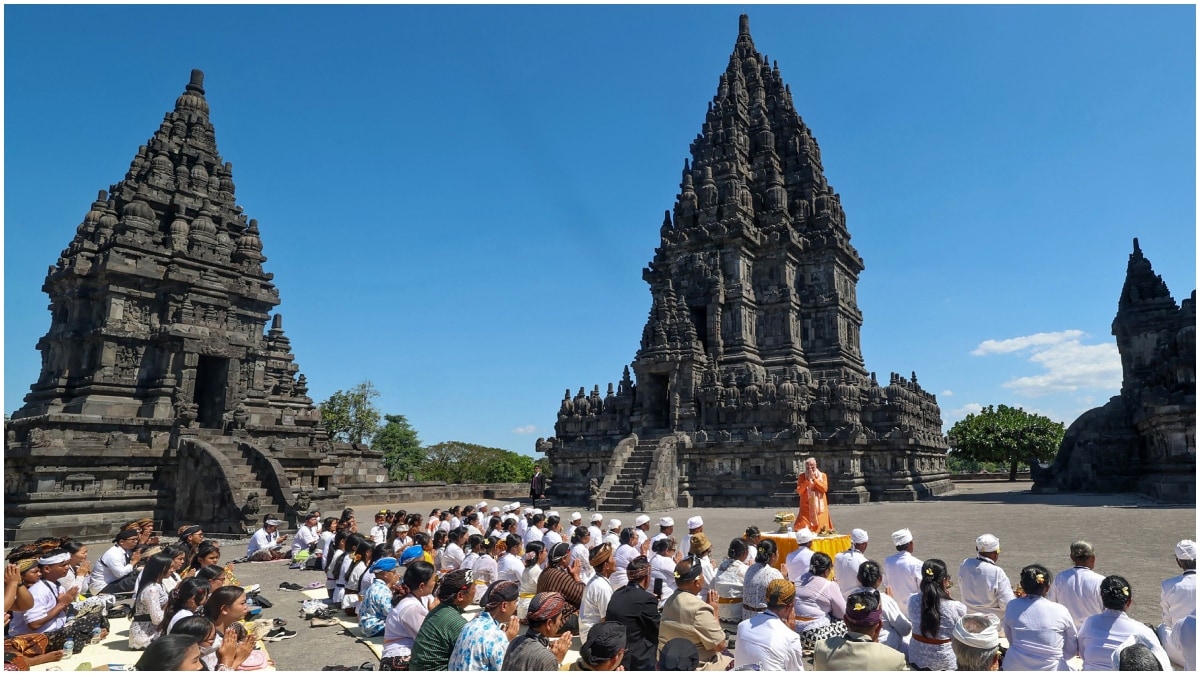
Indonesia, a Muslim-majority state, has more famed Buddhist and Hindu temples than any other such state in the world. Besides, it is the only Muslim-majority state which has adopted ‘Panchasila’ as its ideology. It did this soon after its independence in August 1945, despite some Muslim organisations strongly opposing it.
‘Panchasila’s’ five principles are: (a) Belief in one Supreme God, (b) Just and civilised humanity, (c) Unity of Indonesia, (d) Democracy guided by wisdom and deliberation, and (e) Social Justice for all Indonesians. Large boards proclaim them at many town and city entrances.
How Indonesia’s multi-religious civilizational mosaic was created over two millennia is a fascinating saga. It is briefly narrated hereunder.
After Emperor Ashoka embraced Buddhism in 260 BC, he sent its monks to many countries to spread its noble tenets of non-violence and compassion. The two monks named Sona and Uttara, who were sent to Burma, set up Southeast Asia’s first Theravada Buddhist monastery at Kelasa near Thaton. From here, Buddhism spread eastwards to Thailand and southwards to Malaya and Indonesia over the next eight centuries.
In 650 AD, the Sri Vijaya Buddhist Kingdom was founded in southern Sumatra. Its capital and principal port was Palembang. By 1000 AD, it ruled most of Sumatra and eastern Java, controlled both sides of the Malacca straits, and dominated Indian Ocean trade with China. Resenting this, Chola Emperor Rajendra I attacked Palembang in 1025, dethroned the Sri Vijaya monarch, and looted his treasures. This made the Sailendra Buddhist kingdom in central Java salient. It introduced Mahayana and Vajrayana Buddhism to Java. Borobudur, the world’s largest Buddhist monument, is the tomb of a Sailendra ruler in the Mahayana Buddhist architectural style.
Hinduism came to Indonesia via Borneo from Funan (to which it was taken by a South Indian Brahmin named Koundinya in the 1st century AD). It arrived in Bali in the 6th century AD and spread eastwards to Java. Four centuries later, Buddhism and Hinduism met each other in central Java. Borobudur (built about 800 AD) and the Prambanan Shiva Temple (built about 1000 AD) are just fifty miles apart!
The first traces of Islam in Indonesia are found on a 1082 tombstone at Aceh in northern Sumatra. Two small Muslim kingdoms later emerged in Sumatra’s port cities of Pasai and Perlak. As gold was later discovered and pepper began to be cultivated in this area, these kingdoms prospered. Malacca’s ruler, though of Palembang royal descent, embraced Islam as this facilitated political and commercial relations with Muslim countries. Besides, as it was the Sufi and not the Wahhabi type of Islam which was brought to Indonesia by Indian traders, its people—deeply honed by ten centuries of Buddhism’s and Hinduism’s contemplative and tolerant natures—readily accepted it.
Hinduism and Buddhism reached their apogee in Indonesia in the Majapahit Empire. Some scholars have described it as a “Hindu-Buddhist thalassocratic empire.” Founded as a kingdom by Raden Wijaya in 1292 after the Mongol invasion of Java, it enlarged into an empire during the reigns of Queen Tribhuvana and her son King Hayam Wuruk in the mid-14th century. According to the Nagarakṛtāgama (written in 1365), it had 98 tributaries across the Indonesian archipelago’s many islands, as also in Singapore, Malaysia, Brunei, and the Sulu Archipelago (southwestern Philippines).
About this era, the reputed French scholar Sylvain Lévi wrote: “Mother of wisdom, India gave her mythology to her neighbours who carried it to their neighbours. Mother of law and philosophy, she gave to three quarters of Asia a God, a religion, a doctrine, an art.”
Sadly, after a late 15th-century civil war, it was greatly weakened. This enabled the Sultanate of Demak in northern Java to subjugate it in 1527. This opened the door for other Sultanates to emerge in Java and other Indonesian islands. In the next three centuries, all its islands except Bali were ‘Islamised’. As the Majapahit nobility fled to it after the fall of their empire, it remained, and still is, very Hindu.
Buddhism’s and Hinduism’s deep impact is still seen in many spheres in Indonesia.
Prof. P.J. Zoetmulder, who compiled the Old Javanese–English dictionary (published in 1982), has averred that almost 14,000 words in it are Sanskrit-derived and that, unlike those derived from Arabic and Persian, they “are no longer perceived to be foreign”. Its continued pertinence is seen in official designations such as ‘Pradhan Mantri’, ‘Pradesh Adhikari’, ‘Senapati’, ‘Sukarnoputri’, and ‘Bhumi putra’.
However, the far deeper and wider impact is that of the Ramayana and Mahabharata epics. Dance scholars have identified over 200 versions of the former in Indonesia’s dance and puppetry repertoire. The great impact of the latter I discovered to my amazement when, as Ambassador of India to Egypt, I called on His Eminence the Grand Sheikh of Al-Azhar, the renowned one-thousand-year-old University in Cairo. Placed on a high pedestal in his office was a large, glass-enclosed silver sculpture of Lord Krishna and Arjuna in a chariot. When I expressed my great joy at seeing this outstanding sculpture of the prime episode in India’s Mahabharata epic, he blandly responded that it was presented to him by Indonesia’s President!
Indonesia has preserved and still takes pride in the spiritual and cultural heritage and enlightened tenets India gifted it many centuries ago. Sadly, in India in recent years, its millennial tenets of ‘Ekam Sat’ and ‘Vasudhaiva Kutumbakam’ have been replaced with the Hindutva ideology. ‘Ram Bhakts’ and ‘Gau Rakshaks’ now frequently attack minority communities, their places of work and worship, and educational or charitable institutions. India’s Election Commission has disenfranchised thousands of Muslim and Christian voters. India’s global image, which previously shone brightly because of Gandhi’s non-violent freedom struggle in which patriotic Indians of all faiths participated and thereafter adopted a secular constitution despite their ancient land being partitioned on religious lines, is now greatly tarnished.
The international print and electronic media are now replete with adverse reports of India’s majoritarian and authoritarian government and the oppression of its minorities. Reputed Indian columnist Harish Khare, in a recent article in The Wire titled ‘Modi Raj @ 12: Hindus are paying the price for the blessings of Hindutva’, wrote: “The fizz has definitely gone out of the Modi project, but the ingrained habits of loudly blowing the Hindutva trumpet do not allow for any reality check. But a reality check is overdue and indicates a grim picture: India’s Hindus (and other non-Muslims), have paid a heavy price for a decade of trenchant Hindutva. Since 2014, Prime Minister Modi has been making grand promises but more often than not has failed spectacularly in delivering them except in glossy advertisements.”
India’s Hindutva leaders should therefore make an in-depth study of Indonesia’s enlightened post-independence governance, particularly its policy of funding institutions of higher learning across all its six recognised religious communities (Muslim, Buddhist, Hindu, Protestant, Catholic, and Confucian) through its Ministries of Religious Affairs (Kementerian Agama) and Education and Culture (Kementerian Pendidikan dan Kebudayaan). These ministries also promote equal respect for all religions and ensure that no communal bigotry emanates from any of them, so that its millennial multi-religious social mosaic and renown as a model secular state are safeguarded, preserved, and treasured for future generations.
The opinions expressed in this article are those of the author and do not purport to reflect the opinions or views of THE WEEK.
