



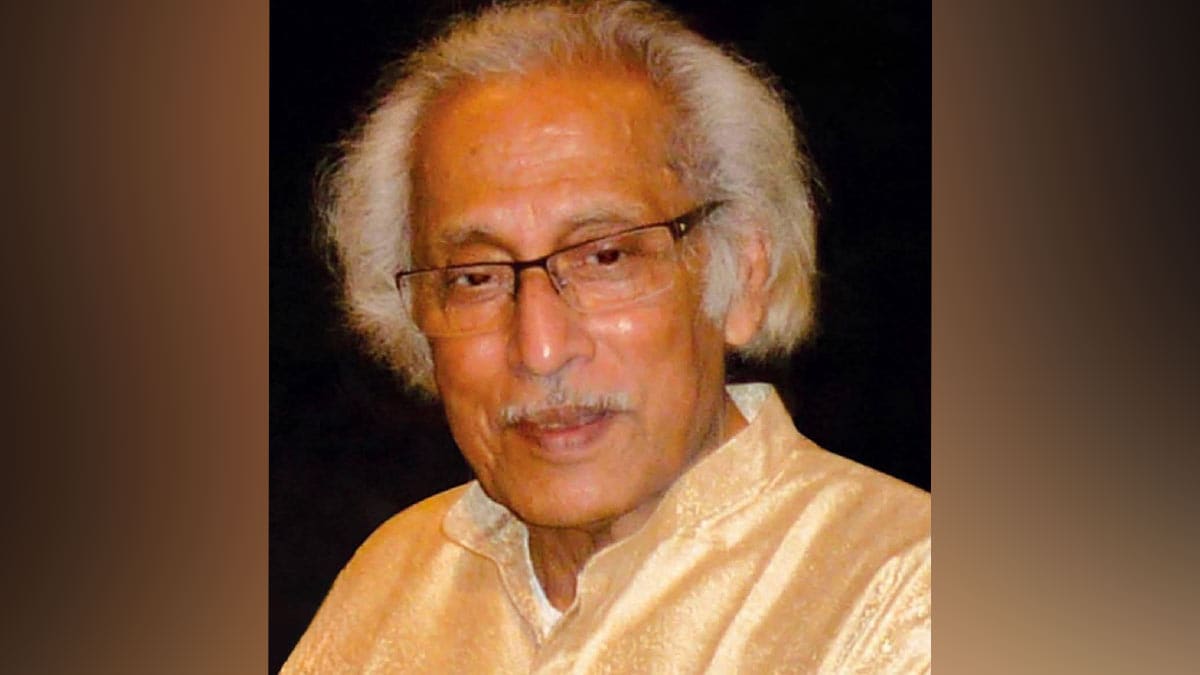
“Whoever is born is destined to die”.
Pandit Amiyo Ranjan Bandyopadhyay had not merely accepted this eternal truth of Indian philosophy; he had lived it. Perhaps that is why, in February this year, he chose not to celebrate his 100th birthday with speeches or ceremonies, but with a live concert. It was as though he wished to mark a century of life in the only language he truly believed in—the language of music.
At the Vivekananda Hall of the Ramakrishna Mission Institute of Culture in Kolkata, the centenarian maestro walked onto the stage in his traditional dhoti and kurta with remarkable poise and quiet confidence. It was difficult to believe that the man before the audience had completed a hundred years of life. What the audience witnessed was not merely a veteran musician but a living embodiment of a timeless musical tradition.
For Bandyopadhyay, who had celebrated his birthday every year in the company of his disciples and admirers through music, the centenary concert was not a display of achievement. It was the natural continuation of a lifetime devoted to swar-sadhana—the relentless pursuit of the perfect note.
He opened the recital with a bada khayal in Raga Bihag, set to Ektaal. The unfolding of the raga was serene, profound, and emotionally compelling. Every phrase revealed a new shade of Bihag, woven together with delicate meends and an effortless command of melody. He followed it with a drut khayal in Teentaal. The taans were concise yet astonishingly expressive. Without a trace of repetition or ostentation, he illuminated the many colours of the raga with extraordinary artistry. The performance was a reminder that true musicianship lies not in dazzling virtuosity but in restraint, depth, and absolute fidelity to the spirit of the raga.
No one in the audience could have imagined that this would be among his final public performances. Barely five months later, on July 28, 2026, at around 2:30pm, Bandyopadhyay quietly departed this world on Guru Purnima—the sacred day dedicated to honouring the Guru. It was a poignant coincidence that a musician who had devoted his entire life to the guru-shishya parampara should take his final leave on the very day that celebrates the eternal bond between teacher and disciple.
Born on February 21, 1927, in Kolkata into a distinguished family of musicians, Bandyopadhyay inherited one of Bengal’s richest musical legacies. His family belonged to the illustrious Bishnupur Gharana, one of the oldest and most revered traditions of Hindustani classical music. His father, the eminent musicologist and vocalist Sangeetacharya Satya Kinkar Bandyopadhyay, was also his first guru. Their home was his earliest music school, where riyaz was not merely daily practice but an integral way of life.
From that nurturing environment emerged a musician who would spend nearly a century preserving, enriching, and transmitting one of India’s most refined classical traditions. By the time he breathed his last, Bandyopadhyay was no longer just a celebrated vocalist; he had become an institution, a guardian of tradition, and one of the last living links to a glorious era of Hindustani classical music.
The extraordinary promise of Bandyopadhyay’s musical genius became evident during his adolescence. Yet, it was not talent alone that defined him. Equally remarkable were his humility as a lifelong learner and his unwavering commitment to rigorous riyaz. He spent endless hours practising, contemplating the lyrical and philosophical depth of traditional bandishes, and absorbing the finest nuances of every raga. To him, music was never merely an arrangement of notes; it was a profound cultural and spiritual experience, deeply intertwined with Indian philosophy, literature, and the country’s timeless artistic consciousness.
The Bishnupur Gharana occupies a singular and distinguished place in the history of Hindustani classical music. Rooted in the austere grandeur of the Dhrupad tradition, it is celebrated for its uncompromising purity of raga, nobility of expression, and exquisite balance in presentation. Within this tradition, a raga is never treated as a vehicle for virtuosity or spectacle; rather, it is approached as a medium for introspection, aesthetic refinement, and spiritual realisation. Bandyopadhyay made these ideals the cornerstone of both his artistic vision and his personal philosophy.
His education was by no means confined to the traditional guru-shishya parampara. Alongside his rigorous classical training, he undertook a serious academic study of the history, theory, and aesthetics of Indian music. This rare confluence of inherited tradition and scholarly inquiry transformed him into far more than a distinguished concert vocalist. He emerged as an eminent musicologist, teacher, and thinker whose intellectual depth matched the brilliance of his artistry. His life embodied a remarkable harmony between ancient tradition and modern scholarship.
The vocal tradition of the Bishnupur Gharana is renowned for its restraint, tonal purity, Dhrupad-inspired gravitas, and impeccable clarity of diction. While remaining steadfastly faithful to these defining principles, Bandyopadhyay enriched the tradition with his own intellectual insight and artistic maturity. His exposition of a raga unfolded with extraordinary patience and quiet authority. Every note found its natural place; every meend gently expanded the emotional landscape of the raga; and every taan emerged organically from the intrinsic character of the melody. He firmly believed that a musician’s highest responsibility was not to impose a personal stamp upon a raga but to reveal its innate essence with honesty, sensitivity, and complete artistic integrity.
There was never the slightest trace of unnecessary display or theatrical virtuosity in his performances. It was precisely this artistic restraint that endeared him to discerning connoisseurs, who experienced his music not merely as a performance but as an act of profound contemplation. His renditions of vilambit khayal were especially admired for their unhurried architectural development, luminous tonal beauty, and impeccable rhythmic poise, drawing listeners into a state of deep concentration. Even in drut khayal, where speed and rhythmic brilliance come naturally to the fore, he retained the same elegance, precision, and aesthetic refinement that became the defining hallmark of his musicianship.
To regard Bandyopadhyay merely as an outstanding khayal vocalist would be to do a grave injustice to the breadth of his legacy. He belonged to that rare lineage of musician-scholars in whom the performer, the guru, the researcher, the author, and the philosopher coexisted in perfect harmony. For him, music was never simply an art to be performed on stage; it was a living continuum of India's civilisational wisdom. Consequently, the influence of his lifelong swar-sadhana extended far beyond the concert hall, enriching music education, scholarly research, and the larger discourse on Indian culture.
One of the defining pillars of his musical philosophy was education. While he remained deeply committed to the guru-shishya parampara, he was equally convinced that Indian classical music deserved rigorous academic inquiry. This conviction led him to serve for many years at Rabindra Bharati University, where he played a seminal role in shaping the Department of Music. As Professor and later Head of the Department, he did far more than train students in vocal performance. He cultivated in them the ability to understand music analytically, interpret its aesthetic principles, and appreciate its wider historical and cultural context.
His classrooms extended well beyond the teaching of ragas and compositions. With remarkable erudition, he engaged his students in discussions on the history of music, literature, philosophy, and aesthetics. He repeatedly reminded them that an artist whose intellectual horizon remained narrow could never attain true artistic greatness. It is therefore no coincidence that many of his disciples went on to establish themselves not only as accomplished performers but also as respected teachers, researchers, and musicologists.
Another enduring dimension of Bandyopadhyay's legacy was his contribution as a writer and musicologist. He reflected deeply on the aesthetics of Indian classical music and authored several important works that continue to be regarded as authoritative texts. His books are not merely instructional manuals for students; they provide profound insights into the philosophical foundations of Indian music. To him, music was never merely an audible art form; it was a harmonious synthesis of human emotion, cultural memory, and spiritual consciousness.
His writings reveal with remarkable clarity that although he was an unwavering custodian of tradition, he never equated tradition with rigidity. He firmly believed that music could evolve only when artists honoured their inherited legacy while remaining sensitive to the demands of changing times. He therefore never opposed innovation; rather, he insisted that every creative experiment must remain firmly rooted in the discipline, grammar, and aesthetic values of the classical tradition.
The middle decades of the twentieth century marked a defining period of transition for Hindustani classical music. Royal patronage was fading, All India Radio was assuming a transformative cultural role, and universities were beginning to recognize music as a serious academic discipline.
Bandyopadhyay did not merely witness this historic transformation; he helped shape it. As a Top Grade artiste of All India Radio and Doordarshan, he delivered numerous memorable performances that became part of India's musical heritage. His appearances at the country's most prestigious music festivals were eagerly anticipated by discerning audiences. Internationally, too, he served as an eloquent ambassador of Indian classical music, demonstrating that the language of the raga transcends geographical boundaries and speaks directly to the universal human spirit.
Exceptionally humble, disciplined, and utterly devoted to his art, Bandyopadhyay regarded himself as a student until his very last breath. It was this rare humility, combined with an uncompromising commitment to lifelong learning, that distinguished him from many of his contemporaries.
His uninterrupted dedication to swar-sadhana well into his hundredth year elevated him to the status of a living legend in the world of Indian classical music. During the celebrations marking his centenary, audiences and fellow musicians alike were astonished by the clarity of his musical intellect, the depth of his understanding of ragas, and his extraordinary mental acuity. These were not simply the gifts of longevity but the natural culmination of a lifetime devoted to relentless discipline, spiritual pursuit, and artistic excellence.
The century-long life of this great sage of swar-sadhana offers a timeless lesson: true greatness is never measured solely by artistic accomplishment. A truly great artist is equally defined by the nobility of thought, the integrity of character, the inspiration imparted to disciples, and an unwavering sense of cultural responsibility. In every one of these dimensions, Bandyopadhyay stood as one of the towering figures of modern Indian classical music.
The author is a retired tax officer from Uttar Pradesh.
