



When he was young, Mikhail Kalashnikov, who belonged to a Russian peasant family, wanted to become a poet; he filled several notebooks with poetry. Later, however, he realised that “there are enough bad poets in the world without me”. He knew his calling lay in another direction. Following a stint as a mechanic at a tractor station where he developed an interest in machinery, he joined the Red Army as a tank mechanic in 1938 and got promoted to a tank commander by the beginning of World War II. He served in the 24th Regiment, but during the Battle of Bryansk in 1941, he was wounded and hospitalised. It was during his last months in the hospital that he overheard his fellow soldiers complaining about the poor quality of their rifles. So, he decided to design one of his own. The result would turn out to be the deadliest individual weapon system of the 20th century—the AK-47.
The prototype was officially adopted by the Soviet Army in 1949 and gave it a distinct edge in the Cold War. It also licensed its production to over 30 anti-Western countries, which resulted in AK-47s flooding the global market. It became the rifle of choice for terrorists, revolutionaries and governments, leading to mass counterfeiting and much illegal use. According to a report by Global Financial Integrity, while an authentic AK-47 cost $1,205 in Pakistan in 2011-2012, a locally produced model could be obtained for as little as $148, a difference of more than 700 per cent. Because of its durability, simplicity and affordability, it was used in conflicts ranging from the Vietnam War to the civil wars in Colombia, Congo, Libya and Syria. It was also used in Afghanistan and during the Russian invasion of Ukraine.
In his book ‘AK47: The Story of the People’s Gun’, Michael Hodges estimated that there were as many as 200 million AK-47s in circulation worldwide, one for every 35 people. In countries like Yemen, AK-47s are handed out as compensation to relatives of those killed in war. The AK-47 became so iconic that it is on the national flag of Mozambique. In Russia, its image is used on knives, watches and umbrellas. In 2004, Playboy magazine placed it fourth on its list of ‘50 products that changed the world’, just below Apple Mac desktop computers and above breast implants and crack cocaine.
If the AK-47 democratised conflict in the 20th century, another weapon—popularly known as ‘AK-47 of the sky’—is doing the same for the 21st century: the Shahed-136 or Iran’s kamikaze drone. What Russia did with the AK-47—produce a cheap, easy-to-use weapon and then distribute its licence indiscriminately—Iran is doing with the Shahed-136. It waged a war of attrition with the US and Israel through the “poor man’s cruise missile”. Swarming the skies with these drones, Iran counted on quantity over its enemy’s superior quality. Its real triumph was not the drone itself, but the ability to decentralise its production. There is no central facility producing these drones, but a network of underground workshops, old tunnels and converted basements in countries like Tajikistan, Belarus, Yemen and Lebanon. The drones themselves are easily destroyable, but the industry that produces them is multiplying, adapting and becoming deadlier.
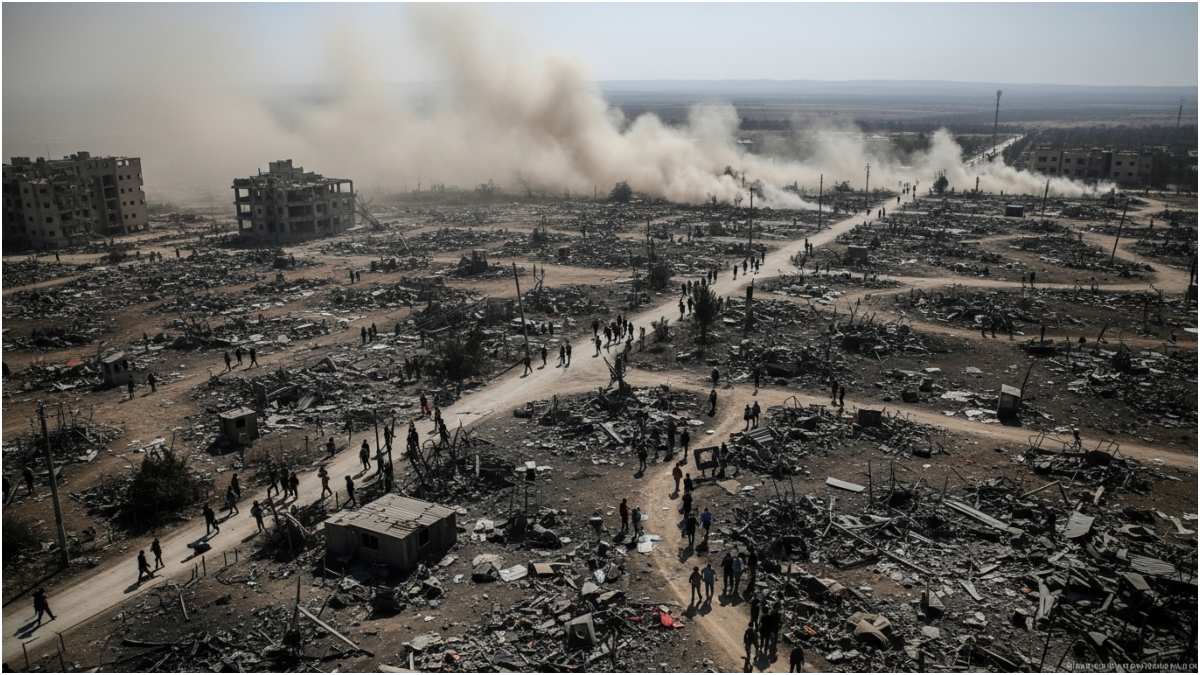
In the drone war of today, it is the civilians who are bearing the brunt. Other than deaths from direct strikes, drones are crippling civilian infrastructure like hospitals and schools, and preventing humanitarian aid from reaching these areas. The rise of civilian casualties during war has been alarming. In 1999—the year that the UN Security Council adopted resolution 1265 on PoC (protection of civilians)—the International Committee of Red Cross (ICRC) reported 20 armed conflicts globally and estimated that between 35 and 64 per cent of conflict casualties were civilians. In 2024—the 25th anniversary of resolution 1265 and the most recent year for which there is complete data—the ICRC counted over 120 armed conflicts, and the civilian casualty ratio was 95 per cent in incidents involving the use of explosive weapons in populated areas. The Secretary General’s annual PoC report that year recorded 36,000 civilian deaths, an increase of 7.65 per cent from 2023, which already represented an increase of 72 per cent from 2022, mainly due to the war in Gaza.
One of the largest franchisees of Iran’s Shahed-136 is Russia. In the Russian town of Yelabuga, a huge factory of 116 buildings produces more than 5,500 drones a month, including an indigenous version of Shahed-136 called the Geran-2, built using Iranian technology, and Chinese and North Korean technical support and personnel. Russia has been heavily employing the Geran-2 in its Ukrainian offensive, targeting hospitals, schools and other key infrastructure in massive nocturnal swarms. The result is untold misery and an atmosphere of fear.
“Kyiv is more or less protected because of its air defence system,” says Dr U.P.R. Menon, an Indian orthopaedic surgeon settled in Ukraine since 1994. “But this is not the case in the border areas, where the real war is being fought. Still, we do experience difficulties because of the constant rocket and drone attacks, especially when they come near residential areas.” He says most of the old buildings in Ukraine are outfitted with Soviet-era bunkers, which are now getting renovated. In his case, the parking area of his apartment complex has been converted into a shelter. Whenever they hear an air siren, they seek refuge there. The alarm can go on for up to three hours, so they have to make a call whether to risk going out or staying in the shelter. “Ultimately, life has to go on,” he says. “There are people to feed and things to do.”
The atmosphere was more intense four years ago, when the war first began. Thousands of Ukrainians tried to get through the clogged borders to neighbouring countries like Poland and Hungary in cars or on foot in the numbing cold. Thousands more sought refuge in the deep metro tunnels, stockpiling blankets, tents and other necessities. People in towns like Volnovakha in Donetsk Oblast were trapped inside, coming under Russian fire if they tried to escape. In Irpin, Russians bombed a railway track to prevent women and children from boarding evacuation trains to Kyiv. In Mariupol, the siege left people stuck in freezing basements without food or water. It was difficult for emergency services even to collect the dead bodies, most of them lying strewn on the streets. “Tears do not stop in Mariupol,” a resident told The Kyiv Independent, a consortium of journalists in Ukraine determined to bring the country’s story to the world.
In countries like Sudan, drones are the leading cause of civilian deaths. Sudan is entering the fourth year of its civil war between its army and a paramilitary group called the Rapid Support Forces (RSF). Both sides are being supplied with top-notch drones by foreign countries—China for the RSF, and Iran and Turkey for the Sudanese army. According to the UN, 880 people died from drone strikes between this January and April. Extreme danger and food insecurity have caused over 12 million people to flee their homes in what the UN has called the world’s largest humanitarian crisis.
According to a 2025 UN Security Council report, this is the first time that two conflict-induced famines are happening simultaneously—in Sudan and in Gaza. There was also a 25 per cent increase both in cases of conflict-related sexual violence and violations against children compared with 2023—a year in which the proportion of women and children killed had already doubled and tripled, respectively, from the year before. Displacement also reached record levels, with over 123 million people forcibly displaced by the end of 2024, an increase of six per cent compared to 2023.
The nature of conflict today is that it does not end; it simply changes shape and goes on. In Syria, for example, people hoped that the fall of the Bashar al-Assad regime in December 2024 would end the 14-year-long civil war. The situation, however, remains volatile, with civilians getting caught in the violence between different armed groups. The worst part, says Farhan, a Syrian journalist and fixer, is the fear. The Syria of his childhood was one of the most secure places in the world, he says. His education at the Aleppo University was free. “Now I’m paying a huge sum to educate my children,” he says. “They have lost their childhoods. I am afraid to let them play outside without my supervision. I have enrolled them in a special Arabic private school. But in the Kurdish area where we live, it is forbidden to teach children Arabic. Sometimes the Kurdish police come and attack these schools, so I live in a constant state of fear.”
And the weapon he uses to protect himself? An AK-47.
Six months before his death in 2013, Kalashnikov wrote a letter of repentance to Patriarch Kirill, the head of the Russian Orthodox Church. He expressed “unbearable spiritual pain”. “If my rifle took away people’s lives, then can it be that I am guilty for people’s deaths?” he asked. Perhaps it would have been a consolation of sorts for him to know that for people like Farhan, what gives him sleep at night is the cold comfort of an AK-47 under his pillow.
