



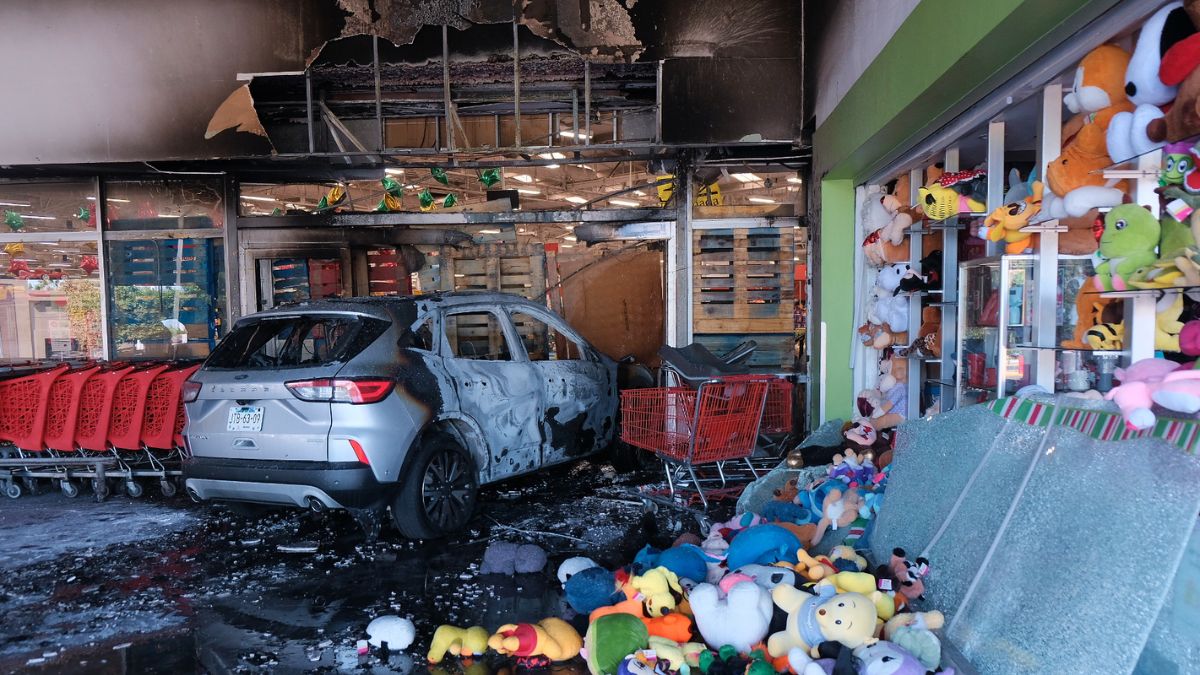
The killing of Nemesio Oseguera Cervantes, known as “El Mencho”, has set off a wave of violence and fire in Mexico.
Oseguera, 59, was one of the founders and the leader of the Jalisco New Generation Cartel (CJNG), one of the country's most violent drug cartels.
The US government had offered a reward of upto $15 million for information which could lead to the arrest of the drug cartel boss in 2024. However, Oseguera evaded arrest for many years, even though his family members involved in the cartel were captured and incarcerated.
Oseguera’s son and successor, Rubén Oseguera, “El Menchito,” was found guilty of drug trafficking and illegal use of firearms in Washington last year.
Soon after the killing, armed groups blocked roads and set fire to supermarkets, banks and vehicles. The chaos has led to about 252 road closures in about 20 states across Mexico, the government's Security cabinet reported.
The biggest reports of violence came from Jalisco, where the cartel is based.
Cártel de Jalisco Nueva Generación (CJNG)
The CJNG, which was formed in 2009, is one of Mexico’s most powerful criminal organisations. Based in Jalisco state, the group has been considered a terrorist organisation by the United States.
The group traffics in high quantities of cocaine, heroin, and methamphetamine into the country. They are also involved in extortion and money laundering.
Many from the group who were arrested by the Spanish government in 2025 were involved in smuggling large amounts of the drugs inside industrial machinery from south America. The drugs were distributed to Spain and other European countries, El País reported.
According to the US Department of Justice, Oseguera’s leadership led to the group being responsible for large-scale homicides against rival trafficking groups and Mexico's law enforcement.
The group is also known for its extreme, high-profile and brutal violent methods since its appearance in 2009. After mass murders, they often leave dismembered or burned bodies in areas where they can be found, including in vehicles. There were also reports of the group’s members being forced to cannibalise its victims as part of training. In 2015, they made headlines with the drowning of a helicopter.
The group has also been found to be behind assassination attempts of Mexican government officials and was behind the 2020 attack against Omar Garcia Harfuch, the secretary of security of Claudia Sheinbaum’s government.
The CJNG uses a franchise model to operate. The group delegates each phase of drug trafficking to a specialised link in its chain. They have regional commanders, financial operatives, enforcement units, logistics and intelligence and surveillance teams. Their operatives have also been found to work to corrupt political proceedings to protect the cartels' political interests.
This method has allowed them to seize territories from their rival groups like the Sinaloa cartel.
Several members of the cartel were also said to have been killed in the operation by the Mexican Army on Sunday. The killing of the world's most wanted drug cartel leaders is set to improve Mexico’s relations with the US. The country’s Ministry of Defence also said that they seized several armoured vehicles and weapons during the operation, including rocket launchers.
