



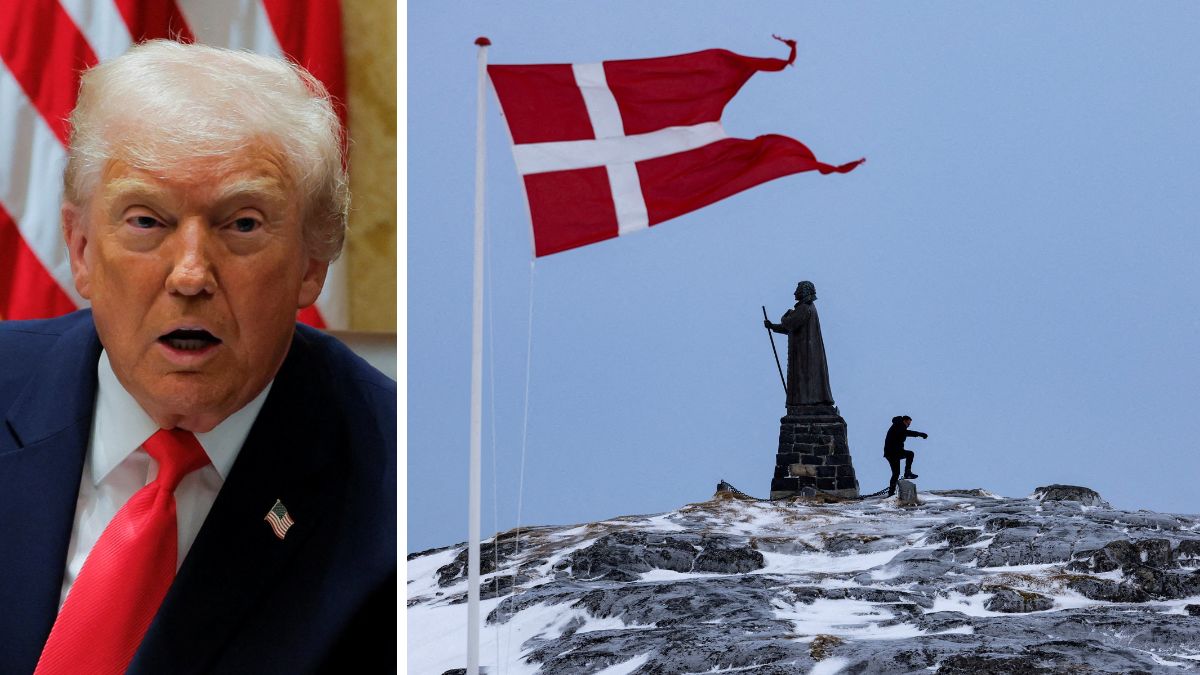
The statement from the White House that US President Donald Trump was considering options to acquire Greenland, even militarily, has triggered a global uproar with European leaders closing ranks behind Denmark, which considers Greenland its autonomous territory.
The Trump administration believes that taking over Greenland is a national security priority of the United States, and was important to defend itself against adversaries in the Arctic region, mainly China.
Now that Trump himself has expressed renewed interest in taking the island and White House Deputy Chief of Staff Stephen Miller openly declaring that military force was “on the table” and “no one was going to fight the US over Greenland”, political analysts now examine four ways the invasion of Greenland could happen.
1) Military invasion
The most talked about option at the moment is a military invasion, with the White House itself declaring that using military power is not off the table. Greenland, the world’s largest island, but with a population of just 57,000 people, does not have the military capacity to take on the US. Though the Danish President has warned that this could mean the end of NATO, Trump hasn’t taken his threat seriously. Miller made it clear in his CNN interview that the US won’t hesitate to flex its military muscles when he said nobody is going to fight the United States militarily over the future of Greenland.
"We live in a world, in the real world, that is governed by strength, that is governed by force, that is governed by power. These are the iron laws of the world," Miller said.
2) Buying the country
Trump could also use coercion as a means to take over Greenland. The real estate maverick that he is, Trump could make an offer the island can’t refuse. The US President has already offered to invest “billions of dollars to create new jobs and make you rich”. This could change the fate of over 57,000 people with a GDP of less than £3 billion, overwhelmingly dependent on fishing and subsidies from Copenhagen.
Secretary of state Marco Rubio told lawmakers on Monday that the administration’s goal is to buy Greenland and not invade it. The US had earlier contemplated buying Greenland from Denmark on three occasions, in 1867, 1910, and 1946.
3) Compact of free associations
Reports hint that the US officials were working on a potential deal where Greenland would sign a “Compact of Free Association” (Cofa) with the US. This means that the US relations with Greenland would be similar to its association with Palau, Micronesia and the Marshall Islands. This means the island to keep its formal independence while effectively giving the American military carte blanche on their territory in return for duty-free trade.
But, for this to happen, Greenland has to be free from Denmark, which can happen only with the Danish parliament’s consent. The Denmark government isn’t enthusiastic about this as it would mean the US get control over their strategically vital territory in their neighbourhood.
4) Greenland independence
One way for the US to remove the Danish hegemony is to push Greenland towards independence. Without Danish control, Greenland could sign deals directly with the US. Danish media claims that the US have already tried this with Denmark’s security and intelligence service, PET, already warning Greenland that it is the target of influence campaigns of various kinds.” They added that Americans with ties to Trump have carried out covert influence operations in Greenland.
Felix Kartte, a digital policy expert who has advised EU institutions and governments, told Politico that this is similar to what Russia did to influence political outcomes in countries such as Moldova, Romania and Ukraine. “Russia mixes offline and online tactics,” he said. “On the ground, it works with aligned actors such as extremist parties, diaspora networks or pro-Russian oligarchs, and has been reported to pay people to attend anti-EU or anti-U.S. protests. At the same time, it builds large networks of fake accounts and pseudo-media outlets to amplify these activities online and boost selected candidates or positions,” Kartte said.
