



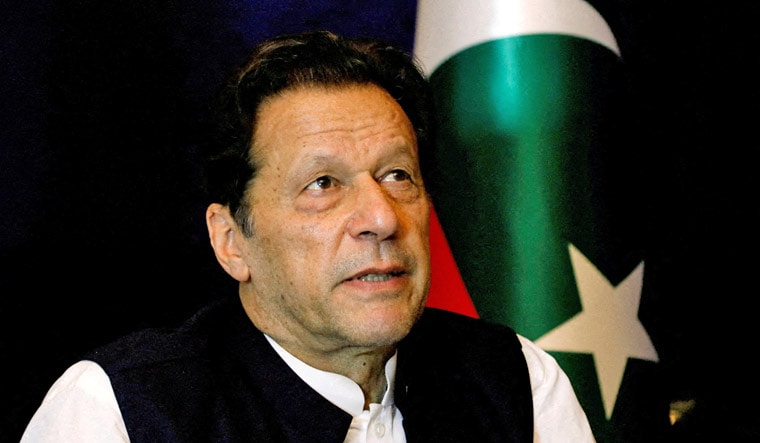
With relations between the Pakistani military generals and former PM Imran Khan at its nadir, it is an ongoing tussle between China and the US to enhance influence in the country that is already beleaguered by economic distress and political turmoil.
The no-holds-barred fight between the cricketer-turned-politician and the Pakistani army in more ways than one is prompted by the interest and influence of the US and China.
While Tuesday’s court order suspending the former PM’s conviction on graft charges may provide relief to Khan, his possible return to captain his Pakistan Tehreek-e-Insaf (PTI) party and affiliated parties opposed to the military may spell bad tidings for India.
Although Khan’s detention will continue in Attock jail on another case relating to making state confidential documents public, the suspension of the August 5 conviction also means that the Pakistan Election Commission’s order banning Khan from contesting elections for five years is in abeyance.
In other words, there is an emerging possibility of him contesting the already much-delayed polls likely to be held by mid-February. Earlier, the conviction had banned him from contesting polls for five years.
While the standing of the military is much diminished, Khan’s political popularity is widely believed to be on the ascendant and chances of his return to power are a possibility in the event of a free and fair poll.
On May 9, protesters stormed the Pakistan Army headquarters in Rawalpindi which in one stroke had virtually demolished the carefully-crafted fearsome reputation of the Army that was prevalent in the Pakistani mindset.
While Khan had increasingly warmed up to the Chinese during his prime-ministership tenure from 2018 to 2022, his relationship with Washington had started deteriorating much to the discomfiture of the Pakistani army that had historically flourished and profited due to proximity with the Americans.
The US would like to enhance cooperation with the Pakistani military to counter the threat posed by the Islamic State (Khorasan) (IS-K) and the Tehreek-e-Taliban Pakistan (TTP)—both of which have established strongholds in Pakistan besides developing the capability to strike at will.
A closer relationship with Pakistan will also allow US manoeuvrability to try and restrict Chinese influence from spreading in the country.
Notably, on Wednesday, US acting deputy secretary of state, Victoria Nuland, in a phone call to caretaker Pakistan foreign minister Jalil Abbas Jilan stressed “the importance of timely, free and fair elections in a manner consistent with Pakistan’s laws and Constitution.”
On the same day, US Ambassador to Pakistan Donald Blome also stated during a programme in Islamabad that he hoped Pakistan would conduct the elections in accordance with the decisions of its institutions in a transparent manner so that the people could decide who their leadership would be.
On the other hand, China, already with a steady foothold in Pakistan, will look to consolidate its sphere of influence given the fact that it has already invested about $58 billion in the Belt and Road Initiative (BRI) and the flagship China-Pakistan Economic Corridor (CPEC) in Pakistan.
Control over Pakistan also allows China to access the sea thereby overcoming the ‘Malacca Dilemma’ that China faces in taking the long and circuitous route through the Malacca Straits to reach out to the markets of South Asia, West Asia and Europe.
Strategically, increased Chinese influence in Pakistan will be unfavourable for India which believes China is pursuing a policy called ‘string of pearls’ or setting up military and commercial facilities in the Indian Ocean region that would result in an encirclement of India.
