



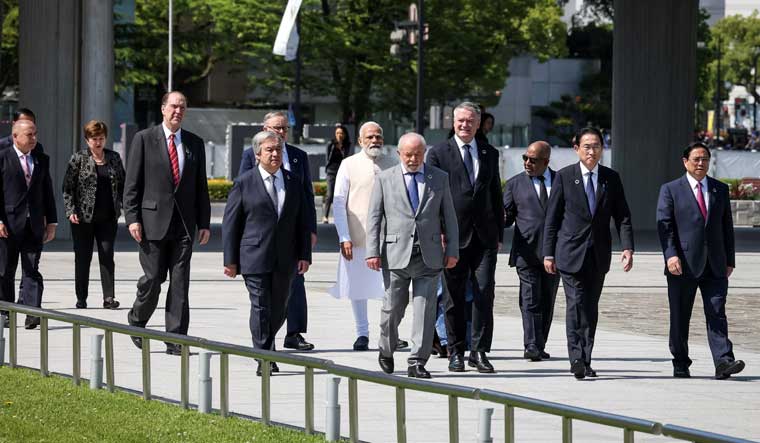
Prime Minister Narendra Modi, who is in Japan to attend the G7 grouping at the invitation of his Japanese counterpart Fumio Kishida, paid floral tributes at the Hiroshima Peace Memorial Park on Sunday. The park is built in memory of those who died in a nuclear attack on the city at the end of the Second World War.
Besides Modi, the leaders of the other invited countries too paid their respect at the part.
Tweeting photos of Modi's visit to the museum at the memorial site, Ministry of External Affairs spokesperson Arindam Bagchi said, "A tribute to the memory of Hiroshima victims. PM Narendra Modi begins his day by visiting the Peace Memorial Museum, where he observed the documented exhibits and signed the visitor's book."
He also tweeted a group photo of the world leaders attending the G7 Summit and said, "The leaders also paid their respect at the Hiroshima Peace Memorial Park."
The Prime Minister also attended the meeting of Quad nations on Saturday, where he described the Indo-Pacific region as an "engine" of global trade, innovation and development and said its success and security were important for the whole world.
Addressing Quad leaders US President Joe Biden, Australian PM Anthony Albanese and Japanese PM Fumio Kishida, Modi also stressed the importance of consolidating Quad's constructive agenda and delivering tangible outcomes for the region.

Meanwhile, the Quad leaders took a veiled dig at China by reaffirming their steadfast commitment to a free and open Indo-Pacific while strongly opposing "destabilising or unilateral actions" that seek to change the status quo by force or coercion.
This comes amid Beijing's increasing bid to militarise the strategically important Indo-Pacific.
The Quad leaders also insisted that it was important to stick to international law and the maintenance of freedom of navigation and overflight with regard to the East and South China seas.
"We express serious concern at the militarisation of disputed features, the dangerous use of coast guard and maritime militia vessels, and efforts to disrupt other countries' offshore resource exploitation activities,' the statement said, in an oblique reference to Chinese activities.
The Quad leaders emphasised that disputes should be resolved peacefully and in accordance with international law, without threat or use of force.
The Quad also mourned the "terrible and tragic" humanitarian consequences of the war in Ukraine, while seeking end of the conflict through dialogue and diplomacy.
The joint statement by the four leaders released at the end of the summit highlighted on peaceful resolution of disputes and respect for principles of the UN Charter, including territorial integrity and sovereignty of all states and in that context, expressed "deep concern" over the raging war in Ukraine and mourned its "terrible and tragic humanitarian consequences".
"We recognise its serious impacts on the global economic system including on food, fuel and energy security and critical supply chains," the statement said. The leaders resolved to continue to render humanitarian assistance to Ukraine for its recovery.
(With inputs from PTI)
