



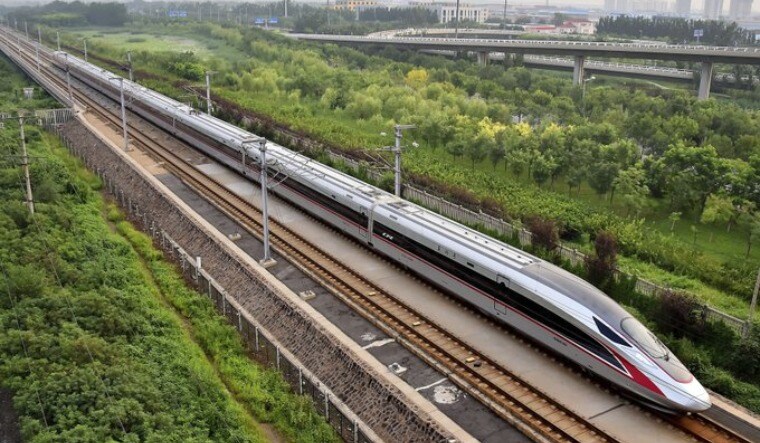
China on Friday operationalised its first fully electrified bullet train in the remote Himalayan region of Tibet, connecting the provincial capital Lhasa and Nyingchi, a strategically located Tibetan border town close to Arunachal Pradesh.
The 435.5km Lhasa-Nyingchi section of the Sichuan-Tibet Railway has been inaugurated ahead of the centenary celebrations of the ruling Communist Party of China (CPC) on July 1.
The first electrified railway in Tibet Autonomous Region opened on Friday morning, linking Lhasa with Nyingchi as the "Fuxing" bullet trains enter official operation on the plateau region, state-run Xinhua news agency reported.
The Sichuan-Tibet Railway will be the second railway into Tibet after the Qinghai-Tibet Railway. It will go through the southeast of the Qinghai-Tibet Plateau, one of the world's most geologically active areas.
In November, Chinese President Xi Jinping had instructed officials to expedite construction of the new railway project, connecting Sichuan Province and Nyingchi in Tibet, saying the new rail line would play a key role in safeguarding the border stability.
The Sichuan-Tibet Railway starts from Chengdu, capital of Sichuan Province, and travels through Ya'an and enters Tibet via Qamdo, shortening the journey from Chengdu to Lhasa from 48 hours to 13 hours.
Nyingchi is prefecture-level city of Medog, which is adjacent to the Arunachal Pradesh border.
China claims Arunachal Pradesh as part of South Tibet, which is firmly rejected by India. The India-China border dispute covers the 3,488-km-long Line of Actual Control (LAC).
Qian Feng, director of the research department at the National Strategy Institute at Tsinghua University, told the official daily Global Times earlier that "If a scenario of a crisis happens at the China-India border, the railway will provide a great convenience for China's delivery of strategic materials.”
