



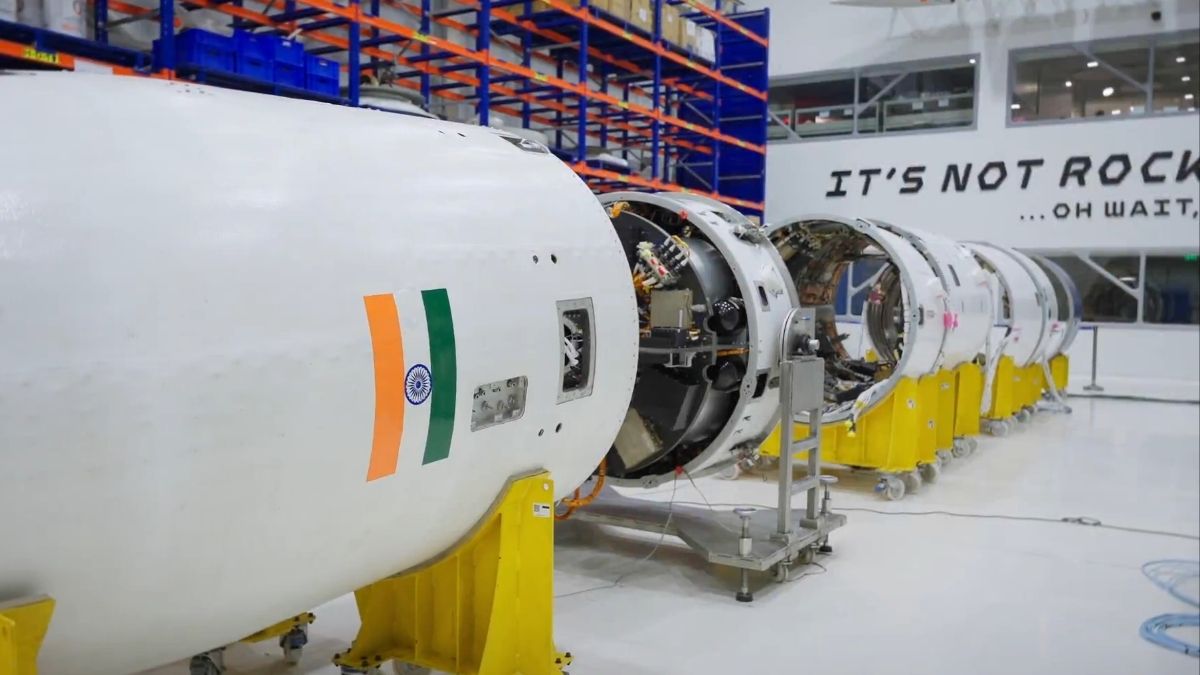
Hyderabad-based space tech startup Skyroot Aerospace raised $60 million and became India’s first space tech unicorn, valued at $1.1 billion. This unicorn moment came at a time when the company is getting ready to launch the maiden flight of the Vikram-1 rocket.
The equity round was co-led by Sherpalo Ventures and GIC, with participation from funds managed by BlackRock, the founders of Greenko Group, Arkam Ventures, Playbook Partners, Shanghvi Family Office, and other investors. The funding is aimed at accelerating commercial launch operations ahead of the maiden flight of the Vikram-1 rocket.
Vikram is built from carbon fibre, which is five times lighter than steel and more fuel efficient. Its upper stage uses 3D printing. In 2022, Skyroot became the first private Indian company to conduct a rocket launch, sending Vikram-S on a suborbital mission.
Around 90 per cent of Skyroot’s customers are not from India. Vikram-1, the full orbital rocket now on the verge of launch, is 95 per cent indigenous and is expected to see strong demand from the telecommunications sector.
With this round, the company has raised a total of $160 million to date, with $60 million in the latest round alone, taking its valuation to $1.1 billion. The company has nearly doubled its valuation in approximately 30 months. The capital raised will be deployed towards scaling Vikram-1 launch cadence, expanding manufacturing capacity, and accelerating the development of Vikram-2.
Over time, with learnings from early developmental launches, the goal is to achieve a 72-hour assembly-to-launch capability for Vikram-1. This will be supported by Skyroot’s 250,000 sq ft facility (Max-Q and Infinity) in Hyderabad.
Interestingly, the new raise reflects strong investor conviction in the space tech segment and Skyroot’s trajectory to become one of the leading space launch service providers for the world.
The Vikram-1 rocket is designed to provide dedicated and customisable access to space for global satellite operators. The upcoming mission builds on Skyroot’s 2022 mission when it launched India’s first privately built rocket, Vikram-S.
“Access to space is one of the key challenges of our time. Skyroot is building the foundational infrastructure for that future with the best cost-to-performance ratio in the orbital-launch industry, and what the team has achieved is remarkable,” remarked Ram Shriram, Founder & Managing Partner, Sherpalo Ventures.
Skyroot’s founder Pawan Kumar Chandana grew up in Visakhapatnam and studied mechanical engineering at IIT Kharagpur. “I loved working with machines, and that inspired me to take mechanical engineering,” he said. The IIT environment, he said, normalised entrepreneurship. “I always wanted to start a company; at IIT, I realised it is doable,” he told THE WEEK.
Chandana, who graduated with a dual degree (bachelor’s plus master’s) in 2012, was campus recruited by ISRO and joined its Thiruvananthapuram rocket-making facility. He worked there for six years and was part of the LVM3 programme. The experience was formative, but he wanted to make his mark on rocket technology. “I thought that when companies like SpaceX can do it, why not Indian companies,” he said. In 2018, many in the investor community did not understand the sector, and it was not easy to fund a startup.
But Chandana got an early break. Mukesh Bansal, founder of Myntra, put in ₹10 crore. Hyderabad was the natural base for Skyroot—the city’s proximity to DRDO laboratories provided both testing infrastructure and a talent pipeline. The company’s technical proposition is focused on small rockets. “We will not build the big rockets costing billions, but the smaller rockets which cost only a few million dollars,” said Chandana.
