


In a quiet hotel parking lot, just hours before he was due to step inside Elon Musk’s Neuralink headquarters and demonstrate the future of human–machine interaction, Noland Arbaugh sat in his van and wept. Barely a month earlier, on January 28, 2024, Arbaugh—a quadriplegic since 2016—had become the first human to receive Neuralink’s N1 implant, a moment many compare to a “moon landing” for neurotechnology. The system uses ultra-thin electrode threads inserted into the motor cortex and linked to a coin-sized device embedded in the skull, designed to read neural signals and convert them into digital commands. The N1 marked the first time a high-bandwidth, consumer-ready device allowed a paralysed person to control a computer cursor, play games and browse the web with their thoughts at near-normal speed.
For the first three weeks after implantation, the technology worked exactly as promised for Arbaugh. He wasn’t just using the interface; he was setting new BCI records daily, sometimes twice a day. Then came a major twist. “I began to lose control of the cursor,” Arbaugh told THE WEEK. “I assumed it was a software switch the team had flipped and forgotten to turn back on.” As the first human to encounter this problem, Arbaugh had no playbook to consult. Though he could no longer use his computer reliably, he continued gathering data as he and his family drove from Arizona to Northern California for demonstrations at Neuralink.
At the hotel, Arbaugh ran an impromptu session. It was no better—the cursor was still nearly unusable. Before leaving for the scheduled demonstration, both the Neuralink team and the clinical trial staff asked to meet him at the hotel. “I didn’t think much of it,” Arbaugh recalled. “I just wanted to get through it and make it to the tour.” That morning, they explained what was wrong: the implant was experiencing what they called “thread retraction.”
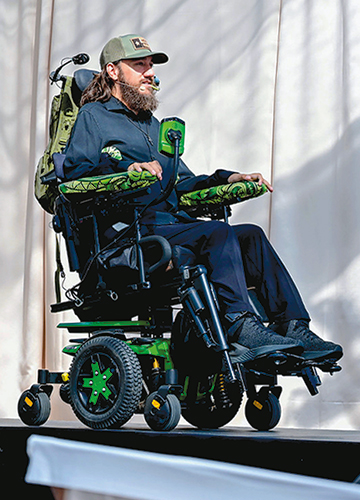 Noland Arbaugh | On special arrangement
The N1 relies on hair-thin, flexible threads inserted a few millimetres into the motor cortex, positioned close to individual neurons to capture their electrical signals. That day, however, there were no clear answers—no immediate fix, no established protocol. “The only thing going through my mind was that I’d been given a second chance at life, had seen a glimpse from the mountaintop—and now it felt like it was all about to be taken away,” said Arbaugh.
Arbaugh was 22 and brimming with energy when his life changed in the summer of 2016. Fresh out of Texas A&M University, he was working as a counsellor at Island Lake Camp in Pennsylvania. On their first day off, he and his friends visited a man-made lake near Binghamton, New York. While running into the water to playfully dunk his friends, Arbaugh was struck on the left side of his head. The impact dislocated and reset his C4 and C5 vertebrae. He lost consciousness and woke face down in the water, injured beyond imagination: he was paralysed.
“I was an athlete, the life of the party, extroverted to extreme extents. I was constantly on the move, travelling when I could and living life to the fullest,” he recalled. “After my accident, all of that came to a screeching halt. It hurt to even watch sports on television because it was a reminder that I would never play again. I began to see myself as a burden, an obstacle preventing my parents from enjoying their lives. It was hard.”
In 2023, a friend, who was drinking and googling SpaceX related matters, stumbled upon the human trials for Neuralink, and he immediately called Arbough and asked: “Hey, you want to get a chip in your brain?”
Arbough’s response: “Yeah, why not?” And that is how he enrolled himself for the BCI trial. In hindsight, however, Arbaugh still wonders why he was chosen as the first person to receive the N1 implant. “I couldn’t tell you what caught the attention of the clinical team or Neuralink, because from my perspective, I am just a regular guy,” he said. “There’s nothing particularly special about me. I was simply blessed—by the grace of God—to be chosen.”
After the accident, Arbaugh had grown deeply religious. Sitting alone in the van on the morning of the demonstration, grappling with the news of thread retraction, that faith was tested. “Why would God let me experience this incredible technology only to take it away after a month?” he asked himself. Even so, Arbaugh decided he would not let the setback define the day.
“I geeked out on the tour,” he said. “I tried to look as many people in the eye as I could to express my gratitude. They changed my life, and they are going to change so many more lives. I wanted them to know that. This technology is bigger than me, and they deserve to see how impactful their work really is.” No one, he added, could have guessed that he had received some of the most crushing news of his life just hours earlier.
Behind the scenes, both the Neuralink and clinical trial teams were racing to understand the failure. “I decided that even if I couldn’t use the chip any more, I would do whatever the teams needed,” said Arbaugh. “I would sit there and collect data for eight hours a day if it helped.” Engineers at Neuralink initially proposed a revision surgery, but the clinical team put the brakes on that plan, opting to exhaust every non-invasive option first.
Eventually, the breakthrough came through software. By refining the algorithms, the team restored—and even improved—cursor control, despite fewer functioning threads.
“I ended up reaching new highs in cursor speed and accuracy, measured in bits per second on the WebGrid, the standard benchmark in the field,” said Arbaugh. “I actually doubled my previous record. There weren’t new abilities that surprised me, but I was surprised by how well I could perform with so few electrodes. That, to me, is a testament to the technology and to the engineers behind it.”
Arbaugh believed that whatever was happening to him could be fixed for those who came after, and that they would never have to experience what he had. “I am glad that I was the first and that the pain rested on my shoulders; I wouldn’t have it any other way. And you know what? Not a single participant after me has had the same issue. So, it was all worth it,” he said.
During the initial implantation, a human surgeon made the incision and drilled the hole in Arbaugh’s skull. The insertion of the electrodes, however, was carried out by a surgical robot—nicknamed the ‘tiny dancer’. Arbaugh recalled approaching the surgery with a mix of hope and doubt. “I hoped the procedure wouldn’t leave me with a traumatic brain injury. I hoped it wouldn’t leave my family broken,” he said. “At the same time, I doubted any of this would actually work. I didn’t know what the technology would do for me; I only knew I wanted to explore it and push the boundaries. I hoped my participation would help others, regardless of the outcome. I kept my expectations extremely level—more than I thought was even possible. And I did hope that whatever came from the study would, in some way, reduce the burden on my family.”
Interestingly, the first thing Arbaugh did after waking from surgery was play a prank on his family. As he came to, he saw them gathered around his bed. When his mother asked, “Hey, honey, how are you doing?”, Arbaugh looked at her calmly and replied, “Who are you?”—sending her into a brief panic.
That playfulness is something Arbaugh has held on to. Still, if there is one piece of life he could reclaim from before the accident, it would be the simple, physical act of playing sports. “I miss it more than anything,” he said. “More than I realised at the time.” Neuralink has not given him a way back to that world—at least not yet. “It hasn’t really allowed me to relive that part of my life,” he said. “And that’s hard.”
Yet the technology has opened other quieter doors. For the first time in years, Arbaugh has been able to play fantasy sports proficiently with his friends, following games closely, competing and belonging again. “It is not the same,” he said, “but it lets me be part of it.” It took years, he added, to accept that this, too, was a form of joy. And in learning to find sports again—differently, imperfectly—he said he had come to appreciate them, and life itself, more deeply than before.
Arbaugh is a crucial bridge between humanity’s present and the future—both a proof of possibility for millions of disabled lives worldwide and a living key to understanding how BCIs might one day unlock the untapped potential of the human brain. Just two weeks after receiving the BCI implant, he began to experience what he described as a “shift in thinking” while controlling the cursor.
“In the field, we use two terms: ‘attempted movement’ and ‘imagined movement,’” explained Arbaugh. “Attempted movement means physically trying to move a body part to control the cursor. For example, I would try to move my right wrist left, right, up or down to produce the same movement on the screen. Even though I cannot physically move my wrist, all the signals are still firing in my brain. When they do, the implant detects those neurons firing and maps them to cursor control.”
Imagined movement, he says, takes the process a step further. “Instead of trying to move my hand, I just think about where I want the cursor to go, and it moves,” said Arbaugh. “The first time I did that, something flipped in my brain. I was giddy for the rest of the day.” That was the moment it stopped being a technology that worked the way he expected. “It became something else entirely,” he said, “something completely sci-fi.”