



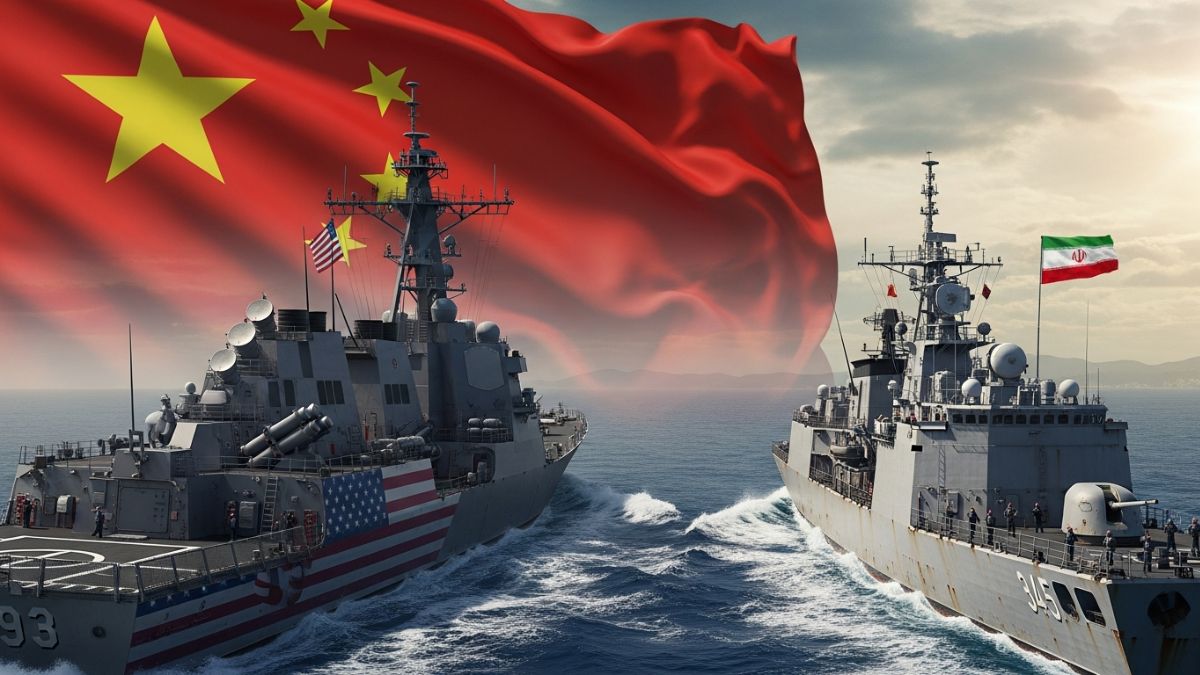
As the smoke clears over the ruins of West Asian infrastructure and Washington declares a "victory" that feels increasingly hollow, a quiet transformation is taking place thousands of miles away in Beijing. While the Trump administration entangles itself in a protracted regional quagmire, China is executing a masterclass in "strategic patience." Without firing a single shot or losing a single soldier, the People’s Republic of China (PRC) is systematically dismantling the foundations of global American hegemony.
The bedrock of energy security
China’s primary victory lies in the fortification of its energy architecture. While the global market recoils from volatility, Beijing has leveraged its bilateral agreements with Tehran to build a staggering strategic reserve of oil and gas. Reports indicate China’s combined strategic and commercial reserves now stand at roughly 1.4 billion barrels, providing a four-month buffer against global supply shocks.
By purchasing Iranian crude at steep discounts, leveraging a 25-year cooperation framework it has with Tehran, Beijing has insulated its economy from the very shocks currently crippling Western markets. Perhaps more telling is the operational reality in the Strait of Hormuz. While American and Israeli assets, as well as that of their allies’, face a gauntlet of naval missiles, drone swarms and naval mines, Chinese-flagged vessels enjoy a free pass. This selective maritime security underscores a shift in regional power dynamics whereby the policeman of the world is stuck in a firefight, while the merchant of the world moves its goods unhindered.
Eroding the dollar’s monopoly
The petrodollar has long functioned as the invisible scaffolding of American global power, but that platform is currently undergoing a structural collapse. The PRC is not merely bypassing the US-monitored SWIFT network, it is actively constructing a Renminbi Zone across West Asia. By settling massive energy contracts via the Cross-Border Interbank Payment System (CIPS), China has effectively sanction-proofed its primary energy artery.
This decoupling goes beyond simple trade. It is a signal to the Global South that there is now a viable, technologically sophisticated alternative to the American-led financial order. As Washington weaponises the dollar through aggressive sanctions, China offers a sanctuary where trade is governed by bilateral interest rather than political conditionalities. For many nations, the Chinese Yuan is no longer just an alternative currency, it is a hedge against American volatility.
Diplomatic heft and strategic neutrality
While the US projects fire and fury, China projects stability and maturity. By maintaining a posture of principled neutrality and calling for de-escalation, Beijing has positioned itself as the adult in the room. This is a sophisticated application of the Global Security Initiative (GSI), where China portrays itself as a partner for peace compared to an American leadership perceived as chaotic. This is the very same framework China leveraged to broker a landmark rapprochement between Iran and Saudi Arabia in March 2023, signaling a significant shift in regional power dynamics and its diplomatic heft in the region.
The vacuum left by Washington’s partisan involvement in the conflict has allowed China to deepen its influence across West Asia, Africa, and the Global South. By brokering peace talks and offering humanitarian corridors, Beijing is winning the battle of narratives, a key component of its Three Warfare Strategy, without deploying a single battalion. In the eyes of the world, America is the arsonist, and China is the architect of the new regional, and possibly, global order.
The intelligence goldmine
The most alarming facet of China’s gain is the real-time laboratory that this conflict provides for the People's Liberation Army (PLA). China is currently gathering invaluable intelligence on US naval strategies, Order of Battle (ORBAT), battlefield supply chains, electronic warfare (EW) capabilities, weapon systems, etc. By leveraging the various agreements and frameworks, it has patiently stitched together over the years, China is successfully mining intelligence which could prove to be a deciding factor in a future Sino-US conflagration in the Indo-Pacific. A list of these are as below:

China is utilising the conflict to test its own high-end systems. Iran’s transition to the BeiDou navigation system has demonstrated a resilience against Western EW that would have crippled GPS-reliant forces. Furthermore, the use of Chinese-supplied YLC-8B anti-stealth radars is allowing Beijing to "paint" and analyse the signatures of F-35 and F-22 fighters. Each missile launch and radar lock provides the PLA with the data needed to fine-tune its military technologies for a future conflict over the Taiwan Strait.
Ceding the Indo-Pacific
The strategic cost to the US is further compounded by the ‘pivot back to the Middle East’ strategy of the White House. As American carrier groups and precision-guided munitions are drained from the Indo-Pacific to reinforce Central Command, the South China Sea is being left increasingly vulnerable. This is a classic case of strategic overextension.
For every Patriot/THAAD interceptor fired at an Iranian drone, there is one fewer available for the defence of Taiwan. China is stepping into this vacuum, accelerating its militarisation of maritime features, while the US is distracted by West Asian quagmires. The Indo-Pacific, once the primary focus of American strategy, is being ceded by default as Washington’s attention is forcibly redirected toward a conflict that offers no clear exit ramp.
The precarious position of India
This shift has dire implications for New Delhi. India’s growth remains tethered to the US dollar. As the petrodollar weakens, so does India’s economic leverage. Furthermore, as China’s diplomatic shadow grows over West Asia, India’s traditional Link West policy faces a shrinking horizon.
Additionally, India’s silence, even during its turn as the Chair of BRICS, contrasts sharply with China’s active brokering. While Tehran requested support from BRICS Chair, India’s hesitation has been noted across the region and the larger Global South. More critically, as China gathers SIGINT on US assets, assets India increasingly relies upon for its defence, they become increasingly transparent to Chinese probing. If US systems are exposed today, the support India expects from Washington in a future Galwan-style crisis may prove obsolete as Chinese systems gain superiority.
Conclusion
In the final analysis, the US-Israel-Iran war is not a victory for the West, it is a strategic haemorrhage. While Washington celebrates tactical wins on the battlefield, Beijing is harvesting the far more valuable assets of energy security, financial autonomy, and military intelligence. China has succeeded in making time its ally, allowing its adversaries to burn through their credibility and their arsenals while it builds the infrastructure for a post-American world order.
The Dragon did not need to enter the fire, it simply waited for the Eagle to exhaust its wings. As the global order shifts on its axis, the real winner of this war is not the one who dropped the most bombs, but the one who meticulously studied the fallout to ensure they never would have to drop any. Thus, we assert that the century of the Silent Strategist is beckoning.
The author is a strategic consulting and national security expert, and a governing body member of SHARE (Society to Harmonise Aspirations for Responsible Engagement).
