



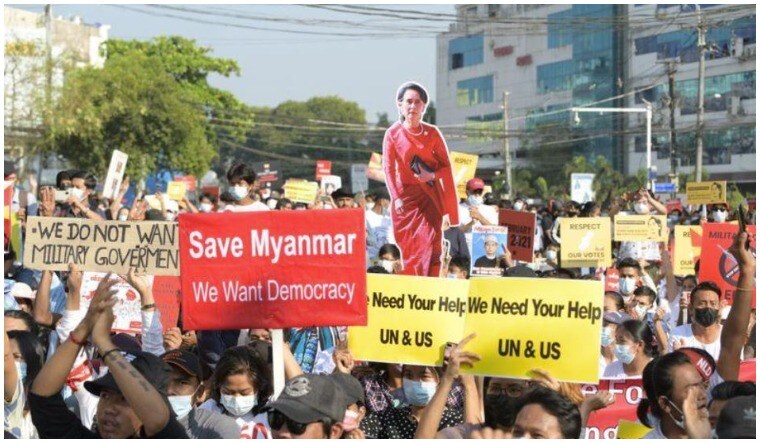
It might have been easy to miss the gravity of what happened in Myanmar a few months back, with COVID-19 dominating headlines and absorbing people’s consciousness. But it is an important example of what can happen to fledgling democracies when the world is distracted, and one which all nations should be paying closer attention to as tensions continue to rise.
Myanmar has only been a democratic nation since 2010, when the ruling military party, known as the Tatmadaw, lost the first general election they had allowed since declaring themselves the head of state in 1962. The National League for Democracy, led by Aung San Suu Kyi, won the election by a landslide, and promised a "rapid, peaceful transition" of power, stating Myanmar’s move to democracy would differ from the "violent protests and bloodshed" seen in other recent democratic transitions. A shaky peace-sharing agreement between the military and the NLD is what followed over the next decade, with the NLD again winning elections in 2015 and 2020 by considerable margins.
The Tatmadaw party had retained enough power throughout this period to forcibly take over the NLD government in the February 2021 coup d’etat, loosely translated as "blow of state, " or the removal and seizure of a government and its powers.
State of Emergency
Declaring a state of emergency is a measure done in many countries, which yields immeasurable power to governments over a normal state of law, allowing resources and actions needed to "stabilize" country or situation. In this case, the military imposed curfews, limited gatherings of people to protest or gather, and restricted external reporting on the situation from foreign journalists or monitors. It also was used to justify cracking down on dissent.
Since that time, more than 800 people have been killed in counter-coup demonstrations, and thousands detained. The mysterious deaths of two top NLD officials identified in early June have raised further concerns about the Tatmadaw’s unchecked power. Party leader Aung San Suu Kyi, or 'Mother Suu,' whose popularity seems to have grown since her detention, was seen on trial facing charges which could keep her detained for up to 14 years.
International Checks and Balances
Democratic nations across the globe were quick to condemn the coup, with the US, UK, Canada and EU imposing rounds of sanctions in May which restricted financial support to the military party. The UN General Assembly last Friday voted for an arms embargo against the country, demanding restoration of the democratic transition. This resolution showed broad global opposition to the military takeover and was the result of a lengthy consensus agreement between members of the UN and the 10-member Association of Southeast Asian Nations, or ASEAN, of which Myanmar is a member.
ASEAN is seen by many as the primary diplomatic influence of its member states within the region. It’s questionable, however, how much influence they have in enforcing non-binding agreements, it seems not all members are interested in standing up against the military party. Thailand, Cambodia and Laos, for instance, opted for abstention from the UN resolution vote. Singapore, the largest investor in Myanmar, opposed sanctions on the military party, though did vote yes in the UN resolution.
Other regional players have adopted a similarly cautious approach. Major investors in Japan and China also refused to employ sanctions and continue to engage financially with Myanmar’s military. Nearly all of Myanmar’s neighbours abstained from voting in Friday’s UN resolution, including Bangladesh, Bhutan, China, Nepal and India.
India has a particularly shaky relationship with Myanmar’s military party given it shares a 1,643km-long border with the country.
A Long Struggle for Democracy
Myanmar has a long history of persecuting its citizens who express dissent to the military party. Notably, the February 2021 coup was the second successful coup completed by the Tatmadaw, who seized initially seized control of the fledgling democratic state in 1962, just after the country’s independence from Britain in 1948. The military has since remained the most powerful institution in Myanmar. Aung San Suu Kyi has been leading the democratic struggle since 1988 and was placed under house arrest for 18 years before running in the 2010 election and winning by a landslide.
In addition to clamping down on dissenters, the military has additionally persecuted numerous ethnic groups, forcibly obtaining their land and stripping some, such as the Rohingya, of their nationality.
Myanmar’s Future
If history teaches us anything, it’s that it will likely be repeated without intentional change. The Tatmadaw party didn’t secede much of their power to the NLD over the past decade while "transitioning" towards a democratic state it appears much of their resources and influence remained intact. While all ASEAN nations have struggled with histories of authoritarian leadership, most have transitioned to democracy within the past 50 years.
Kelsey LeBrun Keswani is the co-founder of RAIN (Refugee Assistance and Information Network). Currently, she is a PhD candidate for migration studies at Institute of Social Sciences University of Lisbon, Portugal
