



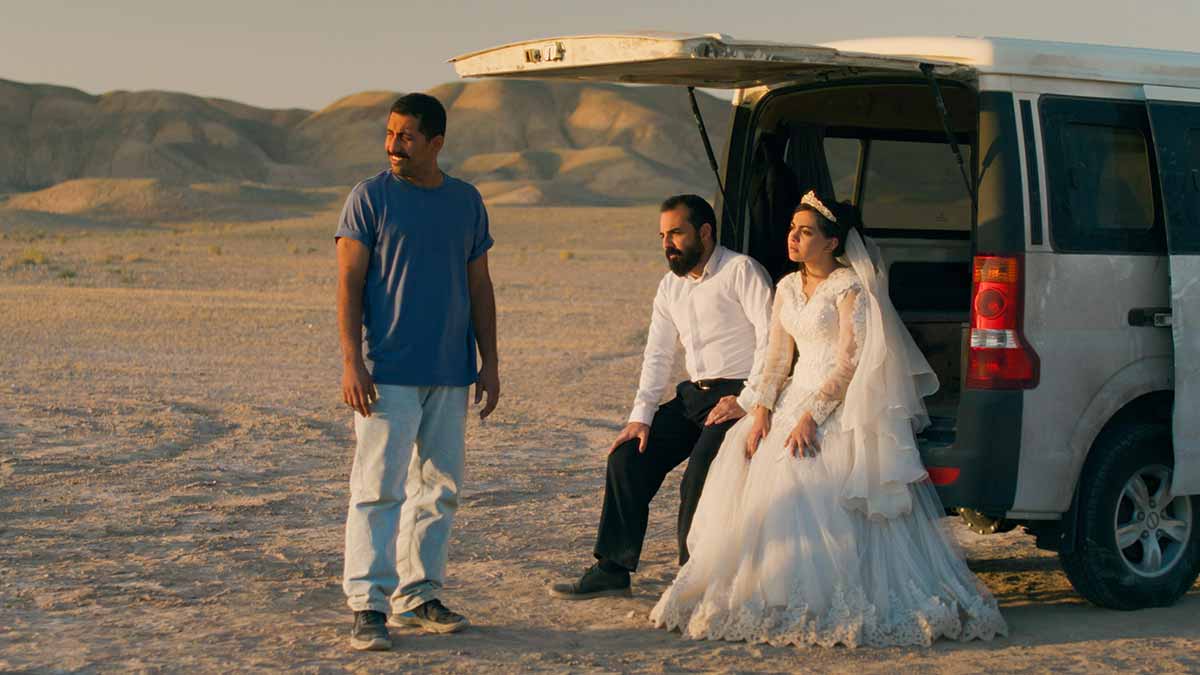
What would you do if you came face to face with your torturer, years after being blindfolded through your time in prison, jailed simply for protesting workers’ rights? By then, the damage has already been done: your life upended, your fiancee driven to suicide.

These are the emotions Vahid (Vahid Mobasseri), an affable mechanic with troubled eyes, carries in Iranian auteur Jafar Panahi’s latest, Palme d’Or-winning It Was Just An Accident.
So what does Vahid do? He abducts the man, packs him in the back of his van, drives out to the desert, and tries burying him alive. But vengeance, Panahi suggests, is rarely straightforward. What follows is a series of gruelling, at times darkly comic, encounters as Vahid and a coterie of former prisoners grapple with doubt, memory and the possibility of being wrong.

As the film moves toward its climax, Vahid finally confronts his torturer—speaking of what the Iranian “state” means to him before breaking down and insisting, “I’m just like you.” The film quietly turns the table between oppressor and oppressed, imagining what remains when power slips from the hands of the former—a quiet but unmistakable indictment of authoritarian regimes.

At a time when Iran is seen through headlines of war and conflict, its globally acclaimed cinema offers a counterpoint, resisting blunt messaging and weaving politics within the lives of ordinary Iranians.
Cinema is typically shaped by the state, mirroring the politics of its time. In Iran, however, despite strict censorship, its cinema has thrived, thanks to filmmakers who have engaged in a relentless cat-and-mouse game with the state—making films in secret, smuggling them, often facing imprisonment or exile.

Panahi famously shot his 2011 film This Is Not a Film partly on an iPhone and smuggled it to Cannes on a USB drive hidden inside a cake. He had been arrested in 2010 on charges of anti-government propaganda and was barred from leaving Iran or making films.
In his 2015 film Taxi, he turned a car into a moving set, driving through Tehran’s streets pretending to be a cab driver. Sociopolitical statements are made through each passenger. The most pointed exchange is with human rights lawyer Nasrin Sotoudeh. Panahi asks where she’s headed. “Paradise,” she replies—she’s on her way to visit a hunger striker in prison. Sotoudeh, arrested in 2018 on charges including spying and insulting the supreme leader, was sentenced to 38 years in prison and 148 lashes, temporarily released in 2020 after testing positive for Covid-19, detained again in 2023, then released once more.
It is this tension, conflict, confrontation with the state, and the lyrical imagery route Iranian filmmakers have adopted that has come to define its cinema. The confrontation is full-fledged in some cases and understated in others.
Like Taxi, ace filmmaker Abbas Kiarostami’s Ten (2002) also unfolds inside a car—two fixed cameras following a woman driving through Tehran, in conversation with her passengers. In the context of the ‘Zan, Zendegi, Azadi’ (Woman, Life, Freedom) movement, sparked by the custodial death of Mahsa Jina Amini in 2022, who was arrested for allegedly violating hijab laws, the image of a woman at the wheel, as early as 2002, reads as a quietly radical, deeply feminist gesture.
No discussion of Kiarostami is complete without his Palme d’Or-winning Taste of Cherry (1997), which follows a haggard, middle-aged man driving through Tehran’s labour market in search of someone to bury him after he dies by suicide. Some try talking him out of it, reminding him of life’s simple pleasures—the “taste of cherry”. Without making an overt political statement, the film reveals something intrinsic to Iranian society: a deep engagement with the philosophical, expressed through stark realism. Underlying this is a broader cultural instinct—a persistent self-interrogation navigating a fraught space between fundamentalist patriarchs at home and neocolonial aggression abroad.
In December, Panahi was handed a third prison sentence in absentia on charges of propaganda against the system, even as It Was Just An Accident received two Oscar nominations. His co-writer Mehdi Mahmoudian was arrested weeks before the ceremony for signing a statement condemning Iran’s supreme leader. The two, incidentally, first met in prison.
While Panahi has said he would return to Iran, for others the cost has been greater. Mohammad Rasoulof, now exiled in Germany, fled in 2024 after an eight-year sentence and flogging for making The Seed of the Sacred Fig without official permission, with additional charges pointing to its actresses appearing without properly observing the hijab. Set against the 2022 protests, the film locates Iran’s larger tensions within a Tehran family: the father, Iman, a government employee promoted to investigator in the Islamic court, remains convinced he is upholding “God’s law” as he handles cases of detained protesters facing long sentences and death—while his teenage daughters side with the protests. As trust fractures on the streets, the same rupture unfolds at home.
It wasn’t Rasoulof’s first confrontation with the state. In 2010, he was sentenced to six years in prison for filming without a permit. He had another run-in with the state over his 2017 film A Man of Integrity, about the widespread corruption in Iran shown through the life of a goldfish farmer. And, in 2020, he was again convicted of anti-government propaganda for There Is No Evil, his Berlin Golden Bear-winning exploration of the death penalty in Iran.
While some films engage directly with the state and citizen; others embed defiance in the everyday. The Friend’s House Is Here, which premiered at Sundance, follows two Tehran roommates immersed in the city’s underground culture—one recording herself dancing at historical monuments, the other performing with an underground theatre troupe. When a woman scolds them for not wearing hijabs, they respond with laughter. Bahman Ghobadi’s No One Knows About Persian Cats (2009) turns its lens on Tehran’s banned underground pop and rock scene. The 2025 documentary Cutting Through Rocks follows Sara Shahverdi—divorced, childless, a motorcyclist—as she campaigns to become the first woman elected to her village council, teaching girls to ride and challenging child marriage along the way.
From secret shoots to smuggling films out and enduring prison or exile, Iranian filmmakers have done it all for the dangerous act of telling stories about ordinary lives upended by political upheaval. It is this very constraint that has shaped something distinctive: navigating a treacherous path under a stifling regime, they have forged a visual language that is innovative, restrained and deeply human, carrying forward the legacy of Iran’s rich cultural tradition.
