


Most people don’t know much about Amelia Cary—or Lady Falkland—the wife of Lucius Bentinck Cary, the 10th Viscount Falkland who served as the Governor of Bombay from 1848 to 1853. A few might know that she authored the book Chow-Chow, selections from her journal kept in India, Egypt and Syria. Apart from the rather unfortunate title (which sounds like dog food but in reality means “odds and ends”), the book is a compendium of crisp observations about life in colonial India, from the architecture of Jain temples and the tameness of the birds and squirrels at Dapoorie (now a suburb in Pune) to the contrast between small-talk in India and north America. But then, to Indians, she is not known for her small talk, scintillating as it might have been. She gained prominence for an entirely different reason—for travelling in the first Indian passenger train that went from Bombay to Thane on April 16, 1853. It carried 400 dignitaries and officials including the guest of honour—Lady Falkland. One cannot know what was exactly going through her mind during the historic journey. Was she holding on to the side bar in white-knuckled fear? Or perhaps, being of literary bent, she was indulging in a spot of poetry:
For better or verse, I’m in this fix
Might as well throw some rhyme into the mix
Whatever she was thinking or doing, one small satin-slippered step for her meant one giant leap for the Indian Railways, which chugged into life with great aplomb. Soon, there was rapid expansion, with 9,000km of railway tracks completed by 1870 and 25,000km by 1900, employing over one lakh workers. Train travel for the white man was steam-powered luxury, with the interiors of a first-class compartment bounteously supplied with silk curtains and gauze blinds that could screen out the unseemly sight of impoverished Indians spilling out of the third class. The disparity is stark, and maybe best illustrated by a cartoon cited by Shashi Tharoor which shows hundreds of Indians hanging off an overcrowded train while two Englishmen lounge in an empty first-class compartment as one tells the other: “My dear chap, there’s nobody on this train.”
Unfortunately, the disparity persisted even after independence and partition, one of the most trying times in the history of the country, let alone the Railways. The violence inside the trains was unprecedented, a vivid description of which is given in Honest John by Bakhtiar K. Dadabhoi, a biography of John Matthai, the first railway minister of independent India. Trains carrying refugees were often derailed with the passengers brutally massacred. India and Pakistan responded to the crisis by setting up the Military Evacuation Organisation (MEO) on September 1, 1947, to move some 10 million refugees through 20 trains from India and 12 from Pakistan, collectively known as ‘Specials’.
But Matthai’s woes were only beginning, writes Dadabhoi. He was viciously attacked upon the presentation of the interim railway budget on November 20, 1947. From the provision of electric fans in new coaches (one member of the house asked whether fans would be provided on doors and windows since many passengers were travelling hanging from them) to the labelling of drinking water as ‘Hindu’ and ‘Muslim’, the members came at him with all guns blazing. One even wanted to know whether there was any ‘Scheduled Caste Water’. Another narrated his experience of being denied water because his beard gave him the appearance of being Muslim. He blamed his “hirsute appendage” for his unquenched thirst.
Then there was the problem of overcrowding inside trains, a perennial problem that exists to this day. One MP suggested a double-decker coach by building an “upper storey to the third class carriages as in the tram cars”. He missed the humour when another quipped, “And then build an overbridge.” Another source of embarrassment which was brought up in the railway budget of 1948-49 was the late running of the Grand Trunk Express, which travelled between Madras and Delhi. All Indian trains were tardy—with three hours being added to the old schedules since the war—but the Grand Trunk Express took the cake, often being six to 12 hours late when it reached Madras. One member suggested they rename the train as the ‘Madras Daily Slow Passenger’.

Things have improved but still, anyone who expects an Indian train to run on time lives in a la-la land of incurable idealism or mild delusion. Then again, tardiness runs in our blood—probably chiselled over centuries of evolution—so our trains are only following unspoken national policy. At least now there are apps to track the progress of your train, a welcome change from the days of lying awake at night in a sleeper train, terrified of missing your early morning stop and squinting in the dark to make out the names of passing stations. Only a rookie would make the mistake of depending on the estimated arrival time.
Of course, the last thing you can do on a sleeper train is sleep. If you get the top berth in a Third AC coach, the air conditioning’s too cold. Also, navigating the pitiable excuse for a ladder that takes you to the said berth does not exactly show you at your most flattering. Climbing down is even more of an ordeal, as you want to make minimum contact with the dirty floor while searching for your slippers. In achieving this, you rival the Russian ballet in the art of the “tip-toe”.
If you get the middle berth… well, the less said about the middle berth the better. The theory of relativity dictates that the most comfortable, relatively, is the lower berth. But this too, only if you are vertically challenged. Tall people risk their outstretched feet bumping into every passing traveller’s bulging suitcase and bad temper.
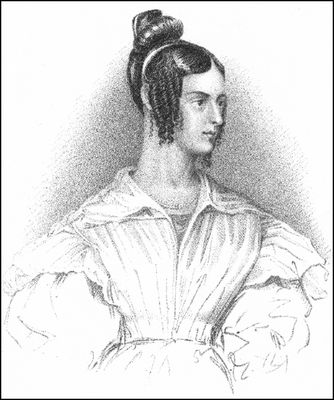 A sketch of Lady Falkland, who travelled in the first Indian train, between Bombay and Thane.
But then, if we are talking about train travel, let’s start at the beginning. Sojourning in a long-distance train involves a fair bit of waiting with bated breath, right from your attempts to enter the IRCTC website. It is like learning to swim or understanding Proust—you never get it right in the first attempt. Once you get past the password—hovering somewhere irretrievable on the outer reaches of your consciousness—you must crack the captcha. You offer up a prayer as you press c instead of the identical looking C. Getting it right is merely luck of the draw.
But then, all this is nitpicking—and a difficult captcha is the height of ecstasy—when you compare it with the days of yore, before digital reservation. Then, you had to depend on a telegram to inform you whether your return ticket was confirmed. Considering the efficiency of our postal system, which might be even worse than our trains, telegrams were probably as reliable as a straying husband or a journalist asked to meet a deadline. For ridding us of this horror, we have an enterprising politician to thank—Madhavrao Scindia—who introduced the Computerised Passenger Reservation System during his tenure as railway minister from 1986 to 1989.
The honourable minister, apart from cracking a whip on the inefficiency of the Railways, was also known to crack a joke or two occasionally. He once related an anecdote concerning the king of Nepal, cited in Arup K. Chatterjee’s book The Great Indian Railways: A Cultural Biography. During a palace banquet, Scindia brought out a magnificent centrepiece—a silver train that went around the table distributing chocolates and cigars to the guests. The crystal decanters were pulled by a silver engine brought from London over a century ago. “This is the train which seems to have caught the imagination of people from all parts of the world,” wrote Scindia. “It was made at a time when the Gwalior Light Railway was first begun and presented as a memento to my grandfather…. All the guests were finishing with dessert when the train started. And everyone as usual was very intrigued. It passed Her Majesty, and served toffees and chocolates. Some had brandies, some had cigars. And, after that the train went on. Unfortunately, before it reached His Majesty’s chair, a rather overenthusiastic guest tried to take two of the decanters out at the same time… then everything went wrong. The train just wouldn’t start again… with electricians scurrying under the table, but no, it just wouldn’t budge. It is a very temperamental train… it was not prepared to suffer the indignity of having two of its decanters pinched at the same time.”
Our trains—not the toy ones—might not serve cigars and brandy, but there was a time when they served something better: roast chicken. Along with tomato soup with croutons and fish-and-chips. There was even an English-style full tea service on the Calcutta Mail Restaurant Car, writes retired Navy officer Vikram Karve in a blog. Continental food was the forte of the Frontier Mail. The Southern Railway specialty was Madras mutton curry and rice. The refreshment rooms at stations like Madras Central and Bombay VT served a hearty English breakfast, replete with cornflakes and coffee.
Piping hot delicacies are often a pipe dream in today’s trains. The best you can hope for is foil-wrapped biryani with a disposable spoon and packaged pickle, opening which comes with an assured guarantee of a spill, thus spoiling your jeans and your journey. But exploding pickle is the least of your worries in an Indian train. The challenge starts with lugging your suitcase inside amid a sea of humanity, each of whom employs every functioning body part (elbows, feet, hips) to ensure they get into the bogie first. You have no choice but to muscle your way in, because you’d rather be the aggressor than the aggressee, trampled under the collective weight of desi desperation.

Once you take your seat comes the next step—assessing your co-passengers’ threat level—from wailing children fatal to your peace during the day to snoring gentlemen fatal to your sleep during the night. Meddlesome aunties and Modi-manic uncles. Tea sellers with their never-ending ‘chai chai’ call in that peculiar nasal twang. TTEs who time their visit to coincide with your dinner. Of course, for the complete train experience, one must book the berth next to the toilet. The scent that wafts inside each time the door swings open is not exactly of rose petals.
But then again, there is no point in complaining. Bad toilets are, after all, a vast improvement from the alternative: no toilets at all, which might have been the case if it hadn’t been for one worthy gentleman’s letter to the Sahibganj divisional railway office in 1909 that resulted in the British Raj instituting toilets in Indian trains for the first time. The letter is now displayed at the National Rail Museum in Delhi.
“I am arrive by passenger train Ahmedpur station and my belly is too much swelling with jackfruit,” wrote Okhil Chandra Sen. “I am therefore went to privy. Just I doing the nuisance that guard making whistle blow for train to go off and I am running with ‘lotah’ in one hand and ‘dhoti’ in the next when I am fall over and expose all my shocking to man and female women on plateform. I am got leaved at Ahmedpur station. This too much bad, if passenger go to make dung that dam guard not wait train five minutes for him. I am therefore pray your honour to make big fine on that guard for public sake. Otherwise I am making big report! to papers.”
Okhil babu’s grammar might have been faulty, but his sentiment was flawless. After all, if he hadn’t exposed his “shocking” to the men and women on that platform, where would we have been today?
Also Read
- The punctuality blindspot: The hidden cost of chronic train delays
- Echoes on the platform: How Indian Railways shaped my life and nation
- Evolution of Indian Railway food: From platform snacks to plush dining cars to IRCTC
- From Toofan Mail to DDLJ: How trains shaped Indian cinema and identity
- India's bullet train: 'Maruti Moment' for Indian Railways and a glimpse into the future
- Sudhanshu Mani: The visionary behind India's Vande Bharat Express
Which brings us to the question of where we are exactly. Perhaps it is time to take stock. It is important to note that not all is doom and gloom when it comes to the Railways, which is introducing fresh and tasty local cuisine in various trains. Today’s rail travel experience includes upgraded stations, modern trains and enhanced safety systems. As of December 2025, 164 Vande Bharat train services were running across the country, with the Vande Bharat Sleeper introduced this January. And 155 modern stations have been equipped with upgraded toilets, lifts/escalators, food courts and plush waiting areas. Then there is the Mumbai-Ahmedabad bullet train project which is expected to become functional by next year.
In a way, for those of us acclimatised to the slow romance of a train journey, a bullet train spells disaster. Trains are built for contemplation. Cradled in the lullaby of a train, the minutiae of everyday life fades into insignificance. There is a breaking and remaking of the self, and possibilities seem as endless as the railway tracks stretching into infinity. “Slow travel by train is almost the only restful experience that is left to us,” said A.P. Herbert, a 20th century playwright. Modernity, that way, is overrated. Who wants hyperloops and high-speed trains when you can have milky tea, rhythmic snoring and explodable pickle.