


One day, Sudhanshu Mani, then general manager of the Integral Coach Factory in Chennai, went to the furnishing shop to check out the problem of an EMU train’s sliding doors getting jammed. The problem persisted after many attempts at moving the poor-quality door by a team of executives. From a distance, an elderly shop worker watched the men’s comical attempts at making the door slide. In the end, after giving instructions to change the supplier, Mani was returning to his car when the shop worker stopped him and told him that moving sliding doors was not his job. If you do this... tomorrow you will be moving shop shutters up and down, he said. Thrusting a piece of paper at him, the man said, “This is your job.”
On the paper was an amateurish sketch of a speeding train with an aerodynamically profiled nose and streamlined coaches. He never met the man again despite searching for him later, but the incident was a wake-up call of sorts, reinforcing Mani’s desire to build a modern, aesthetically superior and technologically advanced train that would be different from the thousands of identical Indian trains in the heaviest passenger railway network in the world.
At ICF, he found a great team of designers and engineers who had his same passion. All he had to do was channelise it. Ordinarily, the train would have taken 36 to 42 months to build, but Mani wanted to get it ready before his retirement in December 2018. Otherwise, the next GM might have different ideas. So, they decided to call it ‘Train 18’. The team worked hard, and in a record 18 months it was ready for roll-out—India’s first semi-high-speed train set, now known as the Vande Bharat Express, built at a cost of Rs97 crore, nearly one third of the estimated price of an imported train. It was received with great fanfare, for it was not just a train made with more than 80 per cent of the components being Indian, but it also represented the spirit of a resurgent India poised at the brink of modernity, change and progress.
After retirement, Mani is now settled in Lucknow with his wife (their son is an investment banker in the US). He might be an engineer by profession, but he has the soul of a poet and artist. Now, he has time to indulge his passions—theatre, poetry and literature. I met him at a performance space he owns in Lucknow, where he organises plays, talks and poetry recitations. Over coffee and sandwiches in a brightly lit room filled with artworks, he reminisced over his 37 years in the Indian Railways, what ails it and what we can do about it.
I was posted at ICF in 2016 as general manager, where I could realise my dream of building a fast, efficient and modern train. The first step was assembling a great team. For that, I asked the employees a simple question: what is your job? This was the question that a general manager asked me a few years into my stint at the Railways. I parroted out the set definition of my job. “No, that is 25 per cent of your work,” he said. “What is the other 75 per cent?” I found this question to be quite surprising. When I asked this to the officers upon becoming GM, most of them would parrot out what they had been parroting out from the beginning of their career. Those who didn’t and instead brought in fresh perspective, I knew, were the ones who could help me build my train. They were the doers—the ones with fire in their belly. That’s how the team of almost 500 people out of the total 10,000 in the factory almost formed itself.
We had to face many challenges, right from getting the sanction to build the train. There was a lot of red tape involved. So I went to Delhi to meet the chairman of the Railway Board. Just give me the sanction to build two trains and I will build it at one-third of the cost of importing them, I told him. I also told him that we would get him to cut the ribbon before his retirement in July 2018. Then I grabbed his feet and told him I was not leaving until he gave me the sanction. People ask me whether I actually did that or whether I was speaking figuratively. I tell them that it is between me and him.
I believe if you work on something with all your passion, commitment and hard work, success will come. But fear of the outcome prevents us from trying. Still, if I were to change anything in the way I built the train, it would be how I handled the project in the ministry and allied organisations. It is always better to have the stakeholders aligned with you instead of against you. To win them over, you often have to kill your ego. Once we got the sanction, we cocooned ourselves from the world, not caring about anyone else. I should not have done that, because in the process we made a lot of enemies. There was a whole lobby which wanted the train to fail. What they did not realise was that the train had already captured the imagination of the country. It became so popular that people were lining up to get a glimpse even before it was launched. But our detractors kept waiting and then struck by slapping the whole team with false vigilance cases which, in time, were dismissed. But other than this, I have no regrets. There is nothing I would change, except for a few minor technical details, like making the train seats more reclinable.
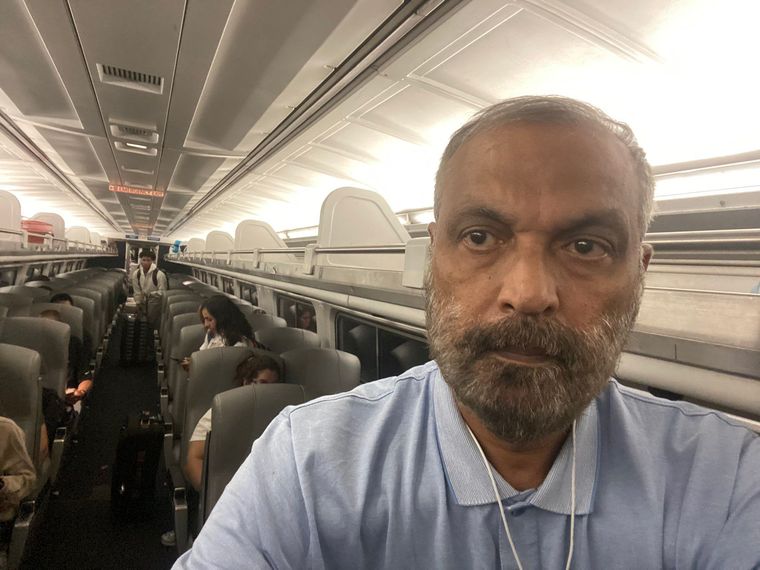 Railway man for life: Sudhanshu Mani in an American train during his travels abroad | X@ManiSudhanshu58
The problems that ail the Railways are many. After the railway budget was merged with the main one, the Railways has become a footnote. Finance Minister Nirmala Sitharaman dedicated three lines to it this time. And that, too, not under the head ‘Railways’, but under the head ‘Infra’. She spoke about seven high speed corridors and one freight corridor—that was it.
Once the railway budget was merged, that financial discipline was no longer there. There is 10 times increase in the investment without generating any incremental income. Earlier, you paid a dividend on whatever you got from the government, now you don’t; it is part of the main budget. The government’s view is that we will not look at the return. It is good for the economy, bringing in employment and tax revenue and improving manufacturing. It will not look at how the Railway’s financials are performing. I partly agree with that but partly don’t, because the organisation must have fiscal discipline. How long can it live on the alms of the Central government?
When it comes to freight, we have to ensure first and last mile connectivity, with fast loading and unloading. The goods need assured delivery. The time has come for time-tabled goods trains, which are not there currently. So, in spite of these freight corridors being built, the first and the last mile is so slow that the earnings are not enough. This must change if railway finances have to improve, because freight is your breadwinner, not passenger services.
In the passenger segment, the way common people travel is abysmal, especially in states like Bihar and eastern UP. They don’t travel like humans, but like cattle. Some sit in the toilets, others travel standing the whole day. You must believe that India is going to be developed and people will have money to pay for their tickets in future but until then, we must give them dignity, if not comfort. What will bring you money is the Vande Bharat and other high-end trains. Why should we subsidise them? Let them be run privately and passengers charged more. So, it is a win-win—you look after the common people and let the rich pay more. If they don’t like it, let them travel by air.
The potential of our country is not being exploited. It is getting lost in hype and hyperbole. We are still singing the praises of a train which was built seven and a half years ago. But compared with the trains of China or Europe, the Vande Bharat is nowhere near. When people call it world-class, I am amused because it is not world-class. It might have been near world-class at that stage, but why have we not been able to build on it? That’s my question as a creator. Many countries are moving to aluminium trains—which are faster, lighter and more efficient—but India still hasn’t got one.
Also Read
- The punctuality blindspot: The hidden cost of chronic train delays
- From colonial charm to modern marvels: The inside story of Indian Railways
- Echoes on the platform: How Indian Railways shaped my life and nation
- Evolution of Indian Railway food: From platform snacks to plush dining cars to IRCTC
- From Toofan Mail to DDLJ: How trains shaped Indian cinema and identity
- India's bullet train: 'Maruti Moment' for Indian Railways and a glimpse into the future
What has improved, which many people are unaware of, is railway safety. Ten years back, around 500 people used to die in railway accidents every year; today, it is 25. This is a great achievement, but you can’t rest on your laurels. We must move towards a zero accident regime, for which we must introduce Kavach in a much larger way, which will significantly improve safety. The progress towards that is very poor. Also, we must get a better understanding of AI and how it can help us examine live data. Every station has a data logger which digitally records the position of a train. And every locomotive has a computer which logs everything. This information is used for post-mortem, but with AI you can analyse the data from all 7,500 stations and 17,000 locos—which is impossible to do manually—to pre-empt and prevent accidents. Because for every accident, there are a thousand near-misses that we can learn from.
But just because I criticise the Railways does not mean I don’t love it. I have given it more than 40 years of my life. In my heart, I’ve enjoyed every moment of service. I am a railway man for life.