



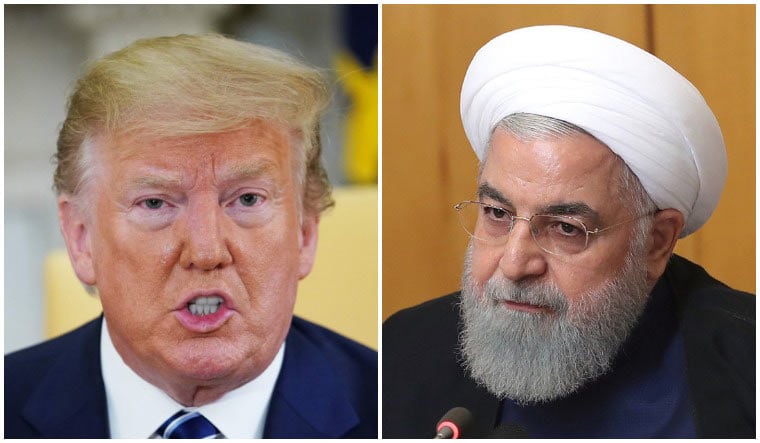
Today, in a shocking move by the US, Iran's top military leader, General Qasam Soleimani was killed in an airstrike at Baghdad's international airport today
Trump's decision to kill the head of Iran's elite al-Quds force Qasem Soleimani is a huge act of aggression. It is unprecedented violence of high intensity and could lead to military hostilities.
Ever since US President Donald Trump withdrew from the JCPOA (Joint Comprehensive Plan of Action) last year, tension has been escalating and causing face-offs between the US and Iran. Sanctions were imposed on Iran, crippling its economy.
In July 2019, an Iranian vessel believed to be carrying oil to Syria was detained by UK Royal Marines. The Iranians believed that the US was behind the act as it was in violation of sanctions on Syria. The vessel called Grace was released in August. Iran, in July, seized the British-flagged tanker Stena Impero by Iranian Revolutionary Guard forces. Stena Impero too was released in August.
Tensions peaked in September when Saudi Arabia's state-owned oil manufacturing unit, Aramco was near-destroyed in a drone attack. The US promptly blamed Iran for the same and Iran denied any involvement.
Iran, who has been warning that they will increase uranium stockpiles to meet weapons-grade levels, in July, announced their decision to go ahead with it.
In the last few months, however, there was a lull of sorts, until the attack on the US embassy in Baghdad, Iraq on December 31 2019. The attack was carried out by a mob that voiced its loyalty to head of Iranian Quds Force Qasem Soleimani. No one at the embassy was reported to be harmed in the attack that involved people throwing bricks at the building.
Even then, the action did not warrant for a response of this scale, a response that seems disproportionate. If North Korea's military actions of testing ballistic missiles and nuclear weapons were to be compared, this incident certainly did not call for action on such a level.
This could be a huge turning point for peace not only between the US and Iran but peace in the Mid-East region. The action is a bit of a shocker since Trump has a few times made it clear that he did not wish for a war in the region. A decision like this coming from Trump could be very well to divert attention from his impending impeachment or the election debates.
It could also be an attempt to highlight his leadership abilities before elections in November. Even then, it cannot be emphasised enough that this was a disproportionate response.
Iran options for a military-led response are currently limited. Firstly due to geographic reasons. Second, Iran's economy that has suffered a great deal due to oil import bans on other nations, cannot afford a large scale military-led attack. What Iran could do, is carry out an attack on US establishments similar to the one in Baghdad. But that would also mean attacking the host nation and creating conflict amongst Muslim nations that are already divided over Shia-Sunni differences.
Also, such an attack comes with plausible deniability, which could increase the US' anger. The situation is not really going to affect Russian interests. President Putin however, might choose to play his cards wisely and get Iran to buy more ammunition from Russia.
Iran could also exit the NPT or the Non-proliferation Treaty, and this could mean a huge diplomatic let-down for the US. Iran could then go ahead and actually test nuclear weapons like North Korea.
Any action against the US on a global level is highly unlikely. Heated debates, however, will take place at the UN Security Council on various possible outcomes of the current situation on how it threatens the security situation in the Middle-Eastern region.
A. Vinod Kumar is an Associate fellow for IDSA (Institute for Defence Studies and Analysis)
As told to Sumitra Nair
