



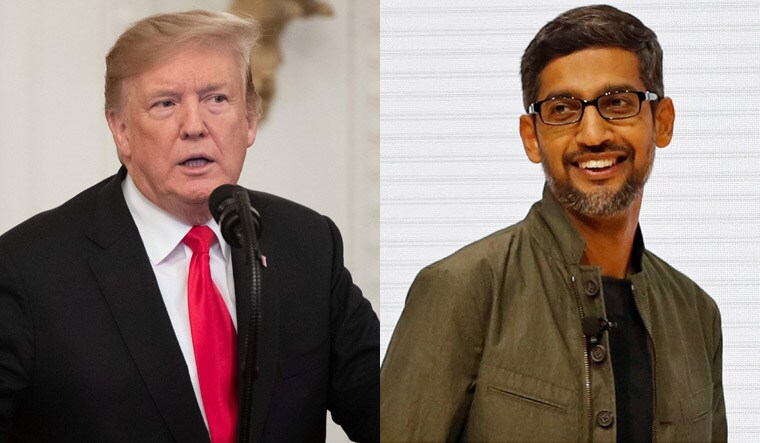
US President Donald Trump had an impromptu meeting with Google CEO Sundar Pichai at the Pentagon. Post the meeting, Trump said that Pichai was totally committed to US security and not Chinese military. The president had previously accused the Google CEO of indirectly helping to boost China's military.
"Just met with @sundarpichai, President of @Google, who is obviously doing quite well," Trump tweeted after a White House meeting. "He stated strongly that he is totally committed to the US Military, not the Chinese Military."
" There was also criticism from General Joseph Dunford, chairman of the Joint Chiefs of Staff, who told Congress "the work that Google is doing in China is indirectly benefiting" China's armed forces.
Pichai planned a meeting in Washington with General Joseph Dunford, the chairman of the Joint Chiefs of Staff post the aforementioned accusation.
Dunford had also urged US tech giants to step up work on next generation 5G wireless technology so that US markets are not reliant on Chinese innovators, like leading telecom firm Huawei.
Pichai and Google’s new policy chief, Karan Bhatia also met with other government officials and congressional leaders on a two-day visit to Washington.
The US government, however, has deep suspicions that Huawei's technology would potentially open the doors to Chinese government penetration of US communications.
According to a Google spokesperson, Pichai had "productive conversations" with Trump about "investing in the future of the American workforce, the growth of emerging technologies and our ongoing commitment to working with the US government."
