



As the Uzbekistan Airways flight bound for Tashkent, the capital of Uzbekistan, prepared for take-off, even the air safety video offered a glimpse into the country’s cultural identity – scenes of ancient Silk Road cities, a caravan of camels travelling across the desert, dancers in richly embroidered costumes, and flashes of traditional craftsmanship, transformed an otherwise routine briefing into an introduction to Uzbekistan itself. Before I had even landed, the airline had already begun telling the story of a nation deeply proud of its heritage.
Tashkent, which is also the largest Uzbek city, has been on the crossroads of the ancient Silk Road for centuries. It has been rebuilt many times in its tumultuous past – when Genghis Khan destroyed the city in 1219 and again when a devastating earthquake decimated it in 1966. Today, Uzbeks, Tajiks, Kazakhs, Kyrgyz, Afghans, all make up Tashkent’s melting pot of nationalities.
After the earthquake, much of the city was rebuilt. Many of these buildings still line the city’s wide avenues with concrete facades softened by intricate geometric screens, mosaics and relief panels that echo Central Asian ornamentation. Even in the underground metro system, each of the stations is like a museum of design with an individual theme, and tiled murals celebrating science, space exploration and everyday Soviet life which makes each ride a cultural tour.

Along the buildings of Soviet modernism, a new design culture is also emerging. Creative spaces such as Teplo Store have become hubs for contemporary Uzbek design. Teplo – a mix of concept store and a cultural salon – brings together fashion, ceramics, textiles and graphic design by young local creatives. I see traditional Suzani embroidery and ceramics reinterpreted for contemporary living.
One of the most striking Brutalist buildings is Hotel Uzbekistan, whose vast concrete façade rises like an enormous, folded screen above the city’s central square. Built in the 1970s, the building’s honeycomb-like grid softens the harshness of concrete while acting as a brise-soleil, filtering the region’s intense sunlight. A few kilometres away stands another unique building built in the Soviet era – the circular dome of the Tashkent State Circus. With its sweeping white canopy and clean modernist lines, the building resembles a futuristic pavilion rising from a leafy park.

At the heart of the old city, the Hazrati Imam Complex, built near the grave of Hazrati Imam, one of Tashkent’s first Islamic preachers, offers a counterpoint to the Soviet era architecture. It’s a serene ensemble of traditional mosques, courtyards and madrassas that feels worlds away from the city’s busy boulevards. Here, turquoise domes rise above sand-coloured brick walls, while intricate tilework and one of the most important Islamic schools in the city with carved wooden doors showcase the craftsmanship that has long defined Central Asian design. Within the complex is the 16th century Barak-Khan Madrasa, which used to be one of the largest Islamic schools.
Passing through its towering portals adorned with geometric tiles and glazed brickwork, we come across the small cells that have now been transformed into souvenir shops offering a variety of traditional arts and crafts, including carved wooden Koran stands, miniature paintings, and fabrics embellished with intricate suzani embroidery. We linger for a while in the sprawling courtyard of the complex, watching artists engrossed in painting the buildings, children flying kites with their parents, and visitors enjoying glasses of fresh pomegranate juice.
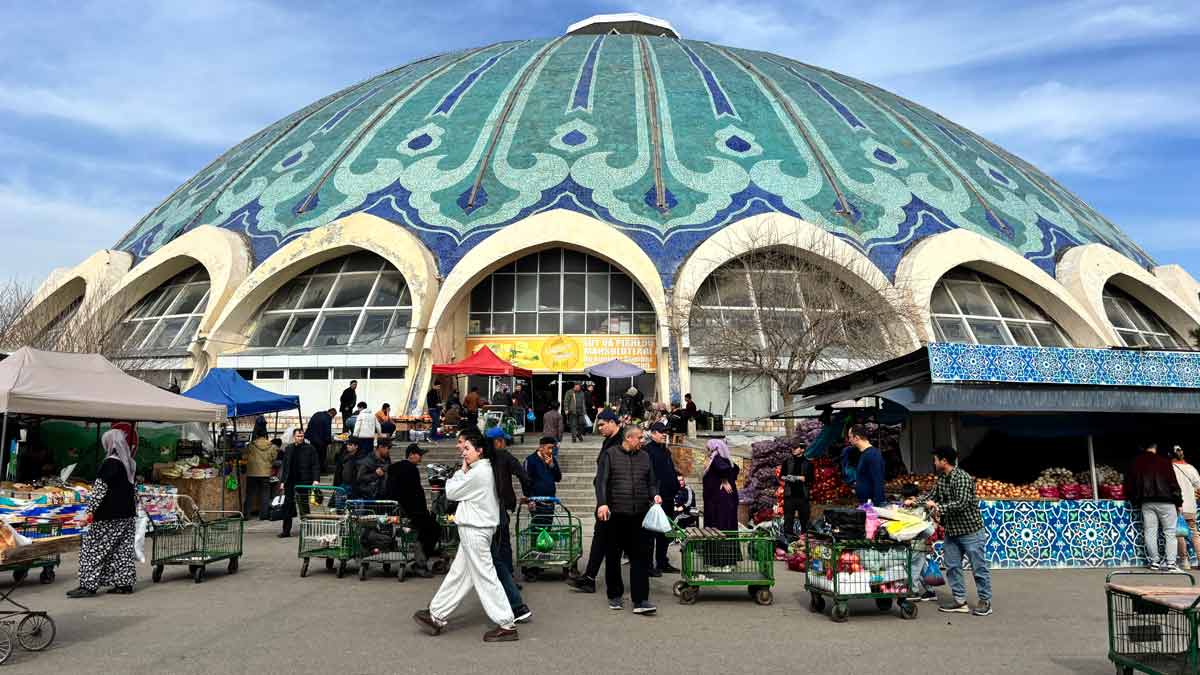
For a slice of local life, a visit to the Chorsu bazaar is mandatory. The building crowned by its striking Soviet-era blue dome, is a modernist structure that takes its design cues from traditional Central Asian market halls. Beneath the gargantuan dome, stalls spiral outward in concentric rings, where vendors sell everything from pyramids of spices and dried apricots to freshly baked non bread stamped with intricate patterns. The air carries the scent of coriander, cumin and roasting meat, while traders call out prices and shoppers haggle over piles of walnuts, pomegranates and golden raisins.
Next to the Bazaar is the stately Kukeldash Madrasa, a working Islamic school. Built in the 16th century during the rule of the Shaybanid dynasty, it remains one of the largest and most significant madrasas in Uzbekistan. The madrasa’s massive brick façade and grand arched portal dominate the square. I enter a courtyard lined with small student cells where scholars once lived and studied Islamic theology, philosophy and law. Students dressed in black and white still walk the corridors. Over the centuries, the madrasa has served many roles, from a centre of learning to, at times, a caravanserai and even a fortress-like structure during turbulent period, till it became a madrasa once again.
Another must-visit spot is the sprawling Besh Qozon Plov Centre, where Uzbekistan’s beloved rice dish is cooked in giant Kazans or cauldrons, that resemble gleaming metal lakes. Enormous iron pots are set over open flames, where cooks stir rice, lamb, carrots and chickpeas with long paddles, working with a rhythm that comes from repetition.
Steam rises from the cauldrons as cooks layer ingredients with careful precision: stacks of meat, onions, mountains of julienned carrots, followed by rice that slowly absorbs the fragrant broth. The result is the deeply aromatic dish that sits at the heart of Uzbek cuisine.
One of my last stops in the city is the new Centre for Islamic civilisation, bordering the Hazrati Imam complex, sprawling over 10 hectares. Opened in March 2026, it’s a multi-million dollar project envisaged as a unique lens on the Islamic world, through the lens of history, art, science, faith and craft.
The majestic building is crowned by a magnificent 65-metre-high turquoise blue dome, with gold details, while its four lofty portals , each decorated with Qur’anic verses and hadiths, symbolising the four ancient learning centres of Samarkand, Kokand, Khorezm and Bukhara.
My guide explains that the museum acquired the extensive collections from archives in the country and from private collectors and auctions abroad, and there was great national pride in bringing back Uzbek treasures to where they belong. Among them are approximately 600 unique works of ceramics, epigraphy, metal art, calligraphy, and miniature painting, as well as rare manuscripts that had been preserved abroad for centuries.
I journey through centuries, from early Qur’anic manuscripts with gold leaf deviation to scientific discoveries made by scholars of Central Asia. Displays are arranged thematically and span a wide variety of subjects like theology, astronomy, medicine, mathematics and philosophy developed side by side. Its seems a fitting finale to my tryst with this fascinating city.
Fact file
Getting there: Fly Uzbekistan Airlines which offers the best connections with direct flights from Mumbai and Delhi.
Local tip: It's better to tie up with a local tour operator like Orient star group.
Stay: Farovon Tashkent is a new boutique hotel with a great location and traditional interiors.
