



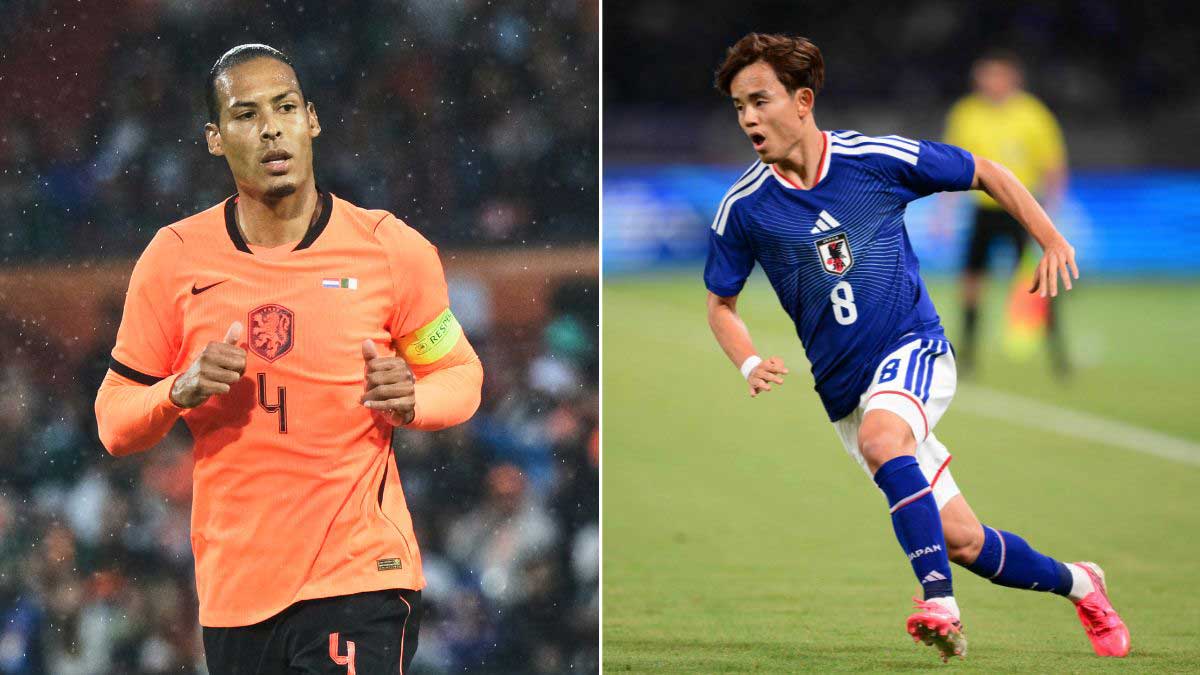
German mathematician Joachim Klement says the Netherlands will win the 2026 World Cup. That may sound a little outlandish considering that the team is not at its strongest. But Klement correctly predicted the last three winners. Despite his past success, the German emphasises his predictions are “completely irrational”. In fact, going by recent form, there is a significant chance that Japan top Group F, not the Netherlands. Then again, perhaps that will open up the path to an Oranje triumph. Or, the team could just win every match on the way to a dominant World Cup victory. After all, anything is possible in the beautiful game.
What is certain is that Group F is likely to be an intriguing contest. Though the Dutch are favourites on paper, Japan come in with genuine belief. Sweden qualified through a playoff and Tunisia have defensive steel.
Group F: The Netherlands, Japan, Sweden, Tunisia
The Netherlands: Virgil van Dijk
The Liverpool captain is coach Ronald Koeman’s lieutenant on the pitch. The team is stricken by injury concerns: Xavi Simons, Jerdy Schouten, Matthijs de Ligt, Frenkie de Jong, Denzel Dumfries and Memphis Depay are all ruled out or coming back from serious layoffs. The responsibility of holding the team together falls squarely on 34-year-old van Dijk. The Dutch are targeting the semifinals, but that is ambitious for a squad this depleted. They start against Japan in Dallas on June 14 in what will be their toughest test of the group stage.
Japan: Takefusa Kubo
Japan have beaten Brazil and England in the past year. They are no longer survivors at this level, but a team to be respected for what they can produce on the pitch. The team lost its best player, Brighton and Hove Albion’s Kaoru Mitoma to injury. And, another star, Takumi Minamino, is also out. But, with 23 players based in Europe, this squad has sufficient depth not to collapse in their absence. The player most likely to produce the decisive moment is Kubo. The Real Sociedad winger, once labelled the Japanese Messi, has long since outgrown that comparison and built an identity of his own. The right-winger cannot be given time and space and is therefore a magnet for defenders. This, in turn, creates space for his teammates and Kubo has the vision to slip them in.
Sweden: Viktor Gyokeres
Sweden had only two points from six qualifying games and finished bottom of their group. But they proceeded to the playoffs via the Nations League. After taking over during this disastrous time, Graham Potter steadied the ship and delivered a playoff campaign built largely on one player. Gyokeres scored a hat-trick against Ukraine in the playoff semifinal, then a late winner against Poland in the final to take Sweden to the World Cup. It has not been all smooth sailing for the Arsenal striker in his first season in the Premier League. Liverpool’s Alexander Isak had a genuinely tough season, but is fast regaining sharpness. Potter plays two up front, so Gyokeres and Isak will form a fearsome strike partnership.
Tunisia: Hannibal Mejbri
Tunisia qualified without conceding a single goal across 10 matches. The coach was changed three times during that campaign. The constant was Hannibal. Formerly a bit part player at Manchester United, the midfielder’s showings have improved with increased game time since joining Burnley a couple of years ago. He now wears the No. 10 shirt for Tunisia that once belonged to Wahbi Khazri and has proven a worthy inheritor of the national legend’s legacy, as Khazri, now a member of the coaching staff, watches on from the dugout. Tunisia have never advanced past the group stage in four attempts. They open against Sweden in Monterrey on June 14.
