



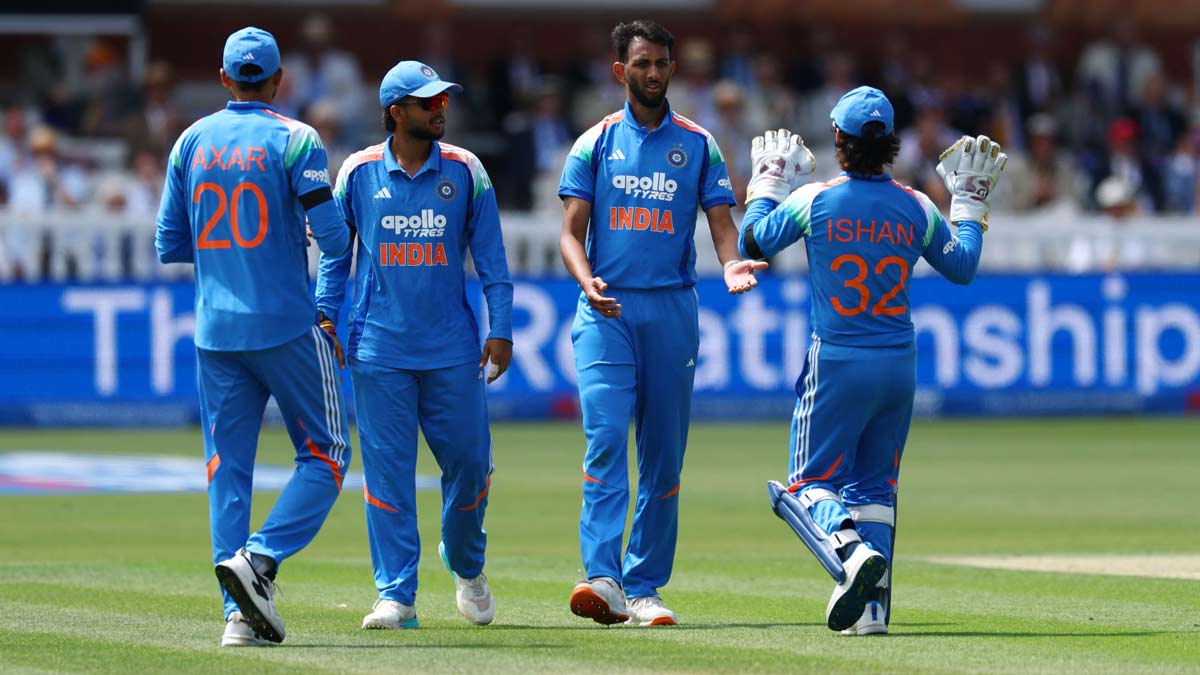
With his ODI career at a crossroads and pressure mounting, Rohit Sharma gave a fitting answer to his critics with one of his most memorable centuries. But his heroic effort was not enough to save India from a 27-run defeat in the third ODI against England, as the hosts won the series 2-1 at Lord's on Sunday.
Chasing a stiff target of 388, India put up a valiant fight, finishing at 360 for 7. Sharma led the charge with a magnificent 138, well-supported by captain Shubman Gill (77) and the ever-reliable Virat Kohli (74). However, England’s mammoth total, built on a career-best 142 from Ben Duckett and a superb 91 from Jacob Bethell, and helped by India’s inexperienced bowling attack, proved just out of reach.
Ultimately, the decisive factor was a blistering late-innings assault from Jos Buttler, whose explosive 41 from just 13 balls powered England to a staggering 82 runs in their final five overs.
For the 39-year-old Rohit, this match was about more than just a series win. Amid whispers that the selectors and head coach were looking to move on, the former skipper walked onto the hallowed Lord's turf with the aim to win the match and series for India and to shut down his critics.
When he reached his 34th ODI hundred—the first by an Indian batsman at this historic ground—there was no customary raising of the bat. He did not even acknowledge the standing ovation from the Members' Balcony, in what was likely his final ODI appearance in England.
During the chase, Sharma’s partnerships of 147 with Gill and 113 with Kohli gave India a genuine chance at an improbable victory. His innings was dotted with 17 boundaries and five sixes, three of which came off Josh Tongue. Another came from a signature pull shot against Sam Curran (4/75), who would emerge as England’s bowling hero.

It was Curran’s clever use of pace-off deliveries in the final overs that sealed India’s fate. In the space of just seven balls, he dismissed Ishan Kishan, Shreyas Iyer, and Virat Kohli, effectively extinguishing any lingering Indian hopes.
Curran found excellent support from left-arm spinner Jacob Bethell (1/49 in 7 overs), a strategic luxury India lacked by fielding only one specialist spinner in Axar Patel.
While India lost the series, one thing seems certain: this performance ensures that neither Sharma nor Kohli are likely to be going anywhere before the 2027 World Cup in South Africa.
On the day, the game plan from captain Gill and head coach Gautam Gambhir went awry. The decision to play four fast bowlers with a combined experience of just 51 matches backfired spectacularly, especially with the absence of Jasprit Bumrah, who was sidelined with an impact injury to his left knee.
The pace quartet of Prasidh Krishna (2/69), Arshdeep Singh (0/72), Prince Yadav (1/79), and Gurnoor Brar (0/97) lacked the skill and experience to contain England's in-form batting lineup.
Duckett and Bethell were exceptional in their planning and execution. After a solid powerplay of 58 runs in 10 overs, they completely dismantled the Indian attack between overs 11 and 30. The lack of a second spinner was glaring, a point emphasised by coach Gambhir having used Kuldeep Yadav in only 38 of 103 matches since his 2024 appointment, leaving Axar Patel (0/61) to toil alone.
Duckett's innings included 18 boundaries and a six, while Bethell, who initially looked more fluent, struck 11 fours and a six before being caught in the deep off Krishna. Joe Root (74* off 48 balls) continued his golden run with his third half-century of the series, before Buttler provided the ferocious final assault. It was a tough lesson for Brar, who was hit for nearly 100 runs in his spell.
From the start, the Indian bowlers struggled. Rookie pacer Yadav, bowling up the famous Lord's slope, couldn't find his length, while a rusty Singh failed to maintain his line. Though Krishna beat the bat on occasion, he too offered up loose deliveries.
Bethell reached his half-century off 51 balls as England crossed 100 in the 16th over. By then, the Indian bowlers had already conceded 15 boundaries, allowing the English openers to settle into a comfortable rhythm. In total, India conceded an alarming 42 boundaries and six sixes.
The match reinforced a growing concern for Indian cricket: the pace attack looks like a pale shadow of itself without the brilliant Jasprit Bumrah building pressure at one end. His absence makes the entire unit less effective, a weakness that has now been exposed in both T20Is and ODIs.
