



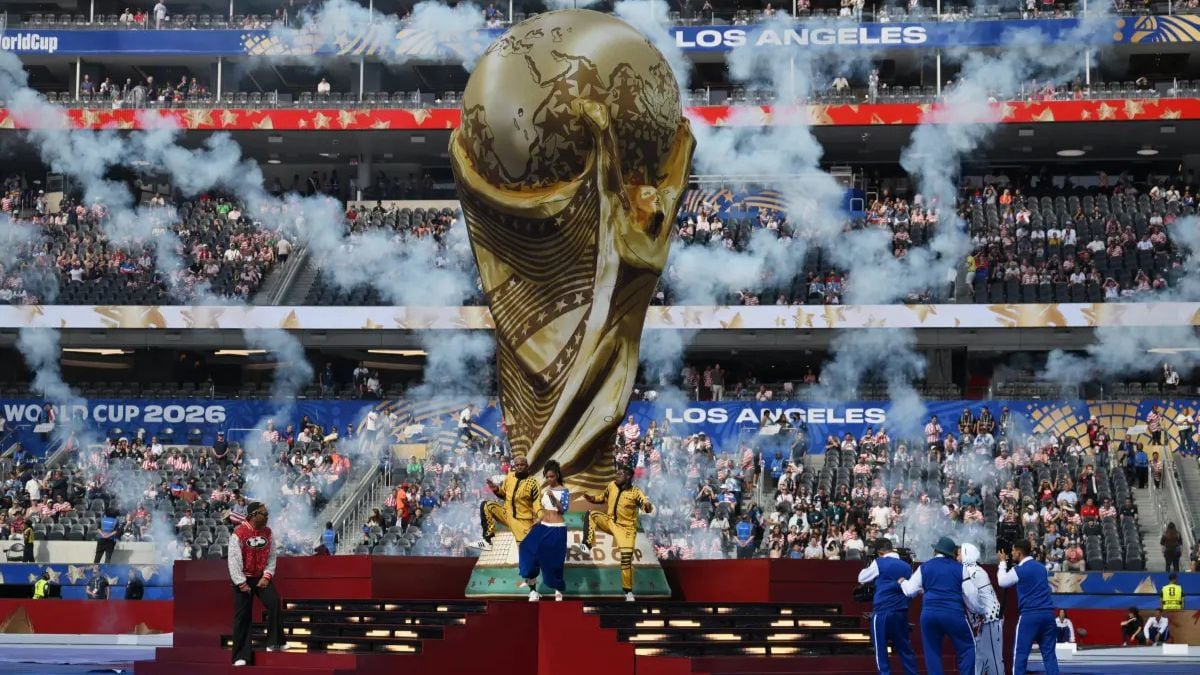
Football is called ‘the beautiful game’. It is simple and exciting. It is the sport of the working class. It remains one of the greatest cultural phenomena in the world, traversing cultures, languages, and geography. It is, loudly and proudly, the people’s game.
Well, it was. Maybe a dissonance is growing.
The 2026 World Cup will be the largest, extended to 48 teams, in the 96-year history of the sport. It is also on the north end of the expenditure scale. As with every World Cup, the build-up has been marked by controversies, albeit perhaps less demonstrative than in recent editions.
Sure, every World Cup raises its share of issues. There were questions raised when Brazil (2014) and South Africa (2010) hosted the World Cups. The last two, held in Russia (2018) and Qatar (2022), have been marked by corruption within FIFA, as well as for the authoritarian regimes in the host countries. This one too, though painted by sections of the media with a lighter brush, reflects the ethos of the host.
If the previous editions pointed the direction of travel for the sport – used as a means to show African rise or the power and might of Russia or Qatar – this edition beams the light from the tower, beckoning it to its final destination. Welcome, you are firmly aboard the hypercapitalism and commodification in sports, fittingly held in the country that embodies it. Sure, lest we forget, the World Cup is officially co-hosted by the United States of America, Canada, and Mexico. But it feels like one country has taken all the oxygen, thanks to the latter stages of the tournament being held in the US, as well as FIFA president Gianni Infantino's repeated house calls, statements, and photo ops with US President Donald Trump. And as such, the US will determine the direction of travel for this tournament.
Aside from the game going in the direction of "bigger is better", this World Cup is perhaps the most politically charged one in recent decades. The advertised 'most inclusive World Cup' is best ignored. How democratic is democracy? How affordable is the beautiful game?
Football is increasingly about posturing – a millionaire's plaything, a venture capital investment, a branding exercise for nation-states. The money flowing through the game is staggering.
Football has long been breaking away from its roots of community clubs and neighbourhood teams. The past year has seen several fan groups in Europe, particularly in England, protesting against increased ticket prices as well as complications enforced on season tickets. Propped up by mouth-watering broadcast revenues, it is becoming increasingly clear that the owners are looking at football matches as tourist attractions, preferring to sell tickets to those who are willing to pay over the odds to watch what could be a once-in-a-lifetime event. The point that it is the atmosphere and the fan culture that has made the product so lucrative in the first place seems to be lost, or probably ignored.
It is in this climate that we see FIFA implement a dynamic pricing system, complete with surge pricing. The tickets are orders of magnitude more expensive; a single World Cup final ticket can cost upwards of $10,000 dollars. An equivalent ticket cost around $1,600 four years ago. Not to mention the resale market created by FIFA, where they extract a 15 per cent commission from buyer and seller on transactions. All this without accounting for the ramped-up prices in travel, accommodation, and parking, among others.
Even the expanded World Cup, 48 teams instead of 32, was done to provide more matches and thus more revenue. The tournament expansion is not a first in its history, but it also reflects the overt money-mindedness of the powers that be. This fact is reflected in other sporting events as well as music concerts, i.e., events of social and emotional value. Interestingly, even the European Championships and UEFA Champions League have all changed formats to accommodate more matches, while the Club World Cup was expanded by FIFA into a larger tournament. It could be argued that the World Cup is FIFA’s biggest cash cow, and maximising profit is paramount in the governing body's ability to help promote the game in lesser and fringe footballing nations.
That being said, the impact on the quality of football during the group stages at the World Cup remains to be seen, especially since the jeopardy of getting eliminated has been reduced, particularly for the bigger nations.
Then comes the politics of it all. The US does cast a long shadow on the world. The country that is central to the world clearly takes centre stage for the tournament. And at the eye of the storm is President Trump, installed as such by FIFA's primer through a highly curated and visible political alliance that included a newly-crafted FIFA Peace Prize that was given to the US president. That the symbolic gesture came on the back of Trump's public attempts to win the Nobel Peace Prize is not lost on anyone. Perhaps, when the build-up to the World Cup started following the curtains in Qatar, Infantino could not have predicted where the world would be in four years.
The host country is at war with one of the participant nations. There is the shadow of ICE agents being present at the World Cup, as immigration remains a central issue in American politics. Ironic, in that football would not occupy the exalted status it holds in the world today had it not been for migration.
Fans from Iran and Haiti are banned from entering the country, while those from several other countries face partial restrictions. Some competing nations have visa bond requirements, which has been called economic exclusion under the guise of security. Iran is facing a farcical notion of having to travel in and out of the US for their group stage fixtures. Every day, news trickles down of teams, fans, and even officials (read pioneering Somalian referee Omar Abdulkadir Artan) facing issues getting into the country. Over the past two editions, FIFA has managed to navigate its way through visa and entry requirements; it seems like their luck does not extend to a third.
Over the years, the World Cup has created a space for itself as a celebration of cultures and sporting nationalism. And once the ball rolls, all the failings and shortcomings of the host nations are forgotten, if not forgiven. Considering the social and political climate of the world and the central role the US plays within it, perhaps this time it might be different. Perhaps it is fitting, after all, that the world's sport should reflect the world: the sporting spirit, camaraderie, and cultural exchange should be on focus as much as the geopolitics and a populous event moving from a mass festival to a premium experience for the global elite.
The opinions expressed in this article are those of the author and do not purport to reflect the opinions or views of THE WEEK.
