



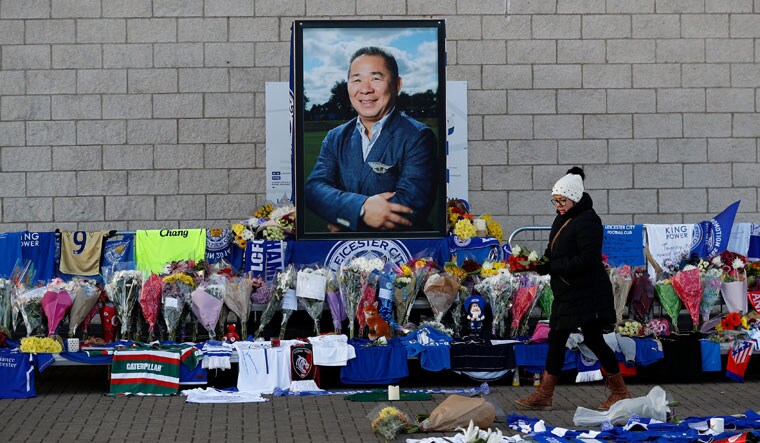
Leicester City's Thai billionaire owner Vichai Srivaddhanaprabha was among five people who were killed in a helicopter crash on Sunday. Vichai's helicopter crashed and burst into flames in the Premier League side's football stadium car park.
The helicopter is said to have developed a mechanical problem in its rear propeller shortly after take off from the pitch.
“The world has lost a great man,” the Premier League club said in a statement. “Leicester City was a family under his leadership. It is as a family that we will grieve his passing and maintain the pursuit of a vision for the club that is now his legacy.”
“Everyone at the Club has been truly touched by the remarkable response of the football family, whose thoughtful messages of support and solidarity have been deeply appreciated at this difficult time,” the statement said.
Fans had laid out flowers and club scarves among other things as tribute to 60-year-old Vichai, who would attend home matches regularly. They credit him for Leicester City's extraordinary run and eventual Premier League title victory in 2016.
Vichai and four others, namely Nursara Suknamai, Kaveporn Punpare, Eric Swaffer and Izabela Roza Lechiwcz, had boarded the helicopter which took off from the pitch after Leicester City's match against West Ham that ended in a 1-1 draw.
Shortly after take off, the helicopter crashed in the car parking area and burst into flames.
Vichai bought Leicester City in 2010 and pumped in millions into the team which eventually helped the club return to the English Premier League from the second-tier Championship in 2014. He became a beloved figure in the club and the city.
Premier League matches on Sunday were preceded by a minute's silence in Vichai's remembrance. Leicester City also postponed its EFL Cup fixture against Southampton.
(With inputs from agencies)
