


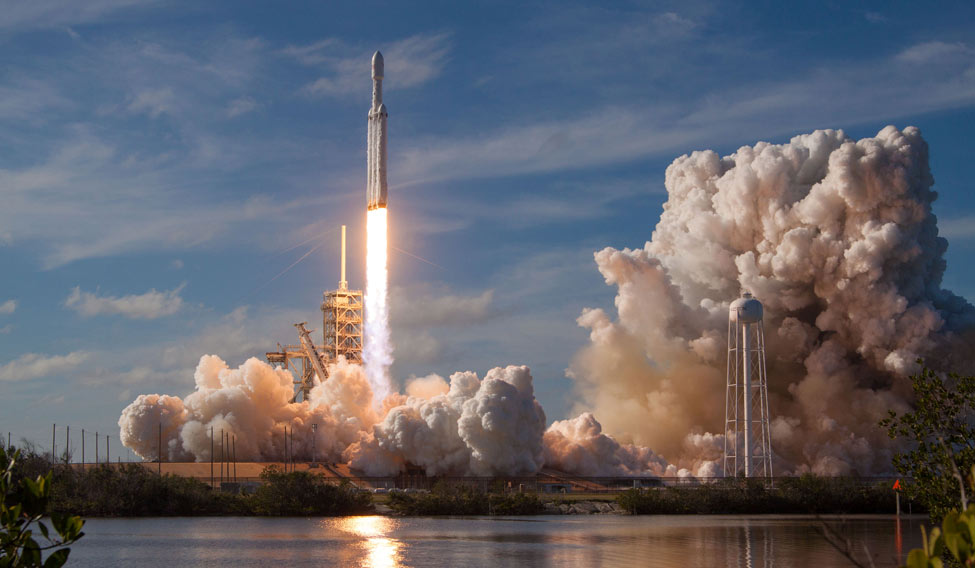
The world’s most powerful rocket, SpaceX’s Falcon Heavy, roared into space through clear blue skies in its debut test flight on Tuesday from a Florida launch site where moon missions once began, in another milestone for billionaire entrepreneur Elon Musk’s private rocket service.
The 23-story-tall jumbo rocket, carrying a cherry red Tesla Roadster from the assembly line of Musk’s electric car company as a mock payload, thundered off its launchpad in billowing clouds of steam and rocket exhaust at 3:45 p.m from the Kennedy Space Center in Cape Canaveral.
Boisterous cheering could be heard from SpaceX workers at the company’s headquarters in Hawthorne, California, where a livestream feed of the event originated. At least 2,000 spectators cheered the blastoff from a campground near Cocoa Beach, 5 miles (8 km) from the space center.
Within three minutes, the Falcon Heavy’s two side boosters separated from the central rocket in one of the most critical points of the flight.
Then, capitalising on cost-cutting reusable rocket technology pioneered by SpaceX, the two boosters flew themselves back to Earth for safe simultaneous touchdowns on twin landing pads at Cape Canaveral Air Force Station, about eight minutes after launch. Each rocket unleashed a double sonic boom as it neared the landing zone.
The center booster rocket, which SpaceX had predicted was less likely to be salvaged, slammed into the Atlantic at about 300 miles per hour (483 kph), destroying two of its thrusters and showering the deck of the nearby drone landing vessel, Musk told a post-launch news conference.
Still, the Silicon Valley mogul known for self-deprecating understatement hailed the launch as a victory and “a big relief.”
“I had this image of this giant explosion on the pad, with wheels bouncing down the road and the logo landing somewhere with a thud. But fortunately, that’s not what happened,” he said. “Crazy things come true.”
While the Falcon Heavy’s initial performance appeared, by all accounts, to have been near flawless, it remained to be seen whether the upper stage of the vehicle and its payload would survive a six-hour “cruise” phase to high Earth orbit through the planet’s radiation belts.
The launch, so powerful that it shook the walls of the press trailer at the complex, was conducted from the same site used by NASA’s towering Saturn 5 rockets to carry Apollo missions to the moon more than 40 years ago. SpaceX has said it aspires to send missions to Mars in the coming years.