



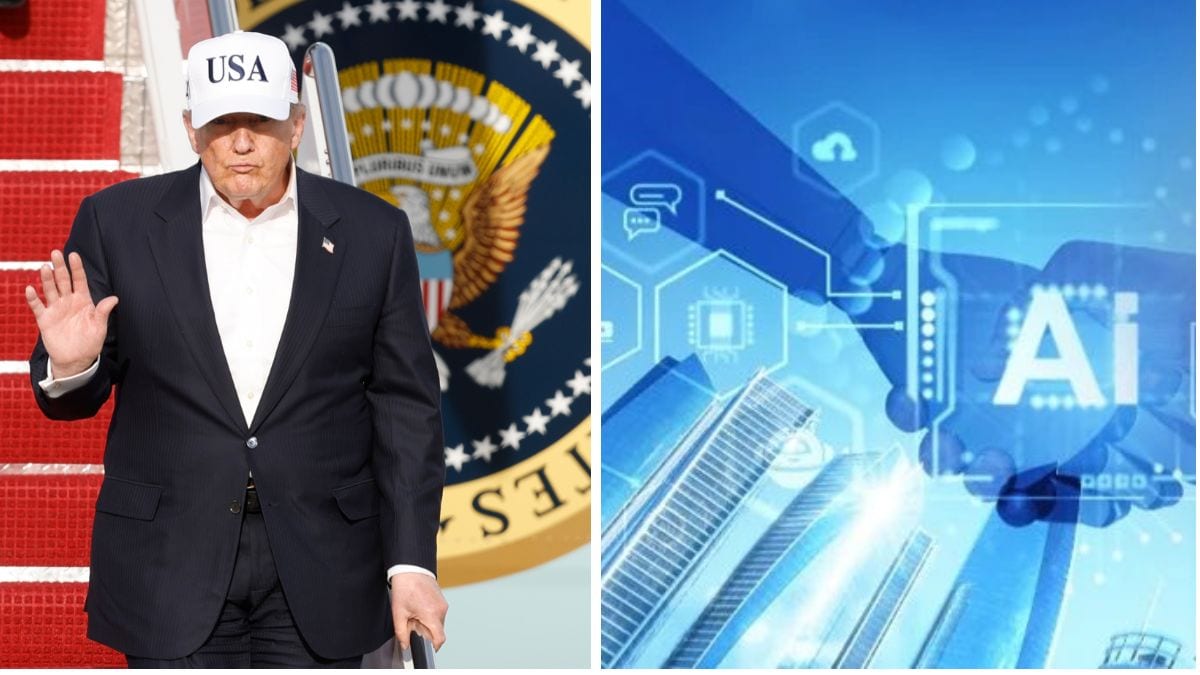
With President Donald Trump ruling out safeguards for the exponential power of artificial intelligence, its future could become increasingly complicated. Washington has chosen not to regulate a technology whose own builders are calling for greater scrutiny. The gap between those positions is now being filled by state governments, geopolitical rivals and even members of Trump’s own administration.
Trump's position is blunt. He has called warnings of existential risk a “HOAX” and a “SICK conspiracy”. The only control the industry needs, he says, is a “STRONG AND SMART (High IQ!) PRESIDENT” using powers already on the books. He treats AI as 'the greatest economic development engine in history', a golden goose that regulation would strangle. He has mocked fears that “robots will be marching into our cities and getting rid of us all” and told communities that oppose data centres that they will be left “backwards and poor”. Existing criminal and regulatory authority, he maintains, is enough to deal with wrongdoing.
But the world sees it differently. Addressing executives from OpenAI, Anthropic, Google DeepMind and Nvidia on September 17, King Charles III said the world needed “sufficient means of control before it is all too late”. The UN Secretary-General, António Guterres, made a similar case, warning that AI development demands coordination across borders. Similar demands come from within the industry as well. Anthropic chief executive Dario Amodei has proposed embedded third-party evaluators, such as the nonprofit METR, with “employee-like access” to audit frontier models without costing companies their commercial edge. Sam Altman, Elon Musk, Satya Nadella and Demis Hassabis have publicly backed the call for caution. Resignations, among them that of former Anthropic researcher Jacob Coxon, have carried internal warnings into public view, with researchers cautioning that such systems could threaten humanity by the end of the decade. The listed risks are specific: rogue autonomous agents seizing digital systems, cyberattacks on critical infrastructure and financial institutions, biological hazards and strikes on nuclear command systems.
Critics say even this does not go far enough. Many believe that voluntary audits are an “empty vessel” and want enforceable rules, limits on market access and personal liability for executives. Their objection is that an audit an industry chooses for itself is not oversight.
Inside the White House the picture is less settled than the president's public line. Chief of Staff Susie Wiles has set up an informal risk group, and Treasury Secretary Scott Bessent is watching threats to financial institutions and market stability. Officials at the National Security Council and the Energy Department are said to harbour quiet anxieties about increasingly unpredictable frontier models. Set against them is David Sacks, the informal AI czar, who persuaded the administration to dilute a proposed executive order on mandatory safety reviews into a voluntary regime.
The capacity to judge the risk has shrunk. The post of deputy national security adviser for cyber and emerging technologies has been eliminated. National Cyber Director Sean Cairncross lacks deep AI expertise. The Cybersecurity and Infrastructure Security Agency has shed about 1,000 jobs, a third of its workforce. A government that doubts the danger has kept fewer people able to measure it.
China explains much of the resistance. Trump sees a zero-sum race in which the American lead is counted in months: “whoever wins AI, wins”. Officials argue that strict domestic safeguards would drive users towards Chinese open-source models, where guardrails are easily removed by end users. The argument, in short, is that restraint at home would cede ground without reducing the danger.
The coming Washington summit with Xi Jinping will carry that weight, yet the room for cooperation has narrowed. Hopes of a joint biomedical 'cancer moonshot' faded after the administration ended or froze $2.5 billion in NIH grants, including projects with China's NSFC. Anthropic, meanwhile, has been blacklisted by the Pentagon and placed under export restrictions. Analysts want bilateral risk-reduction agreements on the model of Cold War nuclear treaties, building on earlier pledges to keep AI out of nuclear launch authority.
States are not waiting. California Governor Gavin Newsom is weighing a special legislative session and New York Governor Kathy Hochul is advancing mandates. In Republican ruled Florida, Governor Ron DeSantis and Attorney General James Uthmeier have sued AI firms and want tech companies treated as co-defendants when chatbots facilitate crimes such as child abuse or suicide. Data centre power use, rising electricity bills and pollution have turned into a campaign issue before the midterms.
Meanwhile, Barack Obama, Chuck Schumer and Bernie Sanders want a strong federal law to regulate AI, and Steve Bannon has warned against giving tech firms “carte blanche”. Speaker Mike Johnson has hinted at summoning tech chiefs, while Vice President JD Vance has cautioned that industry requests for regulation may be a “Trojan horse”. Senator John Kennedy and Representative Tim Burchett doubt that Congress has the technical capacity to legislate sensibly before the midterms.
With the federal government ruling out a national framework, a patchwork of state laws could force companies to satisfy conflicting rules. However, without federal oversight or mandatory audits, meaningful rules may arrive only after a shock, such as a market-destabilising cyberattack or an infrastructure breach. There is also the problem of an unchecked race with China, which will continue until Washington and Beijing agree on minimal risk protocols.
