



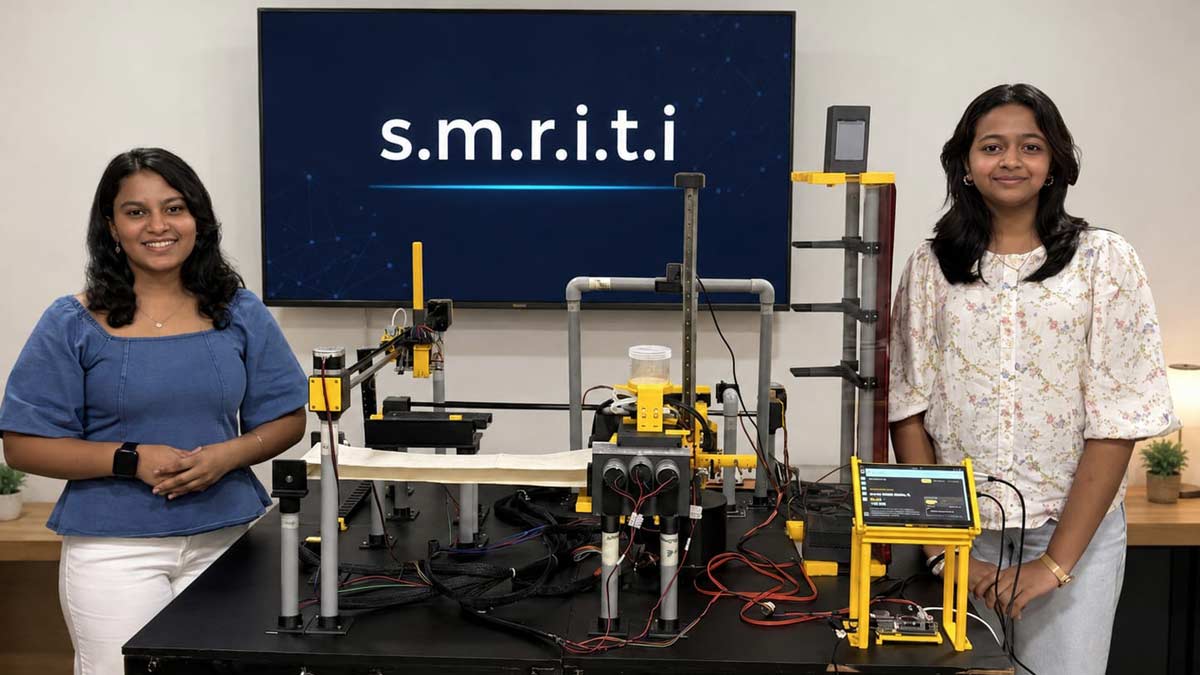
For ages, knowledge has been passed on through palm leaf manuscripts in our country. However, the very material that strives to preserve knowledge and heritage also becomes its greatest vulnerability. The delicate palm leaves deteriorate as they age, and so, preserving them is a largely human-led, painstaking process.
Cathlin Marie Jeesan and Navika D. Nair from Kerala, however, have come up with an innovative solution to this problem by using robotics and artificial intelligence. The two 14-year-olds designed Smriti (Smart Manuscript Restoration through Intelligent Technology for Inscriptions) 1.0 – an automated system designed to preserve and digitise the manuscripts. Cathlin explained that ‘Smriti’ means memory in Sanskrit, reflecting the project’s larger aim, which is to preserve knowledge that might otherwise disappear.
The project won them (Team UWR CNRGY) the first place in Future Innovators - Senior category at the World Robot Olympiad, or WRO India Nationals, held in Hyderabad from August 26 to August 28. They will represent India at the WRO Internationals in Puerto Rico in December.
Cathlin had came third at the WRO International 2024 held in Turkey, alongwith her sister Clare Rose Jeesan.
Cathlin, a ninth-grade student at Holy Grace Academy in Mala, focuses on innovation, robotics and writing. Navika, on the other hand, specialises in design, hardware architecture and research, and studies in class 9 at Naipunnya Public School in Kochi. The two met while in class 8, and their shared interest in robotics made them team up for competitions.
Smriti 1.0: The origin
The seeds of this project were sown by a name many might not have heard – Madhava of Sangamagrama. Cathlin and Navika discovered that the Indian mathematician and astronomer from Kerala recorded his teachings on palm leaves, but they were inaccessible because of the old Malayalam script used or the leaves' fragile nature.

Benson Thomas, whose organisation Unique World Robotics (UWR) mentors the students, says the project took shape from the realisation that palm leaves hold far more than the commonly assumed material.
“It is not just horoscopes that are being written on palm leaves,” he says. “If you look at the history of Kerala, Madhava of Sangamagrama has his mathematical knowledge recorded in palm leaves.”
The girls’ research brought them to the Manuscript Research and Presentation Centre in Irinjalakuda, where they learnt more about the painstaking work involved in preserving such material. According to their coach Akhila R. Gomez, the visit helped them understand that the problem was not simply about scanning an old document.
The students studied how the manuscripts were cleaned, treated and dried before thinking about how each step could be recreated through robotics. Their first instinct was to explore soft robotics, which could potentially handle the leaves gently. But the cost made that impractical for a prototype.
“So, we asked them to come up with another idea,” Akhila says. The result? Smriti 1.0.
How does Smriti 1.0 work?
The system uses a suction-based mechanism to carefully move a manuscript onto a conveyor. Rollers remove dust before applying lemongrass oil, which helps protect the leaf from microbial damage and insects while making the text clearer. A robotic arm then transfers it to a microclimate-controlled drying chamber, where temperature and humidity are monitored continuously.
After drying, the manuscript reaches the AI scanning station. A camera captures the inscription, while the Optical Character Recognition (OCR) technology extracts the writing and convert it into digital text.
For Navika, one of the biggest challenges was ensuring that the technology did not harm the manuscripts it was designed to save. “We had to make sure that the manuscript did not get damaged because of our system, and that the text does not fade away, nor do the leaves become more brittle.”
The project also pushed Cathlin and Navika to address the difficulty of reading ancient Malayalam scripts. “We faced problems in the OCR reading because palm leaf manuscripts contained the old script,” said Cathlin, who handled the language and translation component. Navika worked on the AI OCR training.
Their aim now is to make the system more accurate. Currently, the prototype can handle only a limited manuscript size, and the OCR requires further training. Before heading to Puerto Rico, they hope to develop a system that can accept manuscripts of different sizes, improve OCR accuracy, and make the drying chamber capable of handling multiple leaves in a single run.
“Beyond winning gold on the international stage, our goal is to inspire more students to leverage technology and step forward with meaningful innovations that will benefit society,” they said.
