



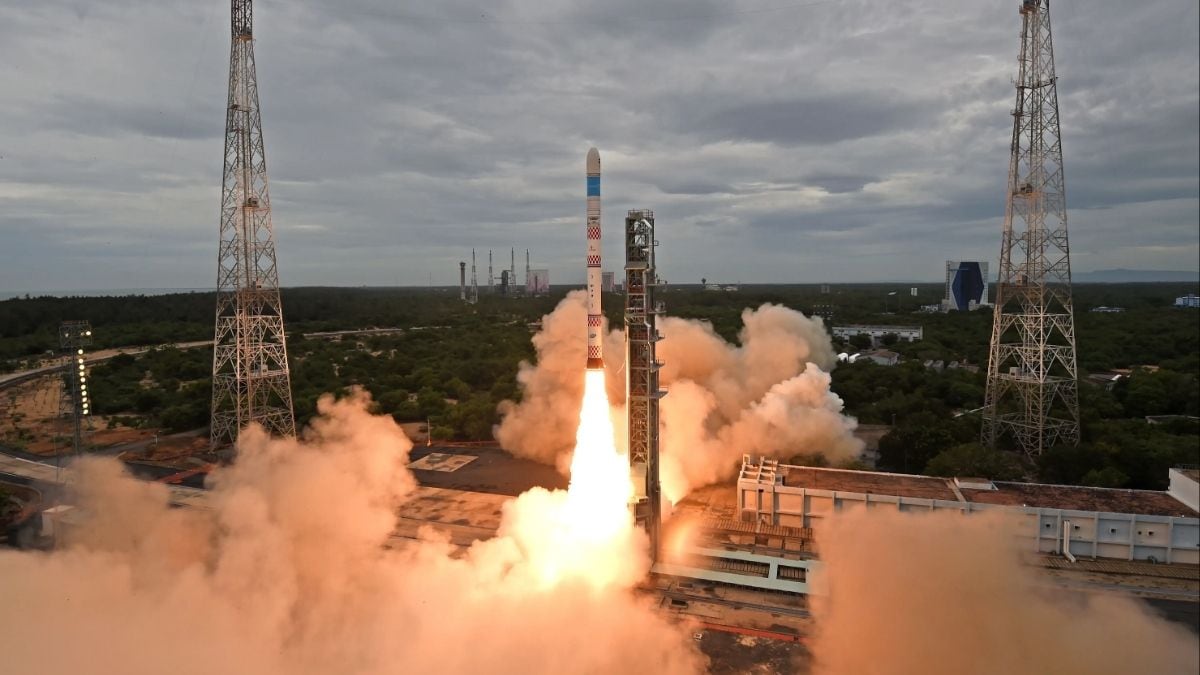
India's smallest rocket has just received a bigger heart. Recently, the Indian Space Research Organisation (ISRO) successfully completed a ground test of an improved solid booster stage named SS1, which forms the first stage of the Small Satellite Launch Vehicle (SSLV). The test was carried out at the static testing facility of the Satish Dhawan Space Centre in Sriharikota.
A static test simply means the motor is fixed firmly on the ground and fired without going anywhere. The rocket stage is clamped tightly, ignited, and allowed to burn fully while engineers watch every second of it.
“Such testing matters especially for solid rockets, because once a solid motor is lit, it cannot be switched off, slowed down or restarted. It burns until the fuel is finished. So everything must be verified beforehand, and it is far safer and cheaper to find a weakness on the ground than fifty kilometres above the sea,” explained space analyst Girish Linganna.
So what exactly was improved in SSLV? The first change is in the fuel. Solid propellant is packed inside the motor like a thick candle and burns from the inside out.
By altering the shape of this fuel block, known as the grain, engineers can control how much surface catches fire at any moment, and therefore how fast it burns.
In the new design, the fuel in two sections of the motor burns at a faster rate, pushing gases out more quickly and producing the required thrust more efficiently.
The second improvement is in the thermal protection system. When solid fuel burns, temperatures inside climb to a level that can easily damage metal.
The inner walls are therefore lined with heat-resistant material, rather like an insulated flask protecting your hand from hot tea. ISRO has strengthened this lining so the casing stays safe under the fierce heat of burning.
The third change is in the nozzle, the bell-shaped opening at the bottom through which hot gases rush out to create thrust. The new nozzle design is simpler, making it easier to manufacture in large numbers, and it is also lighter.
Weight matters enormously in rocketry. Every kilogram of rocket body lifted upward is a kilogram that could have been a satellite instead. A lighter booster therefore directly improves the rocket's efficiency.
During the firing, the motor was watched by a large network of sensors that recorded more than 600 different parameters. These instruments measured how smoothly the motor ignited, how the fuel burned and produced thrust, how strongly the structure held together, how much heat it faced, how much it vibrated and shook, and how much sound and pressure it generated.
Think of it as a very detailed full-body health check-up conducted while the rocket is under maximum stress.
The results were encouraging. The motor behaved almost exactly as ISRO's calculations had predicted, which means the design changes work as intended. The benefit is direct and measurable: with the improved SS1 stage, the SSLV is expected to carry roughly 100kg of additional payload to Low Earth Orbit, the region of space relatively close to Earth where most small satellites operate.
"The SSLV is a compact rocket built by ISRO mainly to carry small satellites. It is a smaller, quicker and more economical option for occasions when a satellite simply does not need a giant rocket. The SSLV stands about 34 metres tall, is around 2 metres wide, and weighs roughly 120 tonnes at lift-off. It can place up to 500 kg into a 500-km Low Earth Orbit," added Linganna.
The rocket climbs using three solid-fuel stages, one firing after the other. At the very top sits a liquid-fuelled Velocity Trimming Module, or VTM. Since solid stages cannot be throttled or stopped midway, they deliver a strong but slightly imprecise push. The VTM, being liquid-fuelled, can be controlled and shut off as needed, so it performs the delicate final adjustment that settles the satellite into its exact orbit instead of letting it drift off target.
"Speed of preparation is where SSLV truly stands apart. Big rockets often need several weeks of assembly and checks before launch. The SSLV has been designed to be put together and made ready in less than a week, and it needs much less launch infrastructure. This makes launch-on-demand a realistic promise rather than a slogan," pointed out Linganna.
Its journey has not been without difficulty. The first flight in 2022 ran into problems, but SSLV-D2 succeeded in 2023, and SSLV-D3 succeeded in 2024, completing the development programme.
ISRO has also begun transferring SSLV technology to Indian companies so they can build the rocket themselves. The idea is to produce SSLVs in large numbers and offer dependable launch services to the fast-growing small-satellite market. This latest ground test brings that goal a firm step closer.
