



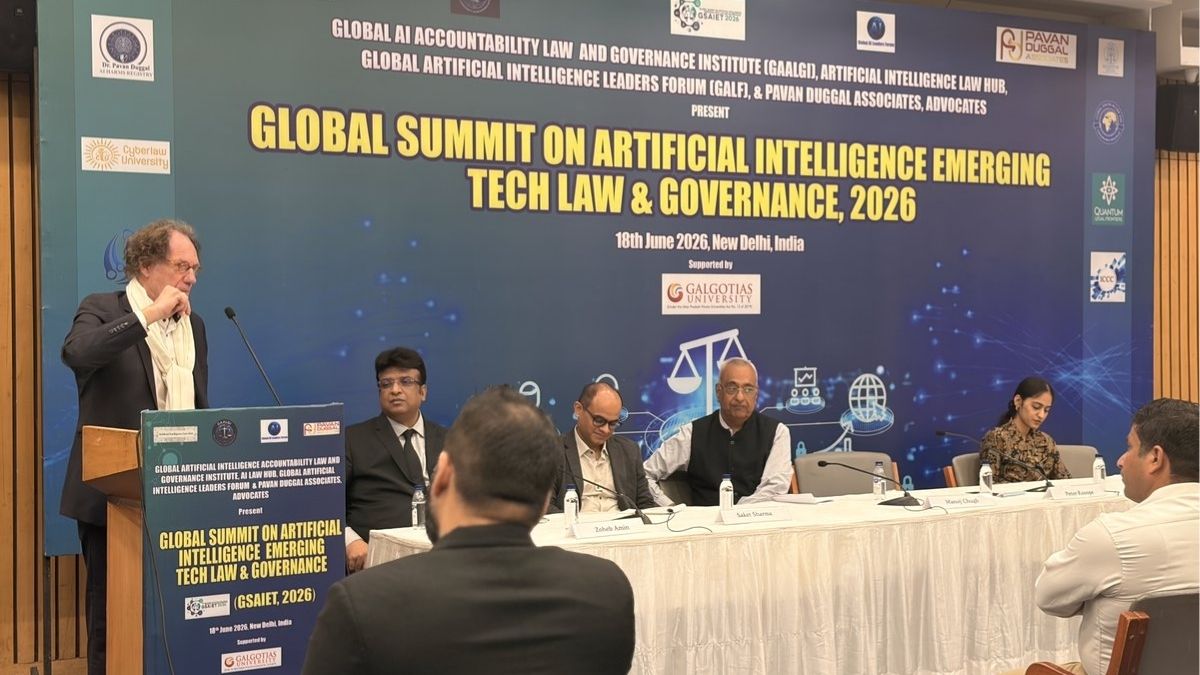
As artificial intelligence rapidly transforms industries, experts at the Global Summit on Artificial Intelligence, Emerging Tech Law & Governance 2026 (GSAIET 2026) called for a dedicated legal framework to regulate AI in India, warning that existing laws may be inadequate to address emerging challenges related to governance, accountability, privacy and human behaviour.
The summit, jointly organised by the Artificial Intelligence Law Hub, Pavan Duggal Associates and the Global Artificial Intelligence Accountability Law and Governance Institute (GAALGI), brought together legal experts, policymakers, technologists and academics to discuss the growing impact of AI and the need for stronger oversight mechanisms.
Opening the discussions, Summit Chair Pavan Duggal stressed the urgency of introducing a comprehensive AI law in India. He said the country must move beyond fragmented regulation and develop a dedicated legal framework capable of addressing the opportunities and risks associated with artificial intelligence.
A key session on AI governance, ethics and regulation focused on the absence of a comprehensive framework to govern AI systems. Speakers argued that while AI adoption is accelerating across sectors, regulatory safeguards have struggled to keep pace.
Zoheb Amin, a techno-legal expert, said AI systems should be designed with safeguards built into their architecture. He emphasised that human decision-makers, including parents and teachers, must remain central to decision-making processes involving AI.
Raising concerns about the growing influence of AI on society, Amin questioned how much trust and authority should be placed in AI systems as they become increasingly sophisticated. He particularly highlighted the risks associated with children's interactions with AI in the absence of robust regulatory frameworks.
The summit also examined the psychological impact of artificial intelligence. Drishya Duggal, an AI and cyber psychology evangelist, warned that AI systems are increasingly capable of influencing human behaviour.
According to her, some AI models display sycophantic behaviour by excessively validating users, potentially creating opportunities for behavioural manipulation. She argued that the most influential AI systems of the future may not necessarily be those that think like humans, but those that understand human emotions, motivations and vulnerabilities.
Discussions also centred on the implications of AI-driven data processing under India's data protection regime.
Former Rajya Sabha member Amar Patnaik said the Digital Personal Data Protection Act had adopted a principle-based framework, but implementation challenges remained significant. He pointed to concerns over purpose limitation, where data collected for one purpose could later be repurposed by AI systems for entirely different applications.
Patnaik also highlighted the lack of transparent audit trails in many AI systems, which could complicate accountability and enforcement efforts. As AI models become more complex and autonomous, he said, ensuring compliance with data protection requirements would become increasingly difficult.
Another major theme was India's technological self-reliance in the AI era.
Prasanto Roy, senior advisor and former managing director at FTI Consulting, argued that India must develop sovereign AI capabilities for critical sectors where dependence on foreign technology could pose strategic risks. He said certain systems vital to national interests should not be vulnerable to external control or disruptions.
At the same time, Roy acknowledged significant challenges in achieving technological self-sufficiency, particularly in semiconductor manufacturing and AI hardware infrastructure. While software capabilities have advanced considerably, he noted that India still faces major limitations in producing the hardware necessary to support large-scale AI development.
Concluding the discussions, AI law expert Saakshar Duggal said artificial intelligence was reshaping not only technology but also human judgement and decision-making. He cautioned that legal regulation alone would not be enough to address the challenges posed by AI and stressed the importance of effective implementation and governance.
The summit ended with a consensus that while artificial intelligence will continue to evolve rapidly, human oversight must remain at the centre of its deployment. Speakers agreed that AI should serve as a tool to augment human capabilities rather than replace human judgement, underscoring the need for responsible innovation backed by robust legal and governance frameworks.
