



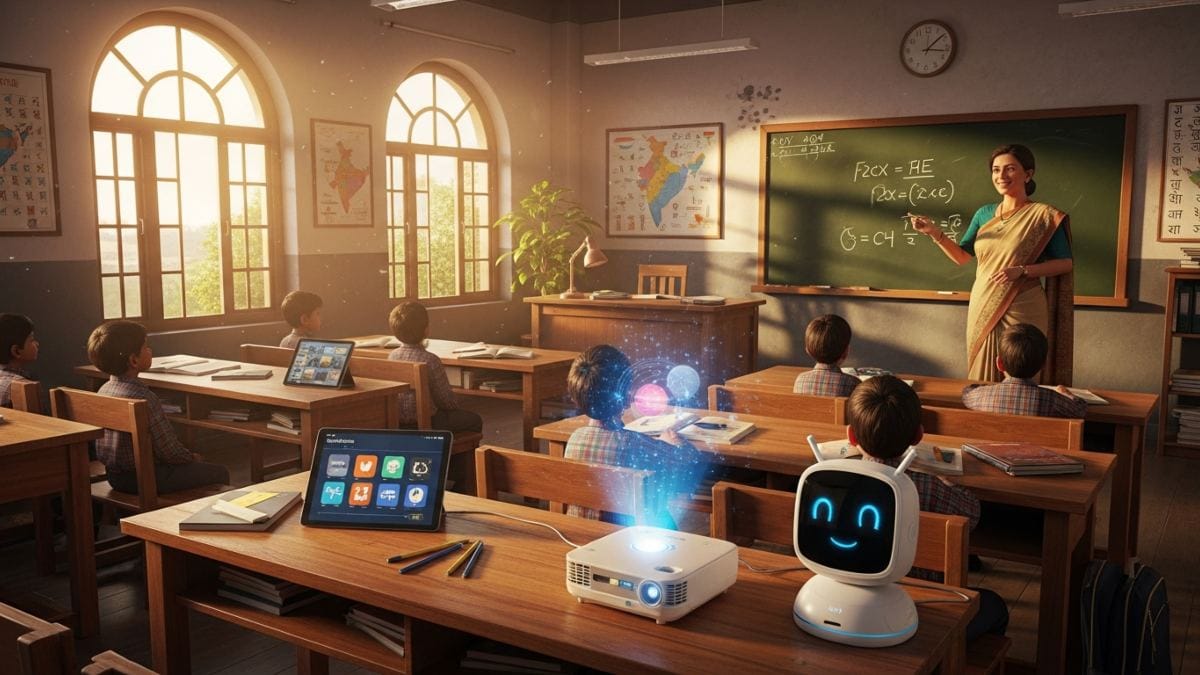
Wisdom, gained through the pursuit of knowledge, is the confluence of memory, concentration, and intelligence. Education and the degrees it bestows illuminate the path toward that pursuit. Throughout this journey, technology and innovation have always been beacons of progress, while those who carry these beacons have even greater stories of leadership to tell and examples for others to follow. This story is aptly illustrated through the following anecdotes from the field of education.
Brilliance to breakthrough
John McCarthy and his contemporaries very carefully positioned AI in education as a philosophy and thought vertical. Its role was not to replace thinkers, but to give them a fast track moving from content generation to agentic research, while humans retained the work of judgement, critical thinking, verification, and validation. While algorithms, pattern recognition, and optimisation prove their credibility, it takes real leadership to decide how to use their outcomes and balance competing values in full responsibility. As AI grew from being a thought to a full-fledged educational vertical, it has always been carefully refined, every time its offshoots crossed borders. In its current form, it is the most sought-after “interdisciplinary” stream, absorbing almost every core stream that has tried and tested AI in any form. This has led to many narratives of brilliance to breakthrough, led by human mentors with AI technological accelerators cutting across sectors of economic relevance in nation-building.
Protected collaborations while staying human
To turn capabilities into impact, natural intelligence and the human touch are a must. In moments of crisis, AI as a technology will deliver nonetheless, while a touch of mindfulness shall go a long way as a game-changer. Provocative leadership and protected partnerships overshadow the success of technologies in crisis management. Education imparts technical wisdom, while human mentoring adds emotional intelligence. The lived experience of human leaders serves as the ground truth for many groundbreaking ideas that stand the test of time through technological brilliance. AI has come a long way in scaling education and automating larger educational systems. The arterial line that connects such systems is still reflection, goal setting, inspiration, and the life directions of its visionary leaders.
Responsibility over equity
AI has undoubtedly enhanced the responsiveness of the student community across age groups, due to its language and translational abilities. With improved speed and convenience, multilingual and differently abled individuals can adaptively upskill themselves for better social dwelling. While we marvel at the equality of opportunity within a region, responsible intervention from thought leaders and policymakers is quintessential to prevent the deepening of AI-based educational and intellectual inequality on a global scale. As the need for infrastructure and technical manpower to enable AI-powered educational systems is scaling, policymaking and normalisation are the need of the hour.
Social systems and social beings
Classrooms and educational frameworks are essential mechanisms for enabling social connections in humans. As we move from the secure network of families to the social network of friends, peers, and mentors, the educational system is expected to build values of empathy, social connection, and engagement over years of technical and professional training. As AI empowers education with automation and normalises shortcuts, it also performs cognitive tasks that can weaken the practice of deep thinking and articulation. Stuck at the top of the thought pyramid, learners may become restricted to generalised thinking. Human-in-the-loop, higher-order learning and the definition of clear boundaries for AI’s adoption as a co-pilot shall help reinstate the valued status of educational systems as social systems.
While brute force can make AI adaptations work, trust alone can ensure its long-term acceptance and sustenance in a system, and trust is human-driven. As classrooms evolve into hybrid environments, AI shall handle routine tasks through automation, while teachers and mentors can focus on higher-order, value-based learning and human development. Mentoring shall evolve as the centre-dogma, rooted deeply in trust, fairness, and privacy. Trust is more ethical and relational in nature, while AI implements the same in a technical and mechanical sense on the ground. Trust works its way through design, governance, and transparency, while AI experiments with the same in data handling using trial and error and scales its way up. Reliability and confidence are the expressive forms of trust, while AI works its way through the results from the information system it processes.
As possessors of reason, we shall continue to evolve. Centuries ahead, we shall still be in the race to reshape the planet with new innovations and technologies, questioning everything that we have mastered in the past. Newer models of education shall empower us with the wisdom of a new apotheosis, replacing the current ones. Nonetheless, purpose and responsibility shall remain with us humans forever.
(The author is Associate Professor, Department of Computer Science and Engineering, Shiv Nadar University, Chennai.)
(The opinions expressed in this article are those of the author and do not purport to reflect the opinions or views of THE WEEK.)
