



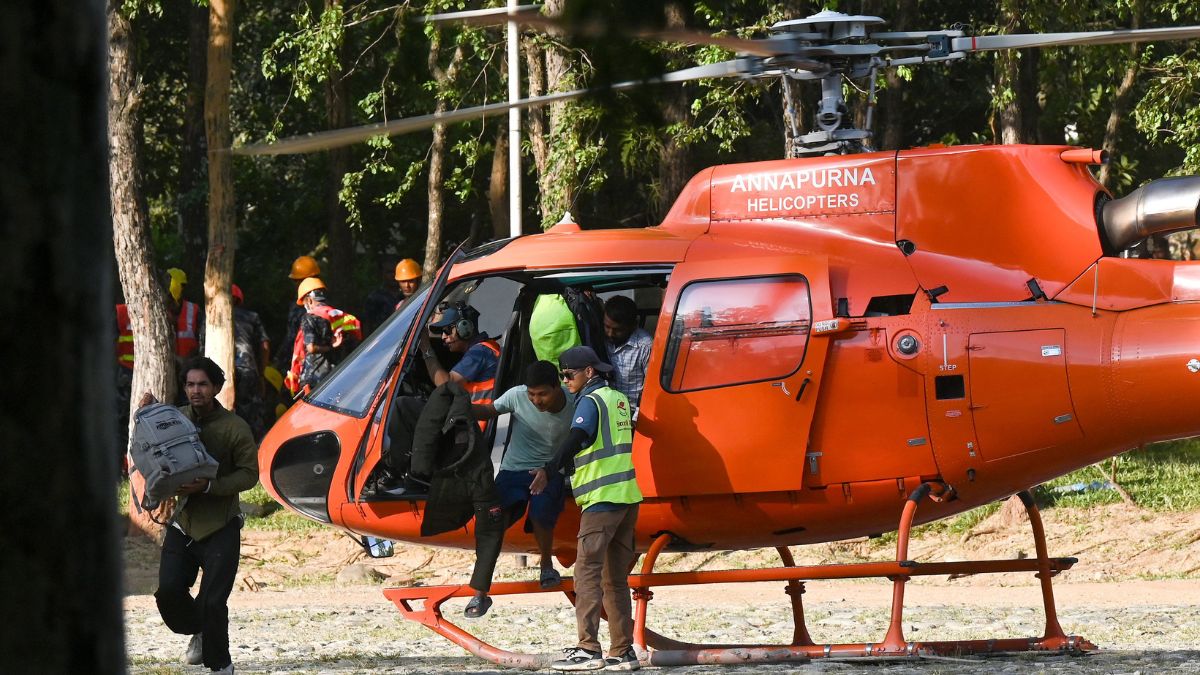
Nepal PM Balen Shah on Thursday revealed that security forces rescued 573 people by air while additional helicopters are on standby.
At least 13,295 security personnel have been mobilised for search and rescue operations, including 7,250 from the Nepal Police, 4,200 from the Nepal Army and 1,845 from the Armed Police Force.
Security personnel are relocating stranded people in Rasuwa, Nuwakot and Dhading to safer places with temporary accommodation arranged in schools and public buildings for immediate settlement of 3,500 people.
At least 10 trucks of relief materials, including noodles, biscuits, sleeping bags, mattresses and blankets have already been sent while more provisions are transported to the affected areas by helicopter.
Is global warming to blame for glacial collapse?
On Wednesday, a huge chunk of a glacier that temporarily dammed the Bhotekoshi river in Tibet broke off, leading to a massive and deadly flash flood that wreaked havoc in Nepal, reveals a preliminary investigation by scientists.
While it was initially feared to be an earthquake-triggered avalanche, the US Geological Survey later reported that a 5.2 magnitude glacier collapse resulted in massive debris surging downstream and causing the flood. A large volume of ice and rock debris reportedly entered the Lende Khola, a tributary of the Bhote Koshi River
The Himalayan mountains are warming considerably quicker that other parts of the world, thanks to human activities like burning coal, oil and gas. However, scientists warn against drawing conclusions to connect the latest glacial collapse to global warming.
"We have to be cautious and not draw a connection yet. However, rising temperatures are changing the Hindu Kush Himalaya region and melting glaciers," said Saswat Sanyal, a disaster risk reduction specialist at the Kathmandu-based climate research group International Centre for Integrated Mountain Development.
However, another expert suggested that climate change could have played a role. "It is related to climate change because the snow covers are reducing, the glaciers are receding, more rocky or barren areas are exposed -- they absorb more heat which makes the slopes more vulnerable," Mohd Farooq Azam, senior cryosphere specialist at ICIMOD and associate professor at the Indian Institute of Technology Indore, told PTI.
