



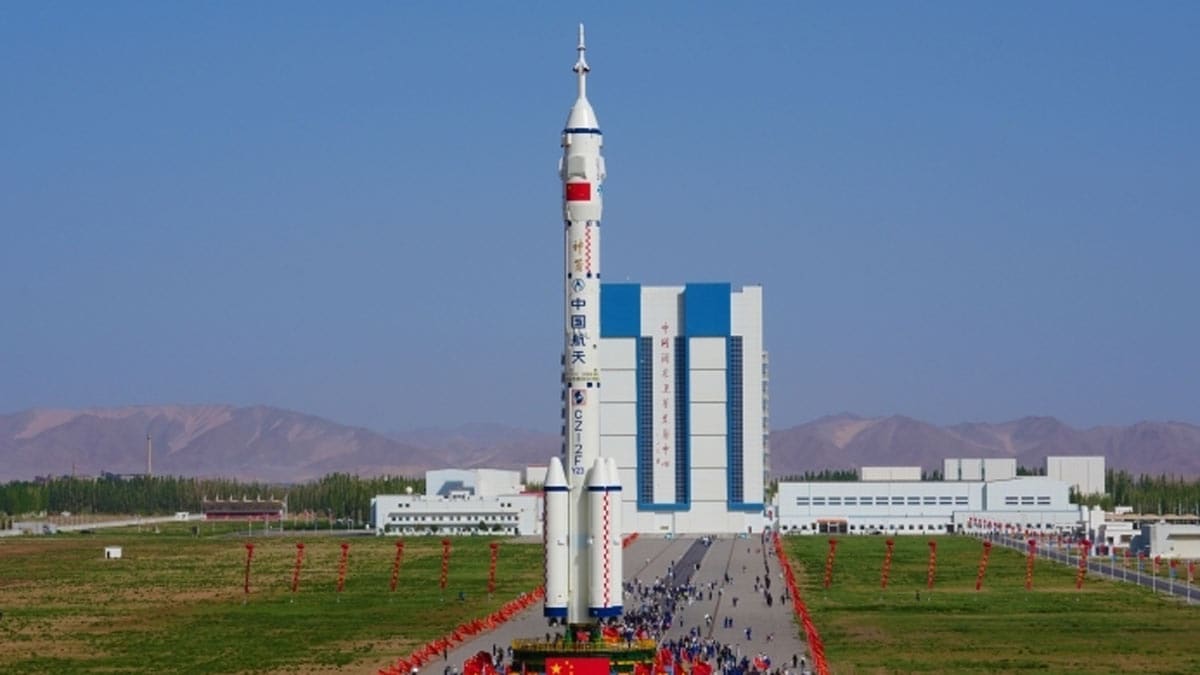
China's next crewed space mission, the Shenzhou XXIII, is set to be launched in the coming days to transport three astronauts to the Tiangong space station, according to the China Manned Space Agency. The Shenzhou XXIII spacecraft and its carrier, a Long March 2F rocket, were moved to the service tower at the Jiuquan Satellite Launch Center in northwestern China's Gobi Desert for the launch. The Shenzhou XXIII crew vessel and the rocket are expected to undergo final functional checks in the next few days before the actual launch.
Following that, the Shenzhou XXIII crew will carry out China's 17th manned spaceflight and will become the 11th group of inhabitants of Tiangong, which is currently the only operational space station independently run by a single nation. Interestingly, China's space programme runs on a fatter wallet. "Latest estimates put their yearly space spending between $12 to $18 billion, around $14.5 billion on average. This means China spends roughly 8 to 12 times more than India every single year. Some of this money is linked to defence work, so exact numbers remain hidden, but experts agree the gap is huge. This large budget allows them to launch rockets almost every week, operate a fully functional space station called Tiangong (meaning Heavenly Palace) where people live for months, and prepare to land their astronauts on the Moon before 2030," said space analyst Girish Linganna.
Because of this high spending, China has already sent 28 unique taikonauts—their word for astronauts—into space. "They send fresh teams of three every six months to Tiangong. Now they are starting their first-ever one-year stay in orbit, training the human body for future Moon and deep space trips. China also broke a world record with around 92 rocket launches in 2025 alone, sending hundreds of satellites up. Simply put, extra money buys extra speed," added Linganna.
Tiangong is currently manned by the Shenzhou XXI astronauts: mission commander Senior Colonel Zhang Lu, spaceflight engineer Major Wu Fei, and payload specialist Zhang Hongzhang—who arrived on November 1 and are scheduled to return around the end of this month.
The Shenzhou XXII spacecraft was used in an emergency response task in late November following a window damage incident on the Shenzhou XX vessel, becoming an unmanned mission.
Smaller pockets, yet sky-high pride
However, in comparison with China, although India has much lesser budgets, it has achieved much more. For 2026-27, our government has allocated ISRO and the Department of Space around Rs 13,706 crore, roughly $1.64 billion. This is just a 2 per cent rise over last year, modest but steady. The money will be used to build new rockets, weather and communication satellites, and fund our dream mission Gaganyaan, where Indian astronauts will soon fly to space for the first time. It will provide cheap DTH TV in remote villages, accurate rain forecasts that save crops, navigation assistance for fishermen and truck drivers, and eyes in the sky during floods.
Mangalyaan reached Mars on the very first attempt, on a budget smaller than some Hollywood films. Chandrayaan-3 soft-landed near the Moon's south pole, a spot no country had reached before. Aditya-L1 is now studying the Sun. Each mission quietly helps the common man: better mobile signals in the hills, farm advisories through phone apps, fishing zone alerts for coastal families, and disaster warnings that save thousands of lives every year.
