



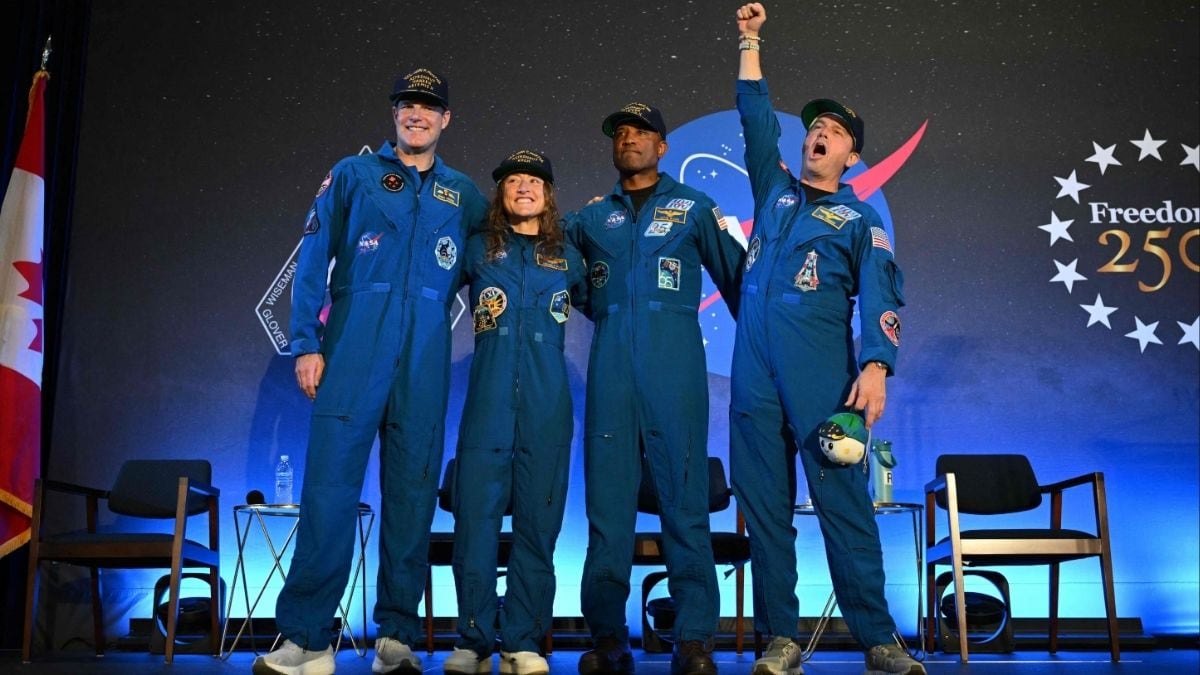
Christina Korp, the US-based astronaut manager and founder of "SPACE for a Better World," who works closely with multiple astronauts, including the second man on the moon Edwin Aldrin, knows the Artemis II crew members, including Reed Wiseman, the commander and Victor Glover. She had first met Weisman around 10 years ago at the Kennedy Space Center, when an announcement was being made about Orion and the Artemis mission. “I was there with Buzz Aldrin at the assembly building at Kennedy Space Center and they had the Orion spacecraft. I found him to be very friendly and nice. I was amazed by the great respect he showed towards Aldrin,” said Korp in an exclusive interaction with THE WEEK.
Over the last ten years, Korp kept meeting Wiseman at different events. The last time Korp met him was about a year and a half ago. “I was with astronaut Nicole Stott at the Johnson Space Centre in Houston, where she was doing a screening of her art film. Interestingly, Wiseman has always been very supportive of Stott’s Space for Art foundation, where she does space art primarily with kids in cancer hospitals. Wiseman’s wife had died of cancer, and he is very supportive of kids in the cancer hospitals.
Korp also knew astronaut Victor Glover, who was also one of the astronauts for the Artemis II mission, for about five years. Korp was planning to put together a project to honour Glover after he was announced as an Artemis II astronaut.
“I was going to do something in Los Angeles, but it didn't come together. But we have seen each other multiple times. Stott and I were in Houston and had gone to see Glover at the Johnson Space Center there. He hung out with us, where Stott had arranged for NASA to do an interview with Glover, talking about the similarities of the Artemis II mission and the Apollo missions. So he brought out a bunch of Apollo tools, like the shovels and the hammers that they had used on the surface of the moon. He was also talking about the challenges of the difference between what Apollo did post their landing on the moon and what Artemis will do. It was just really cool,” remarked Korp.
In the near future, Korp is really eager to see the Artemis II crew and ask them about their thoughts about looking at the moon as they were photographing it and what their emotions were. “I am super excited about the future of Artemis missions and the aim of having a lunar base much faster than we were before,” added Korp.
The Artemis II mission was successful with a final splashdown in the Pacific Ocean on the evening of April 10, 2026, concluding a nearly 10-day mission and marking the first human journey to the Moon in more than half a century.
NASA astronauts Reid Wiseman, Victor Glover, and Christina Koch, along with Canadian Space Agency astronaut Jeremy Hansen, were safely extracted from the Orion spacecraft, according to NASA. Following the splashdown, US Navy helicopters transported the crew to the USS John P. Murtha ship.
The astronauts went for post-mission medical evaluations before returning to shore and boarding a flight to Johnson Space Center. It was a triumphant homecoming for the four astronauts whose record-breaking lunar flyby revealed not only swaths of the moon's far side never seen before by human eyes but a total solar eclipse.
Artemis II also set a new record for the farthest distance travelled by humans in space, reaching 252,756 miles (4,06,771 km) from Earth while navigating beyond the Moon’s far side. This surpasses the previous record set by Apollo 13, which reached 248,655 miles from Earth.
Prior to the splashdown, the re-entry to the Earth was equally dramatic when the Orion capsule, the small pod where these four people have been living and working all this time, hit the Earth's atmosphere, moving at nearly 38,500 kilometres per hour faster than a bullet.

At that speed, the friction with the air created a wall of fire reaching about 2,760 degrees Celsius on the outside of the spacecraft. The return of Artemis II represented one of the most complex and high-risk phases of modern human spaceflight. While launch captured global attention, it is the return to Earth that ultimately determined the mission’s success.
This process began long before the spacecraft reached the Earth. Artemis missions follow a carefully designed free-return trajectory, allowing Orion to loop around the moon and naturally head back toward Earth using gravitational forces.
This trajectory acted as a built-in safety system, ensuring that even in the event of propulsion failure, the crew successfully returned home. After completing the lunar flyby, Orion began its approximately four-day journey back, during which engineers and astronauts conducted detailed inspections of the spacecraft, particularly the thermal protection system that faced the harshest conditions during re-entry.
Unlike the Apollo-era capsules, Orion is capable of controlled, guided re-entry. Rather than simply falling through the atmosphere, it generated a small amount of aerodynamic lift, allowing it to “fly” its descent path. This capability enabled mission controllers to precisely adjust the landing location and manage heat and g-load distribution.
During Artemis I, NASA successfully demonstrated a skip-entry technique, where the spacecraft briefly exits and re-enters the atmosphere to reduce stress.
There were concerns this time because during the first Artemis mission back in 2022, which had no astronauts on board, when the Orion spacecraft's heat shield, the protective outer layer designed to absorb all that fire, did not behave as expected. Pieces of it chipped and broke off in more than 100 places. If this had happened with people inside, it could have been catastrophic. That discovery delayed Artemis II by years while engineers worked around the clock to understand why it happened.
As a result, NASA changed the angle at which Orion comes back to Earth. Instead of gliding in gently like a paper plane, the spacecraft came in at a steeper angle, briefly bounced back upward like a skipping stone on water, and then made its final descent. This "skip re-entry" method released the trapped heat and gases slowly and steadily, instead of all at once, which reduced the stress on the heat shield and kept it from overheating.
Interestingly, what made Artemis II so significant was not that it landed on the Moon, but that it did something arguably even more important first: it validated the architecture needed to return safely and sustainably.
Orion’s life-support capabilities were tested with the crew aboard in deep space. The mission included manual piloting demonstrations, proximity operations, communications, reentry, splashdown, and recovery. During the mission’s far-side flyby, the crew travelled farther from Earth than any humans in history, reaching 252,756 miles away, while also passing roughly 4,067 miles above the lunar surface. This was not only a technical milestone, but a psychological and civilisational one. After half a century, humanity once again crossed that threshold into deep space.
One of the most remarkable aspects of the mission was its flyby trajectory, which carried the crew beyond the far side of the Moon, a region never visible directly from Earth.
“This phase enabled the validation of deep space communication systems, operations beyond Earth’s direct line-of-sight, and a deeper understanding of lunar gravitational dynamics. Throughout the mission, astronauts continuously monitored spacecraft systems, conducted experiments related to human health in space, and gathered essential data to support future missions to the Moon and Mars. They also captured new images of Earth and the Moon, including unprecedented views of the far side, offering perspectives that until now belonged only to imagination,” said Evangelina Nguema Ayaga, Mission ShaKhitSAT Ambassador for Equatorial Guinea.
Inside the spacecraft Orion, the living area was barely the size of two minivans (≈ 9 m³). Four people lived, ate, and slept there for about ten days. The daily routine included roughly 30 minutes of exercise using compact space equipment, eight hours of sleep in hammocks that float gently, and three precisely timed meals. Dishes included beef brisket and veggie quiche, warmed in a small onboard heater. Each astronaut received two flavoured drinks a day, like coffee or fruit mix, and the crew shares one communal meal daily. The capsule’s compact Universal Waste Management System used airflow rather than gravity to collect waste.
But for many people, the question is simple: why should the general public care? “The answer is that missions like Artemis II are never only about space. They are about energy systems, communications, materials science, medicine, robotics, remote sensing, international cooperation, and learning how to survive in extreme environments. Artemis II carried research such as the AVATAR organ-chip investigation, which studies how deep-space conditions affect human tissue and may ultimately benefit medicine on Earth as much as exploration beyond it. That is one of the enduring truths of space exploration: when we reach outward, we also come to better understand ourselves,” Daniel Leeb, executive mission director at the Iceland Space Agency, told THE WEEK.
He further added that the Apollo program proved that humans could reach the Moon, orbit it, land on it, and return home. Artemis is proving that we can do it again in a more sustainable, international, technologically sophisticated, and inclusive way. “Apollo was about arrival. Artemis is about return, presence, and preparation for what comes next. Iceland has a remarkable place in that story. During the Apollo era, astronauts came to Iceland in 1965 and 1967 to train in volcanic terrain that NASA considered among the most Moon-like on Earth. Nearly 60 years later, the Artemis II crew returned to Iceland in 2024 for geology and analogue field training, continuing that same lineage of learning how to read other worlds through the lessons of our own planet,” said Leeb.
Interestingly, the Moon Analog Network of Iceland (MÁNI) programme is helping build the terrestrial research, testing, and training environment that supports the Artemis generation. “Iceland’s volcanic deserts, lava fields, glaciers, and subsurface caves allow us to test procedures, technologies, and human-robot teamwork in landscapes that meaningfully resemble the Moon and Mars. Artemis did not appear out of nowhere; it stands on years of field science, engineering, and analogue testing, and Iceland is part of that foundation,” explained Leeb.
Many space experts eagerly followed the mission. Take the case of Mylswamy Annadurai, the former director of Chandrayaan-1 and Chandrayaan-2, as well as the Mangalyaan and Mars Orbiter missions, and is also known as the ‘Moon Man of India’. He told THE WEEK that his bonding with the Moon started in the Apollo era and took him to the Chandrayaan missions.
“I eagerly followed the Artemis II mission, and I look forward to the day Indians will walk on the moon. I followed Artemis II with the utmost curiosity as I followed Apollo 9, 10, and 11. I knew Apollo 9 and 10 were to test the technical readiness of the entire systems of Apollo-11 for human landing on the Moon. Whereas now Artemis II was to test Artemis III and follow-on missions with the engineering philosophy—test everything with humans before attempting a landing. Apollo 11 was a source of national pride for the US. Artemis II heralds international collaboration and equal opportunity,” said Annadurai.
He said that the entire mission of Artemis II from launcher to Orion crew module is technically much superior and robust, combining the advancements starting from materials to imaging systems over the last five decades. “I foresee an active participation of public and private players in the Indian space program. Already, I am in the midst of initial talks on various aspects of the lunar base like lunar habitat, lunar AI compute and data centre, lunar logistic rovers, etc.,” added Annadurai.
