



Last Saturday, Chinese President Xi Jinping reiterated his four-point proposal for peace in the Middle East in his BRICS speech in New Delhi. First presented during Abu Dhabi’s Crown Prince Sheikh Khaled bin Mohammad’s visit to Beijing last April, the proposal rests on four principles: peaceful coexistence, respect for national sovereignty, international rule of law, and coordination between development and security.

Xi argued that a political settlement leading to a permanent and comprehensive ceasefire would facilitate de-escalation and end hostilities, helping to rebuild trust and establish a new regional security architecture. Xi’s speech and the proposal suggest that after observing the successive failures of mediation in the US-Iran-Israel War, China is now inclined to play a more direct role in facilitating a settlement.
The war in the Middle East has now continued for over six months, marked by multiple rounds of attacks followed by tactical pauses. Both the US and Iran have also pursued negotiations, but a durable resolution remains elusive. US President Donald Trump has even suggested that the war may continue until after the US midterm elections in November. Increasingly, both belligerents appear trapped in a quagmire, unable to secure their objectives or find a face-saving exit.
Several states have sought to mediate the conflict. Oman, Pakistan, and Qatar have played facilitative roles, while Egypt and Türkiye have supported diplomatic efforts and carried messages between the parties. Most major powers, however, have remained on the sidelines, calling for peace and indirectly encouraging both parties to seek a ceasefire and resolution. China, similarly, has sought a ceasefire and peace and indirectly exerted influence over Pakistan and Iran.
However, the leading mediators either lack the coercive leverage of great powers or carry perceptions of strategic bias. Unless a major power or a coalition of them becomes more directly involved, the conflict may prove difficult to resolve. The war's second-order effects on regional economies, particularly energy supplies and their dependent sectors, make greater involvement by major powers increasingly urgent and necessary.
For China, the war has raised input costs for its manufacturing sector, while instability around the Strait of Hormuz and Bab el-Mandeb could compound these pressures by disrupting energy supplies and trade. Both waterways are critical to China’s energy security, commercial connectivity and Belt and Road interests; their destabilisation would therefore deepen the conflict's economic costs for China and aggravate wider regional insecurity.
On mediation, China is Iran’s largest oil customer, purchasing 80 per cent of the latter’s shipped oil in 2025, and Tehran’s access to Yuan-denominated trade has been an important economic lifeline against the US sanctions. Beijing has also openly opposed unilateral US sanctions targeting Chinese entities involved in Iranian oil trade. These ties give China unusual access to Tehran and can prove crucial in mediation.
China’s leverage over Washington is indirect, but Trump understands that Beijing can raise the costs of prolonged confrontation. The two powers have intensified their economic rivalry, but their deep economic interdependence leaves room for high-level bargaining. Washington’s recognition of Beijing as a near-peer, together with Trump’s promotion of a possible “G2” relationship, could provide additional scope for such engagement. Collectively, these factors give Beijing a potentially valuable role in mediating between the two belligerents. Beijing’s rhetoric on mediation has also gained momentum, with its 2023 role facilitating the restoration of diplomatic relations between Iran and Saudi Arabia frequently cited as evidence of China’s potential to contribute to another regional settlement.
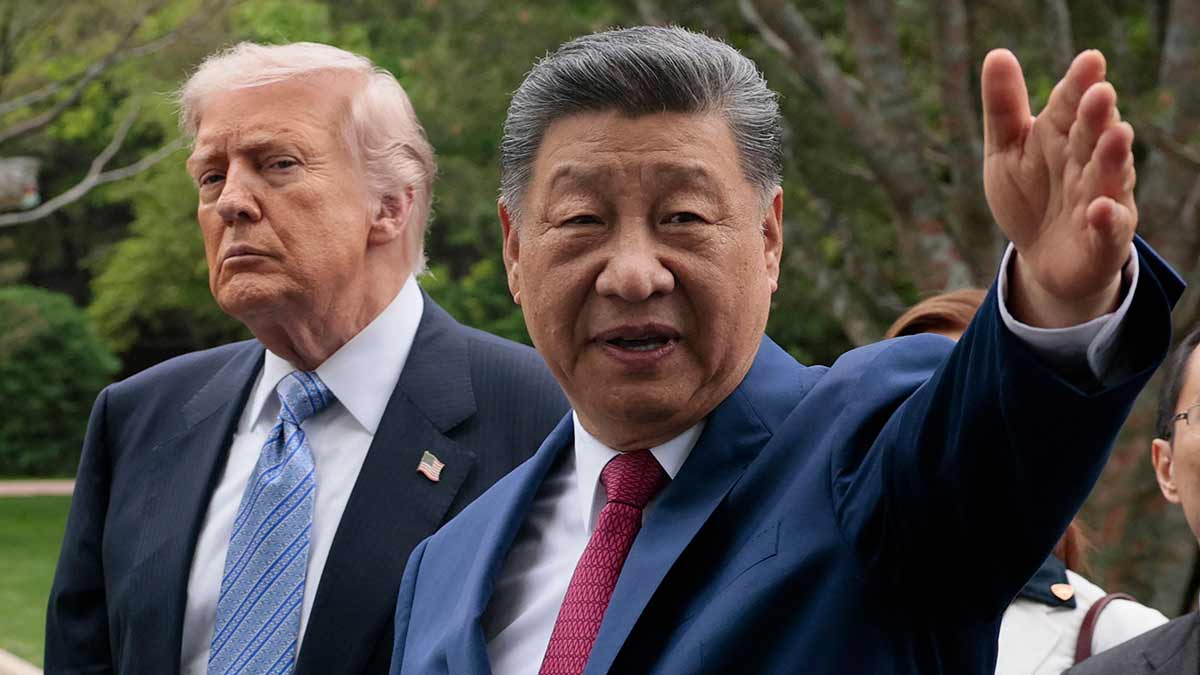
Middle Eastern states have increasingly engaged China and signalled support for a proactive Chinese role. Since the war began, several senior Middle Eastern leaders have travelled to China, including Abu Dhabi’s Crown Prince, the King of Jordan and Qatar’s Prime Minister, alongside the foreign ministers of Saudi Arabia, Iran and Kuwait. In addition, Xi visited Egypt and met with other regional leaders at the recent SCO Summit in Bishkek and the BRICS Summit in New Delhi. These interactions suggest that consultations between China and Middle Eastern states are taking place at an increasingly high tempo. In parallel, Trump visited Beijing in May, while Xi is expected to visit Washington on 24 September, where the Middle East will be a major item on their agenda.
The eventual Chinese mediation in the US–Iran War, if proven successful, could mark the end of the unilateral moment. An existing superpower concluding a war with a smaller regional power on terms shaped by a rival rising power would offer a powerful image of America’s relative decline. Already, US bases have come under sustained attack, while regional states are increasingly wary of granting Washington unfettered access lest the embers of war reach their shores. A successful Chinese mediation might end the war and help restore regional stability. However, it will also signal a broader erosion of US primacy and accelerate Washington’s strategic retrenchment from the Middle East.
The author is a fellow in National Security and China Studies with the Strategic Studies Programme at Observer Research.
