



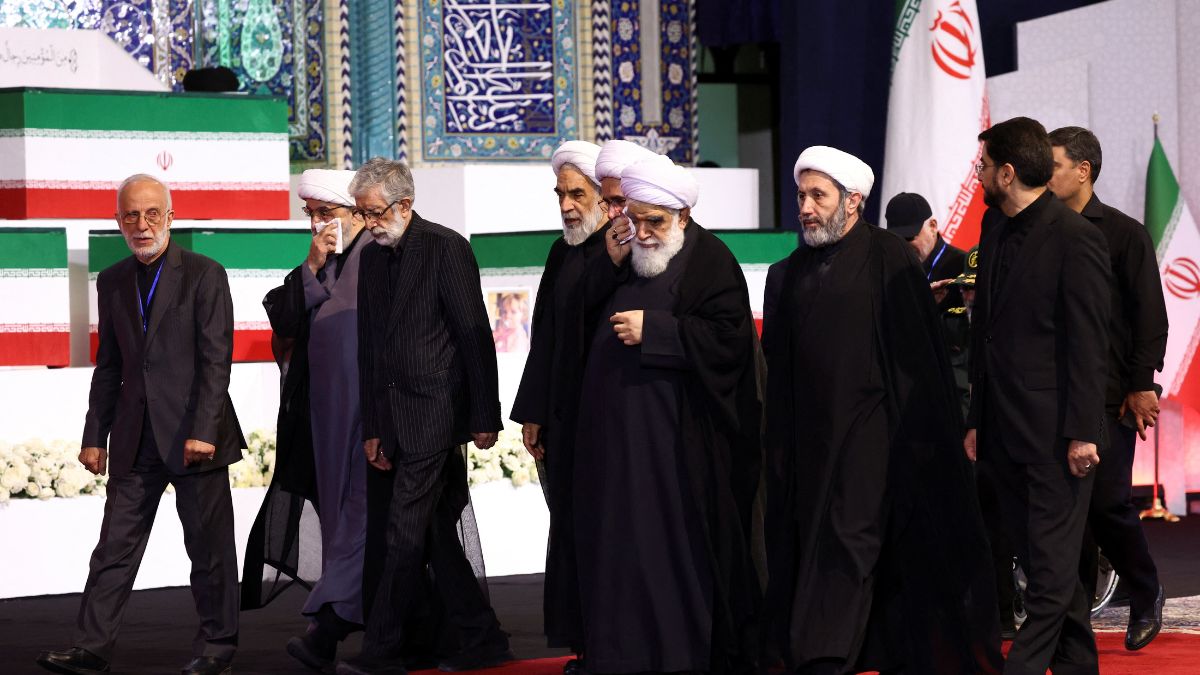
Following the week-long funeral, Ali Khamenei was finally laid to rest. Hostilities have resumed, and familiar questions about ‘outcomes of the war’ have re-emerged. Questions like what the new Middle East will look like after the war ‘really’ends? Or would there be a regime change in Iran? While valid and timely, a more profound question needs to be asked: what if the Iranian regime does survive – what then lies ahead in that Third Republic?
For the Iranian regime now, options are limited, no matter how much spin is put on its circumstances. After Khomeini passed in 1989, the tenure of Ali Khamenei is eponymously described by scholars as the beginning of the Second Republic. The description was semantic but built around the substantive differences in the trajectories and pathways the Islamic Republic of Iran sought and pursued under Khamenei.
Fairly, the passing of the baton from Ali Khamenei to Mojtaba Khamenei is now dubbed as the beginning of the ‘Third Republic’ or ‘Republic 3.0’. Commentators are outlining what this version of the revolutionary regime could look like. Contrary to what many are arguing, the Third Republic would be driven less by external factors and more by domestic realities.

First, such a republic would be hollow ideologically but vocal illustratively. Revolution, from the beginning, seems to thrive in conflict, not in its absence. So long as the conflict continues, the Revolution remains intact. Peace, however, does not appear acquiescent to the Revolution. Therefore, Mojtaba and Co. are likely to carry on Khamenei’s policies but will be louder and more theatrical about issues such as proxies and the nuclear programme.
Ideology, meanwhile, is no longer the glue that holds Iranian society together. The protests in January told an uncomfortable reality: religion and resistance matter as long as economic and social costs permit. Once bread is too expensive to buy, ideology seems to matter less. When inflation soared in the 1980s, it was Khomeini who scoffed at his detractors that the Revolution was “not about the price of watermelon.” Perhaps a wrong pretension that Ali Khamenei and his allies have come to believe.
Second, this Third Republic would neither be ‘republic’ nor ‘revolutionary’. The whole pretext of revolutionary ideas was to resist hereditary power and the brutality of the Shah’s rule, which the Revolution sought to break. However, the sheer brutality used to suppress the January protests, followed by Mojtaba’s elevation as the Supreme Leader, has meant that the new republic would not function on those presumptions of the Revolution. Since the June War last year with Israel, the arrests and hangings have risen dramatically in Iran. Similar patterns are likely to continue under Mojtaba, as evidenced by the frequent raids and purges reported since March.
Third, it would be aggressive outside until it becomes sufficiently strong inside. The task before Mojtaba (and the IRGC) is not to oversee a succession that many believed would eventually come, but rather to oversee a completely new transition in which old ways would no longer work. Some commentators have argued that the new IRGC and regime structure would be more radical than before. But such an assumption, arguably correct, oversimplifies and overlooks a structural issue: on what institutional foundations?
The IRGC and security apparatus survived and thrived through an intricate bureaucratic system, sustained by loyalists and experienced hands, many of whom at the upper echelons are now eliminated in the war. So, to build those networks from Basij’s suppression tactics to proxy supply chains in Iraq and Lebanon requires consolidation, rebuilding, and, above all, time. Hence, for Mojtaba, the immediate imperative would be to project strength externally until logistical and succession-related concerns with its security apparatus are addressed.
Fourth, while disenchantment and disillusionment with revolutions are unfailingly common, the Third Republic would dwell heavily on repression. The economic woes and social fissures that Iran faced, pre-war and pre-October 7, had been more concerning for regime survival than missile strikes. Addressing those requires reforms, which in turn require stability and trust in governance. Iran, today, has neither, and therefore, the regime’s survival would require an iron hand to weed out spies and sceptics alike because nothing brings out the worst in an authoritarian regime like the fear of its own survival.
All said and done, Mojtaba’s sympathetic succession has turned out to be a safe bet to bandwagon hardliners in a critical time. But it was and remains a short-term fix. It is difficult to imagine a stronger and more confident Iran emerging after the war when its Supreme Leader remains unseen as his critics derisively call him the “Cardboard Ayatollah”.
Therefore, the debate over the Third Republic is no longer simply about war or regime change, but it increasingly concerns what kind of political order survives or evolves within Iran. The fear of regime change from outside may be over for the regime, but internal challenges abound. During the war, people did rally around the flag against the external enemy, but such rallying is never perpetual and rarely even.
The Third Republic may have emerged from the war, but it would no longer be entrenched in external factors per se. Instead, it would be contingent on the post-war domestic situation in the country. What would be emerging in Iran is essentially the Third Republic that is going to be survivalist, paranoid, and repressive. Would such tactics ensure the regime’s survival depends on how Mojtaba and his security apparatus approach post-war Iran: would it reform or would it repress its own people in its quest to survive?
The author teaches at the Centre for Political Studies, Jawaharlal Nehru University, New Delhi.
