



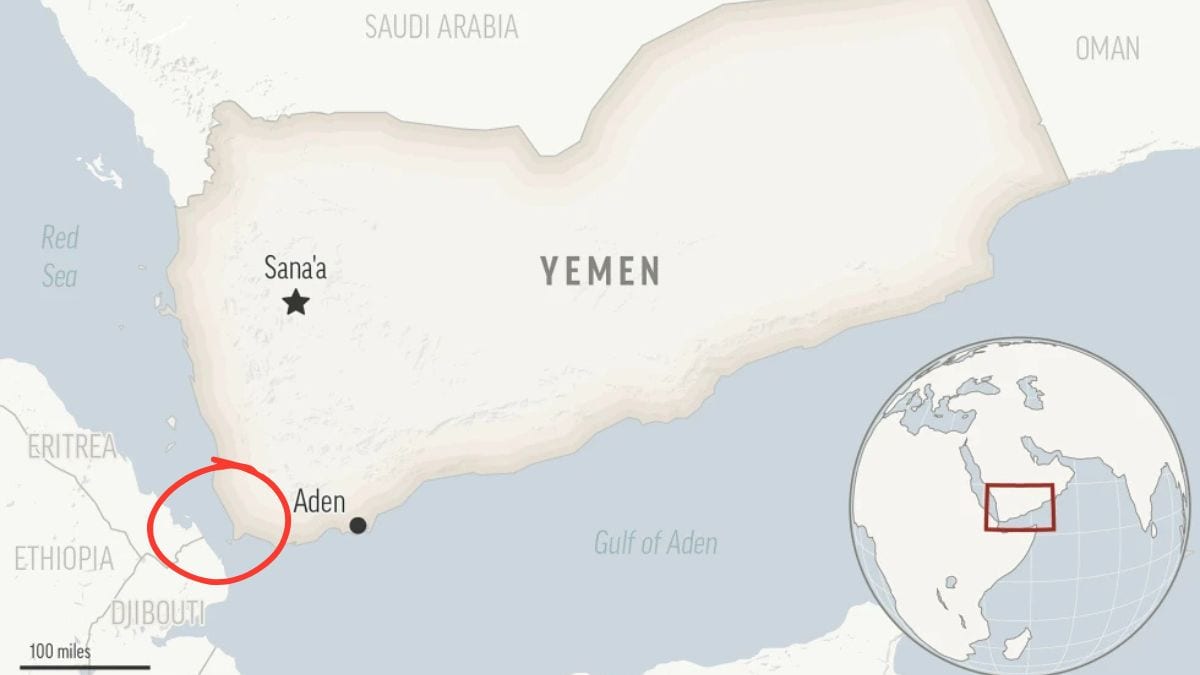
Iran has asked Yemen's Houthi rebels to get ready to close the Bab El Mandeb Strait, a key shipping route in the Red Sea, if the US were to attack Tehran's power infrastructure.
This is one of the latest ways in which Iran is trying to gain the upper hand in the four-month-long conflict, just weeks after fighting resumed when the ceasefire broke down.
The idea to block the key shipping route amid the crisis in the Strait of Hormuz was earlier discussed within Iran's top brass, after which it has now been conveyed to Iran's Houthi allies, a Reuters report said, citing three sources in the know.
Though the report noted that the Houthis had been recently informed of Iran's request, they did not add further details on how it was conveyed, or whether these plans were a direct response to US President Donald Trump's earlier threat to attack Tehran's power facilities.
He claimed that "next week it gets really bad for (Iran)".
"We're going to knock out all their power plants. We're going to knock out all their bridges unless they get to the table and negotiate," he told Fox News earlier this week, while also claiming that he "did not want to negotiate now".
This comes after the US Navy blockade resumed after the 14-point peace plan fell apart, which has led to fresh hostilities between the two sides.
The past six days have been no different from the pre-ceasefire days in the war: Washington's repeated strikes in areas around Tehran, and the Central Command (CENTCOM) of the US Navy attacking an Iranian-linked tanker, to which Iran responded with aerial attacks on US bases in Bahrain, Jordan and Kuwait.
In any case, the report added that the group has already completed preparations to attack shipping in the Bab El Mandeb Strait by deploying missiles and drones in Yemen's highlands overlooking Hodeidah and the Gulf of Aden.
This is expected to heavily impact shipping lines like Maersk, which had cautiously begun transits through the Bab El Mandeb Strait again.
In fact, the shipping giant on July 9 even said that ships on its its Middle East to US East Coast (MECL) service will now transit through the Red Sea rather than routing around the Cape of Good Hope.
It added that ships on its West Africa 6 (WAF6) service would also transit via the Red Sea between Salalah and West Mediterranean, in a bid to improve transit times amid the crisis in the Strait of Hormuz.
Another major shipping line, Hapag-Lloyd, also said that vessels on the AE15, its joint service with Maersk, would slowly return to the trans-Suez corridor, which comprises the Red Sea and the Bab El Mandeb Strait.
