



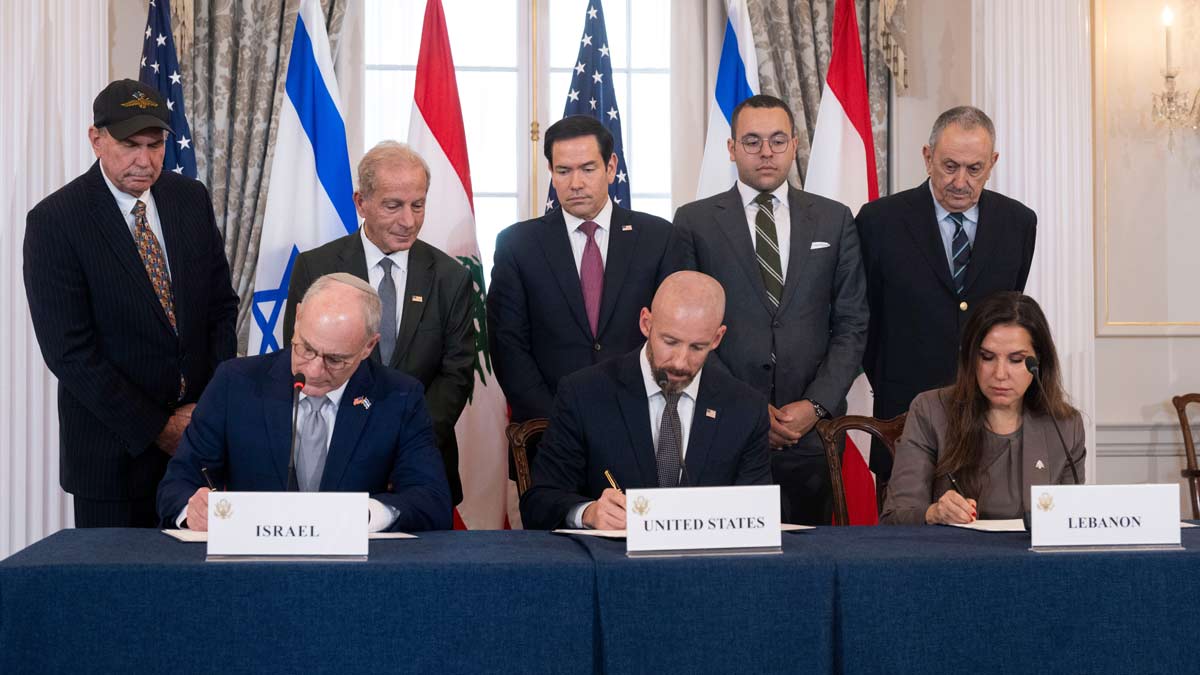
Israel and Lebanon signed a landmark 14-point framework agreement in Washington yesterday, brokered by the United States, in an ambitious attempt to establish lasting peace and security after months of devastating conflict. Describing the accord as the "beginning of the beginning", US Secretary of State Marco Rubio said it marked the start of a structured process aimed at ending one of the region's most dangerous confrontations. The agreement was formally signed by Israeli Ambassador Yechiel Leiter and Lebanese Ambassador Nada Hamadeh, signalling a shared aspiration to coexist as neighbouring sovereign states.
Yet the diplomatic breakthrough is overshadowed by a critical omission. Hezbollah, the Iran-backed militant group that lies at the heart of the conflict, was entirely excluded from the negotiations. Its absence raises immediate questions about whether any agreement can succeed without the participation of the most powerful armed actor operating in southern Lebanon.
At the heart of the framework is a phased security plan centred on the creation of experimental "pilot zones" on both sides of the Litani River. Within these designated areas, the Lebanese Armed Forces (LAF) would gradually assume full responsibility for security, restoring the Lebanese state's authority over territory long contested by armed groups.
The agreement, however, ties Israeli withdrawal directly to Hezbollah's disarmament. Israeli forces will remain inside the pilot zones until the "verified disarmament of non-state armed groups", an unmistakable reference to Hezbollah, and the dismantling of their military infrastructure have been confirmed. To oversee the transition, the framework establishes a US-backed military coordination mechanism while Lebanon has appealed for international security assistance, particularly from Arab partners. Washington has also pledged $100 million in humanitarian aid to support Lebanon during the implementation process.
Although both governments signed the same document, they interpret its practical implications very differently.
Lebanese leaders, including President Joseph Aoun and Prime Minister Nawaf Salam, have described the agreement as a first genuine step towards restoring Lebanon's territorial integrity and ending Israel's military presence on Lebanese soil. For Beirut, the framework offers a route back to state sovereignty after years of instability.
Israel, by contrast, views the agreement almost exclusively through the prism of security. Prime Minister Benjamin Netanyahu has made it clear that Israeli troops will remain in southern Lebanon until Hezbollah has been completely disarmed. Israeli Finance Minister Bezalel Smotrich went even further, suggesting that Israel may have to maintain a long-term military presence to secure what he described as "defendable borders". Such statements reflect deep Israeli doubts about both the willingness and the capacity of the Lebanese Armed Forces to dismantle Hezbollah's extensive military network.
Hezbollah has predictably rejected the agreement outright. The group insists it will not surrender its arsenal unless Israel first withdraws unconditionally from Lebanese territory. Hezbollah parliamentarian Hassan Fadlallah warned that any attempt by the Lebanese government to enforce the US-backed disarmament provisions could push the country towards civil war.
The agreement places enormous expectations on the Lebanese state while offering few realistic means of achieving them. The Lebanese Armed Forces have neither the military strength nor the political backing to forcibly disarm Hezbollah, while Israel appears unwilling to withdraw until precisely that happens. Critics, therefore, fear that Hezbollah's continued possession of weapons could become a permanent justification for an indefinite Israeli military presence in southern Lebanon.
The deal is also closely linked to the broader regional confrontation between the United States, Israel and Iran. Tehran maintains that events in Lebanon cannot be viewed apart from its wider talks with Washington, while Israel firmly dismisses any such connection.
Netanyahu has cast the Washington framework as a strategic triumph, insisting it makes clear that Iran has no place in Lebanon's future. That position has reportedly strained relations with President Donald Trump, whose administration has been working to balance backing for Israel with cautious diplomatic outreach to Tehran amid escalating regional tensions, including recent Iranian attacks on commercial shipping in the Strait of Hormuz.
Despite the significance of the agreement, conditions on the ground remain shaky. Israeli military operations have killed more than 4,000 people in Lebanon, wounded thousands more and displaced over 1.2 million civilians. Limited fighting has continued even after the signing of the framework, with Israeli strikes reported in areas including Nabatieh.
