



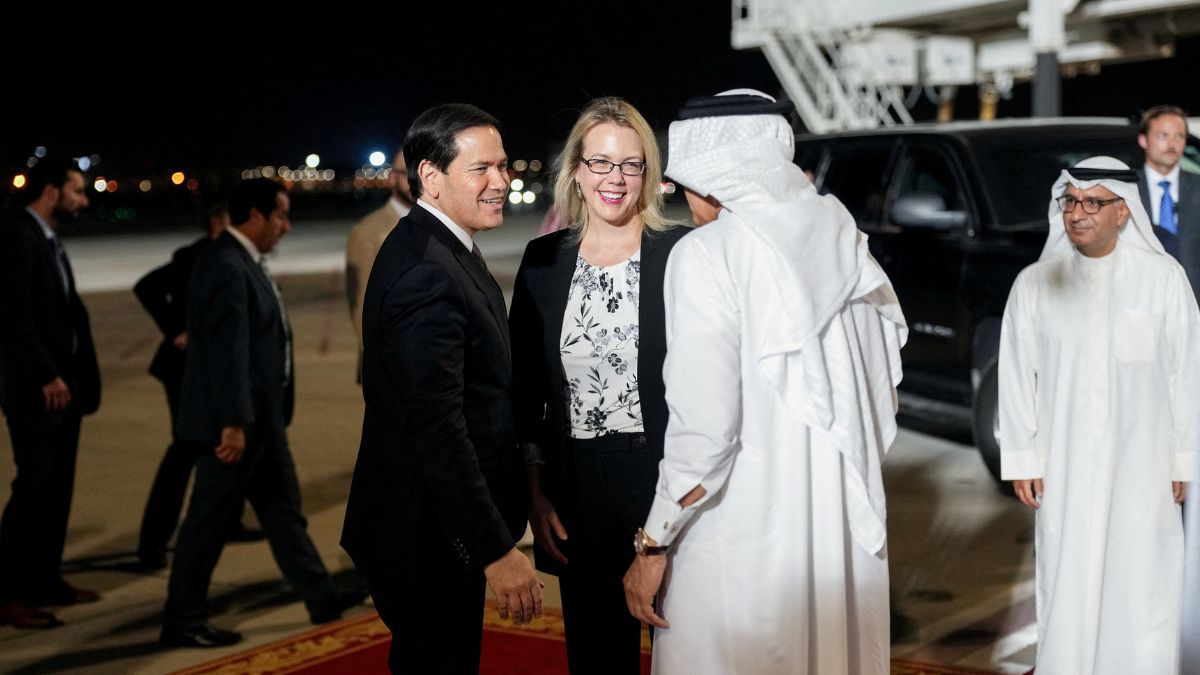
US Secretary of State Marco Rubio is on a high-stakes diplomatic tour of the Middle East, seeking to reassure anxious Gulf Arab allies following the signing of a memorandum of understanding (MoU) between Washington and Tehran. The MoU is intended to extend a fragile ceasefire and find a way to end the hostilities following the war launched by the United States and Israel against Iran on February 28.
While Gulf leaders broadly welcome the ceasefire, they are deeply uneasy about what they see as generous concessions granted to Tehran by President Donald Trump. Many fear the deal could ultimately undermine regional security rather than strengthen it. The six Gulf Cooperation Council (GCC) states are clearly bothered about the enormous costs the war imposed on them. Facing the US-Israeli attacks, Iran retaliated against the GCC states with ballistic missiles and drones, with the UAE alone being hit close to 3,000 times. Saudi Arabia, too, witnessed widespread damage, while in Kuwait, ports, desalination plants and the airport came under attack. Qatar was not spared either, especially during the early days of the conflict. It was forced to halt production at the Ras Laffan Industrial City, the country's most important gas facility.
American military installations in the UAE, Kuwait and Bahrain were also targeted. The attacks forced the temporary suspension of operations at the US Embassy in Kuwait, which Rubio recently visited for a ceremonial flag-raising marking its reopening.
Another major card played by Iran was the closure of the Strait of Hormuz, disrupting fuel and fertiliser export by the Gulf states, resulting in the loss of billions of dollars. Rubio's meetings so far have focused on convincing them that Washington will not abandon them.
The Gulf states seem particularly upset about the provisions in the MoU that reportedly offer a $300 billion fund, the unfreezing of Iranian assets and waivers on US sanctions. Analysts estimate that Iran could earn an additional $30 billion annually simply by resuming oil exports to China at full market prices. Gulf governments worry that such a financial windfall could strengthen Tehran's regional influence and alter the strategic balance of power.
Those fears are compounded by what many regard as significant gaps in the draft agreement. The current framework does not address Iran's ballistic missile programme or its support for regional proxy groups. For Gulf states, it is a glaring omission. Their concerns have been reinforced by Iranian President Masoud Pezeshkian's insistence that restrictions on the country's missile capabilities will never form part of a final peace settlement.
The future of the Strait of Hormuz remains another contentious issue. Although the agreement would end the US blockade of Iranian ports and restore maritime traffic, Iranian officials have previously suggested that passing vessels could be charged tolls or service fees. Both Trump and Rubio have firmly rejected that possibility.
Trump wrote on his Truth Social platform that no tolls, fees or insurance charges would be accepted, warning that negotiations would end immediately if Iran attempted to impose them. Rubio echoed that position during his visit to Kuwait, arguing that the entire international community supports free navigation through international waterways. He assured Gulf partners that the strait would remain open and accessible to global shipping.
Even so, maritime traffic is yet to recover fully. According to maritime analytics firm Kpler, only 31 ships recently transited the strait in a single day, far below the pre-war average of around 130 vessels.
To reassure nervous allies, Rubio has stressed that sanctions relief remains temporary. The current arrangement is scheduled to last for 60 days while a technical working group returns to Switzerland to negotiate a permanent agreement. He has repeatedly emphasised that Trump retains the authority to reverse sanctions relief if Iran fails to comply with its obligations, including permitting international inspectors to resume visits to damaged nuclear facilities.
Domestic politics in Iran present another challenge. Senior Iranian officials have adopted triumphalist rhetoric aimed at reassuring hardliners. Parliamentary Speaker Mohammad Bagher Ghalibaf recently described the preliminary agreement as "America's declaration of defeat". Some analysts warn that Tehran's longer-term objective remains the reduction of American influence across the Middle East and the eventual emergence of a regional power bloc involving countries such as Turkey, Saudi Arabia, Egypt and Pakistan.
