



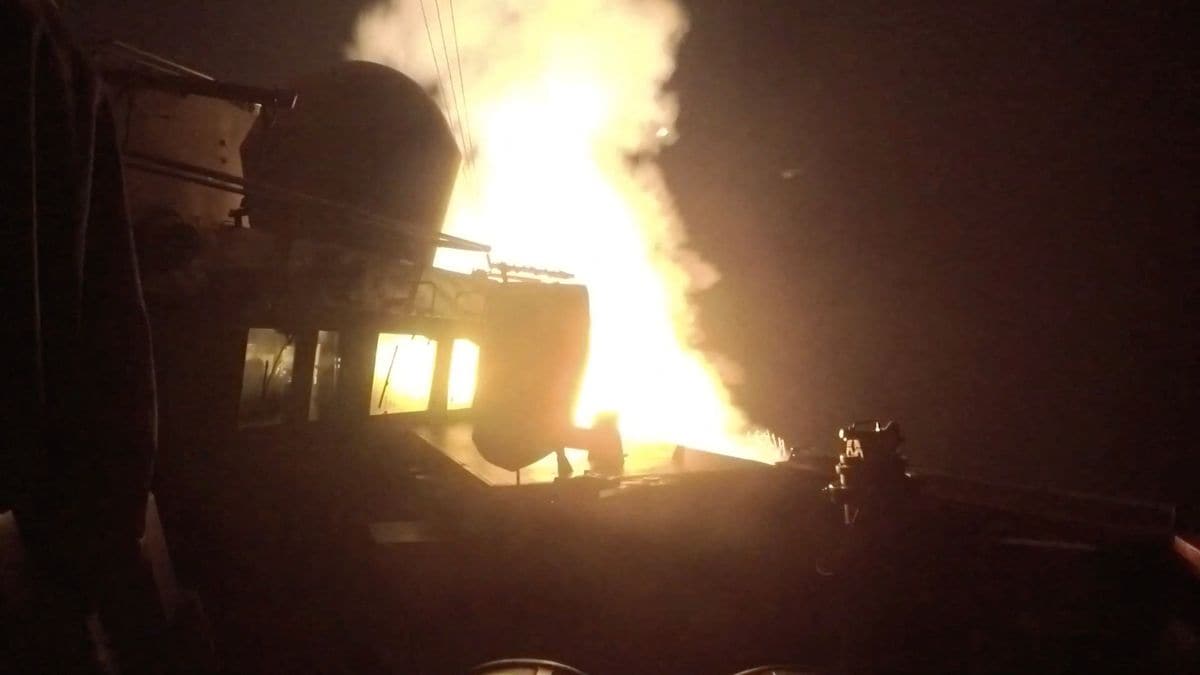
The United States and Iran have hit each other with missiles, drones and air strikes for a second consecutive day, raising fears that the Middle East may be sliding back towards a full-scale war. The latest confrontation marks the most serious breakdown yet of the fragile ceasefire brokered in early April, a truce that never fully silenced the guns.
The latest escalation is an indicator of a shifting approach by the United States in terms of strategy. From limited retaliatory strikes, Washington has quickly progressed into an openly coercive strategy, hoping to force Tehran to the negotiating table on its own terms. Senior US officials have made little effort to conceal that objective, arguing that military pressure is necessary to bring Iran to the negotiating table.
The immediate trigger for the latest crisis was the downing of an American Apache helicopter near the Strait of Hormuz earlier this week. Washington blamed Iran for the incident and responded with an initial round of strikes. Those attacks were followed by a much larger operation personally authorised by President Donald Trump.
Beginning at 2:45am IST today, US forces launched three waves of attacks involving fighter aircraft and 49 Tomahawk cruise missiles. The strikes hit a broad range of targets across Iran, including the strategically important oil terminal at Kharg Island, the islands of Qeshm and Kish, and locations in Bandar Abbas, Sirik, Karaj and Shiraz.
According to US Central Command, the operation targeted military surveillance networks, communications infrastructure and air defence systems. Iran's Islamic Revolutionary Guard Corps acknowledged that several coastal military facilities had been struck. Iranian state media, however, reported that civilian infrastructure also suffered damage. Among the facilities allegedly hit were two major water reservoirs in southern Iran, leaving around 20,000 residents without safe drinking water amid intense summer temperatures.
What has made the latest American action particularly striking is the administration's candour about its political purpose. President Trump and Defence Secretary Pete Hegseth have both argued that the bombardment is intended not merely as retaliation but as leverage in peace negotiations.
"If we need to negotiate with bombs, we'll negotiate with bombs," Hegseth declared, insisting that the United States was prepared to dictate the terms of any future settlement. Trump has voiced growing frustration with Tehran, accusing Iranian leaders of delaying negotiations and "playing us for suckers". In a television interview, he warned that critical infrastructure, including power plants and bridges, could become targets if Iran refused to accept Washington's demands.
Tehran responded swiftly. Within hours of the American strikes, Iran launched a series of retaliatory attacks against US military interests across the region. The Revolutionary Guard claimed responsibility for drone attacks targeting Bahrain's Sheikh Isa Air Base and Kuwait's Ali Al Salem and Ahmad Al-Jaber air bases. Iran also said it fired 12 ballistic missiles towards Jordan's Al-Azraq Air Base.
The attacks prompted Bahrain to activate air raid sirens twice, while Kuwait reported that its air defence systems were intercepting incoming threats. US military officials said the overwhelming majority of Iranian missiles and drones had been successfully intercepted and reported no immediate casualties. Iranian President Masoud Pezeshkian dismissed Trump's threats as a "sign of desperation" and vowed that Iran would not yield under pressure.
Beyond the battlefield, the confrontation is already reverberating through the global economy. Much of the concern centres on the Strait of Hormuz, the narrow waterway through which a significant share of the world's oil supplies pass.
Following the US attacks, the Revolutionary Guard declared the strait "closed until further notice" and threatened commercial shipping operating in the area. Iranian forces reportedly targeted two oil tankers in the waterway, while the US continued its blockade of Iranian ports. The disruption has already taken a toll on international shipping. And there is also the rising human till.
The uncertainty has rattled energy markets. With maritime traffic sharply reduced, Brent crude prices have surged past $95 per barrel, stoking fresh concerns about inflation and global economic stability. Trump claimed that covert American operations had been removing "millions of barrels of oil" from Iran each night, insisting that this intervention had stopped prices from spiralling as high as $250 per barrel.
Yet even as missiles fly and threats escalate, diplomacy has not completely collapsed. Regional mediators are working intensively behind the scenes to prevent a wider war. A Qatari delegation has arrived in Tehran to facilitate discussions, while American officials privately maintain that an agreement may still be within reach.
