



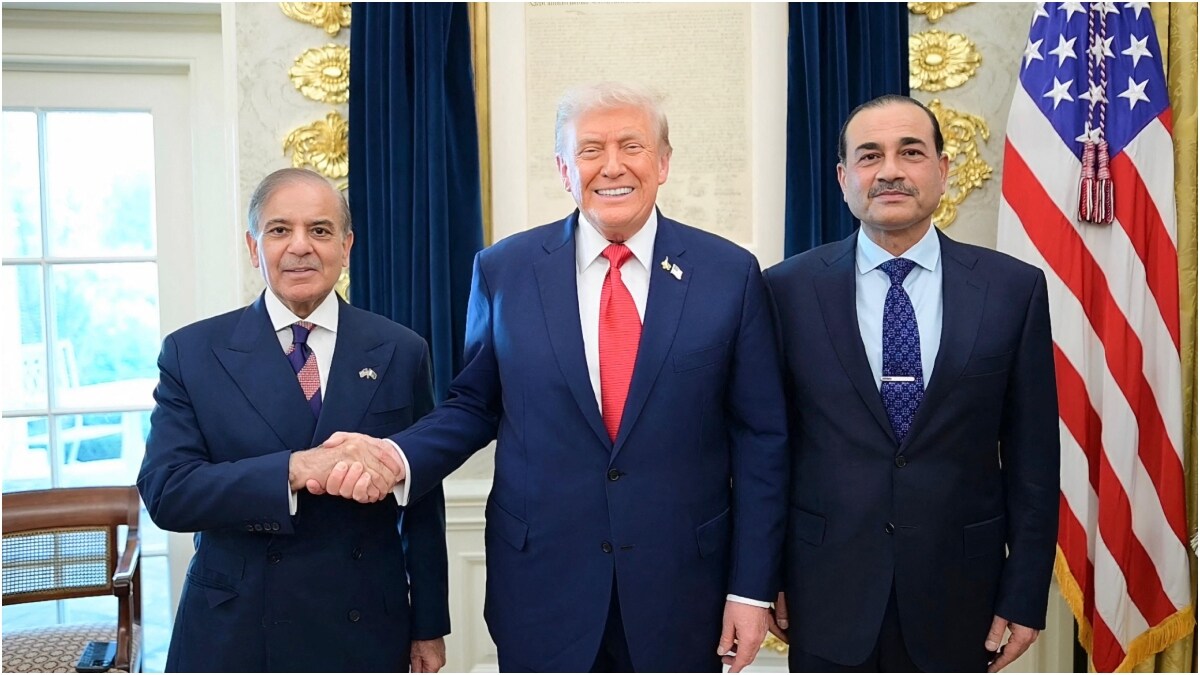
U.S. President Donald Trump's statement on Monday that all Muslim nations engaged in negotiating the Iran peace deal should 'mandatorily' join the Abraham Accords has landed Pakistan in a fix. Pakistan, which is mediating between Iran and the United States to end the Iran war, has never recognised the Israeli state since its formation in 1948.
Trump took to his social media platform on Monday to link the Abraham Accords, a series of agreements which have normalised diplomatic relations between Israel and five other states, with the Iranian ceasefire agreement, thereby reviving one of the signature foreign policy projects of his first term.
"I am mandatorily requesting that all countries immediately sign the Abraham Accords," Trump wrote in a social media post on Monday, local time, adding that, "if Iran signs its Agreement with me, as President of the United States of America, it would be an Honor to have them also be part of this unparalleled World Coalition," the US President added.
"It should start with ... Saudi Arabia and Qatar, and everybody else should follow suit. If they don't, they should not be part of this deal, as it shows bad intentions." The post followed a phone call between Mr Trump and leaders from Saudi Arabia, the United Arab Emirates, Qatar, Pakistan, Türkiye, Egypt, Jordan and Bahrain.
This has brought the spotlight on Pakistan, which rushed to reject the idea, while other states kept mum.
Pakistan's Defence Minister Khawaja Asif rushed to state that it was not acceptable for Pakistan to join the Abraham Accords proposed by President Trump, as they contradict the nation's fundamental ideals.
Speaking to private news channel 'Sama', Khawaja Asif said, 'I don't think we should join any agreement that contradicts our fundamental ideologies. At this time, we have not taken any action, nor has anyone asked us (to formally join). Even now, the Gaza (ceasefire) agreement is being violated, so how can we sit with people who cannot be trusted for even a day," he added.
That said, many wonder whether Pakistan can reject Trump's demand. According to journalist Kamran Yusuf, Pakistan is unlikely to change its policy. "Though Pakistan is playing a mediating role between Iran and the United States and currently has good relations with President Trump, this does not mean that it will change its policy towards Israel," he told the BBC.
He added that Islamabad has been at odds with Washington on several issues in the past. "President Trump is also aware of this, as he said in a statement on Truth Social that one or two countries could decide not to join the Abraham Accords and that would be acceptable. He may be referring to Pakistan," Yusuf said.
According to Michael Kugelman, a South Asian expert at the Atlantic Council, any decision by Pakistan in this regard will depend on Saudi Arabia.
"Some Pakistani civilian and military officials have had informal contacts with Israel in the past," he said. "However, Islamabad has always made recognition of Israel conditional on the establishment of a Palestinian state. This has been an unwavering position. Therefore, joining the Abrahamic Accords is not acceptable to Pakistan at this time."
So can this position change? Regarding this, he said, "It is possible that if Saudi Arabia joins the Abraham Accords, pressure will increase on Pakistan to reconsider its position. But given current public opinion, any Pakistani government that joins these agreements could face serious political losses," he added.
Many believe Trump is unhappy with Pakistan and Saudi Arabia for their refusal to join the Accords, and the statement is nothing more than a pressure tactic from the US President. They believe it is just a means to appease Israel.
Other Muslim countries
While Pakistan has been vocal about its refusal to join the Accords, for Saudi Arabia, recognising Israel is a sensitive national security issue. Saudi Crown Prince has reiterated that it will not sign the Abraham Accords until a roadmap for the establishment of a Palestinian state is agreed upon.
Middle East affairs expert Hassan al-Hassan told CNN that many countries view Israel with suspicion. "Israel has occupied territories in Gaza, Lebanon and Syria. Egypt, Turkey, Pakistan and Saudi Arabia have also formed an alliance to confront Israel. So I don't think the countries in the region agree with Trump's desire," he added.
Egypt, Jordan, and Turkey already have diplomatic relations with Israel, but these relations have been strained since the Gaza war.
Ali Vaez, director of the Iran Project at the International Crisis Group, told Reuters that Trump is trying to portray the deal with Iran as "a continuation of the Abrahamic Accords, which would be beneficial for both Israel and the region and difficult for Washington."
They are replacing one concept with another. On the one hand, the idea of forcing Iran to bow down, and on the other, the idea that a weak agreement could lay the foundation for a new Middle East order," he said.
The United Arab Emirates and Bahrain signed these agreements during Trump's first term in 2020, breaking a long-standing tradition and becoming the first Arab countries to recognise Israel in a quarter of a century. Morocco and Sudan later followed suit.
