



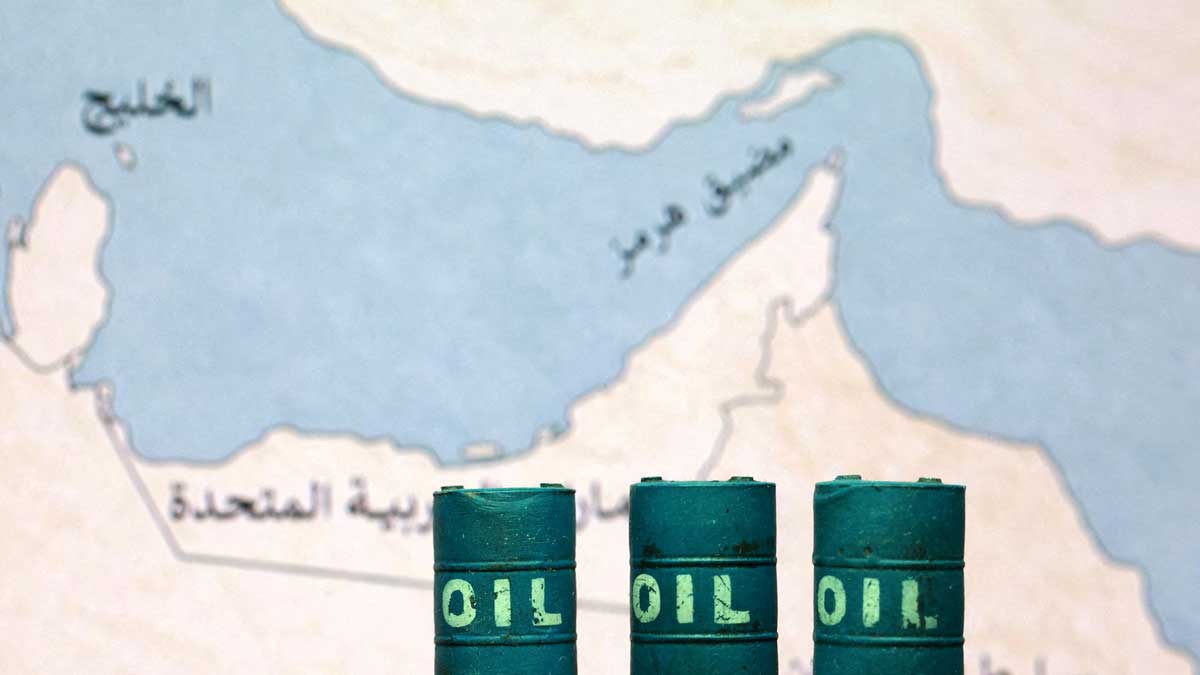
Following the collapse of highly anticipated peace talks between the United States and Iran in Islamabad, uncertainty looms over the six-week-long conflict in the Middle East, which has already disrupted global oil markets.
President Donald Trump on Sunday shared a newspaper article on Truth Social suggesting that the United States could explore the option of a naval blockade against Iran. The article, published by Just the News, cited experts who argued that such a blockade could counter Iran’s control over the Strait of Hormuz, drawing parallels with US military operations in Venezuela earlier this year, where a naval blockade impacted the country’s economy.
The piece highlighted that the USS Gerald Ford, which led the Venezuelan operation, is now stationed in the Persian Gulf alongside the USS Abraham Lincoln and other major naval assets.
Rebecca Grant, a national security expert at the Lexington Institute, was quoted the article: "It would be very easy for the US Navy to exert complete control over what does and does not go up and down the Strait now."
"I've heard about 10 ships have moved in the last 24 hours. One of them was a reflagged Russian tanker, and we know that cargos have gone out to China, to India, and we've seen some inbound traffic. If Iran gets intransigent, then absolutely, the US Navy can set up with great overwater surveillance ... and watch everything that goes in and out of that Strait and you'll have to ask the US Navy if you want to move past Kharg Island or past that narrow part by Oman," she said.
The article noted that the idea of a naval blockade was first proposed last week by retired General Jack Keane, a senior military strategist.
In a New York Post column, Keane wrote that if the conflict escalates, the US military could consider occupying or destroying the Kharg Island. “Alternatively, the US Navy could set up a blockade, shutting down Tehran’s export lifeline,” he added.
Earlier in the day, US Vice President J.D. Vance, who led the US delegation to Islamabad, returned to Washington after the nearly 21-hour negotiations with Iranian officials yielded no results.
"The bad news is that we have not reached an agreement, and I think that's bad news for Iran much more than it's bad news for the United States," Vance said.
The United States continues to seek a clear, binding commitment from Iran not to pursue nuclear weapons or acquire the means to quickly develop them. Reopening the Strait of Hormuz also remained a key sticking point throughout the negotiations.
