



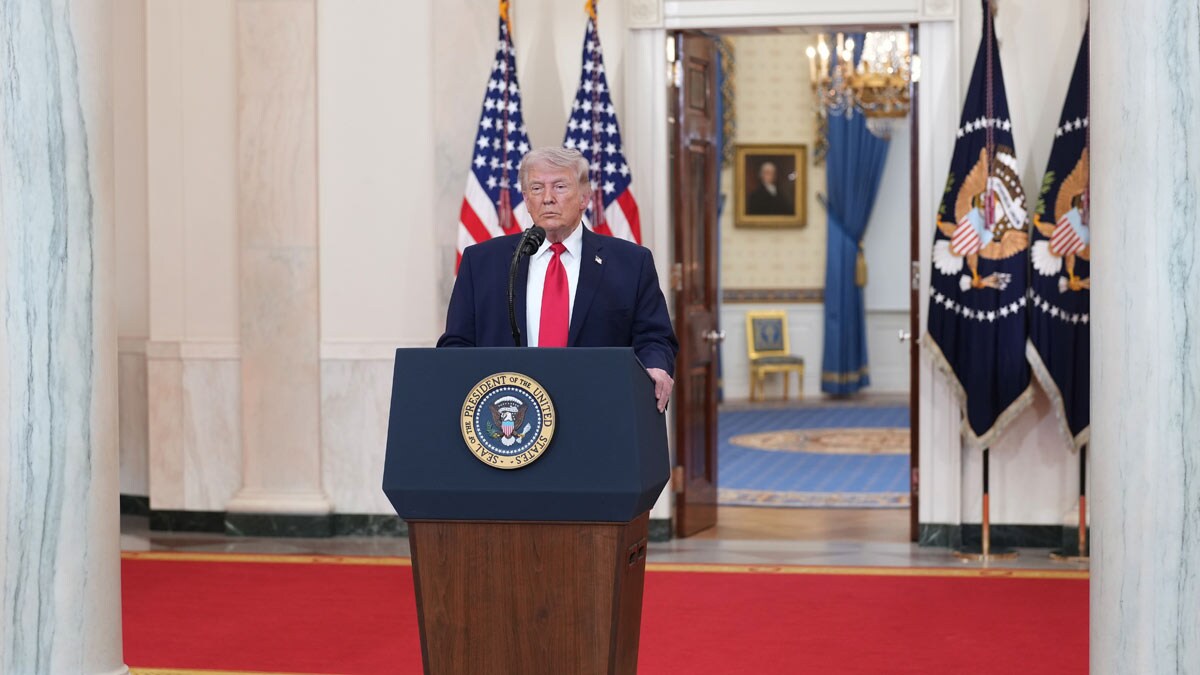
When Donald Trump issued an expletive-laden ultimatum on Easter Day, taunting and threatening Iran, he did more than signal frustration. He raised the stakes in a conflict that was already teetering on the edge of something he is finding difficult to contain.
At the centre of the crisis lies the Strait of Hormuz, through which a substantial share of the world's oil passes every single day. By choking this artery, Iran has found a way to punch well above its military weight. It is not a strategy built on battlefield dominance. It is built on geography, patience and the knowledge that economic pain travels fast and far.
Trump's ultimatum reflects frustration as much as confidence. “Open the Fuckin' Strait, you crazy bastards, or you'll be living in Hell - JUST WATCH! Praise be to Allah," Trump wrote on Truth Social. A recent high-risk rescue operation to rescue a weapons specialist from a downed fighter aircraft, conducted deep inside Iranian territory, appears to have sharpened his appetite for bold action. Yet the broader campaign has not delivered the kind of decisive strategic blow that would justify such confidence. Iran's leadership, increasingly shaped by the hardline instincts of the surviving leadership, appears willing to absorb sustained punishment. They are playing a longer game, and they know it.
As the deadline attached to Trump's warning passes, there is clearly the danger of escalation against civilian infrastructure. Trump has explicitly threatened to strike power plants, bridges and other non-military assets. Should such attacks materialise, they would mark a fundamental shift in the nature of this war. Legally, they would raise serious questions under the Geneva Conventions, which prohibit the targeting of civilian infrastructure for coercive ends. Strategically, they would likely backfire. The evidence from Iraq to Ukraine suggests that punishing civilian populations tends to harden resolve rather than break it. In Iran, it could lend an embattled regime exactly the kind of moral authority it currently lacks.
Meanwhile, Iran has already shown a readiness to widen the conflict, targeting energy and water facilities in neighbouring states. Further American escalation would almost certainly provoke a response aimed at the more vulnerable points of Washington's regional alliances: facilities in Saudi Arabia, the UAE, Kuwait and Bahrain. The result could be a cascading regional crisis, pulling in multiple governments and pushing the war well beyond its current geography.
There is also the prospect of a dramatic expansion of American objectives. Trump has floated ideas that go far beyond punitive strikes, including the seizure of Iran's main oil export hub on Kharg Island and possible operations near Isfahan to secure nuclear material. This would effectively transform the conflict from a pressure campaign into something resembling an occupation. The risks are considerable. Any ground presence on Iranian soil would expose American forces to sustained counterattack, significant casualties and the very real possibility of an open-ended military commitment with no credible exit.
However, despite the noise, there are indications that back-channel conversations are taking place, with Pakistan, Turkey and Egypt reportedly acting as intermediaries. There are also reports about the US, Iran and a group of mediators exploring the possibility of a potential 45-day ceasefire. Trump has repeatedly suggested that Tehran is looking for a deal, though there is little sign that Iran feels any particular urgency. From where they stand, time may be an advantage. Every day the Strait of Hormuz remains under pressure, global economic anxiety grows, and the diplomatic balance shifts incrementally in their favour.
That economic dimension is what gives this crisis its global character. Further disruption to Gulf energy supplies would send oil prices sharply higher, with consequences felt well beyond the region. Europe and large parts of Asia, heavily reliant on imported energy, would bear considerable pain. Even the United States, now a significant energy producer in its own right, is not insulated from market instability and the political fallout that tends to follow.
Trump has, in a sense, trapped himself. If he follows through on his threats, he risks triggering an escalation that may quickly outpace his ability to manage it. If he steps back, he risks looking weak after some of the most explicit public ultimatums an American president has issued in years.
The most likely outcome in the short term is not a single decisive moment but a tangled overlap of the multiple scenarios: limited strikes, proxy attacks, and quiet diplomacy conducted beneath the surface. The real danger is how rapidly that tangle can become a knot nobody knows how to unpick. Wars rarely follow the scripts of those who start them, and this one has all the hallmarks of a conflict drifting towards a moment nobody planned for, and nobody wants.
