



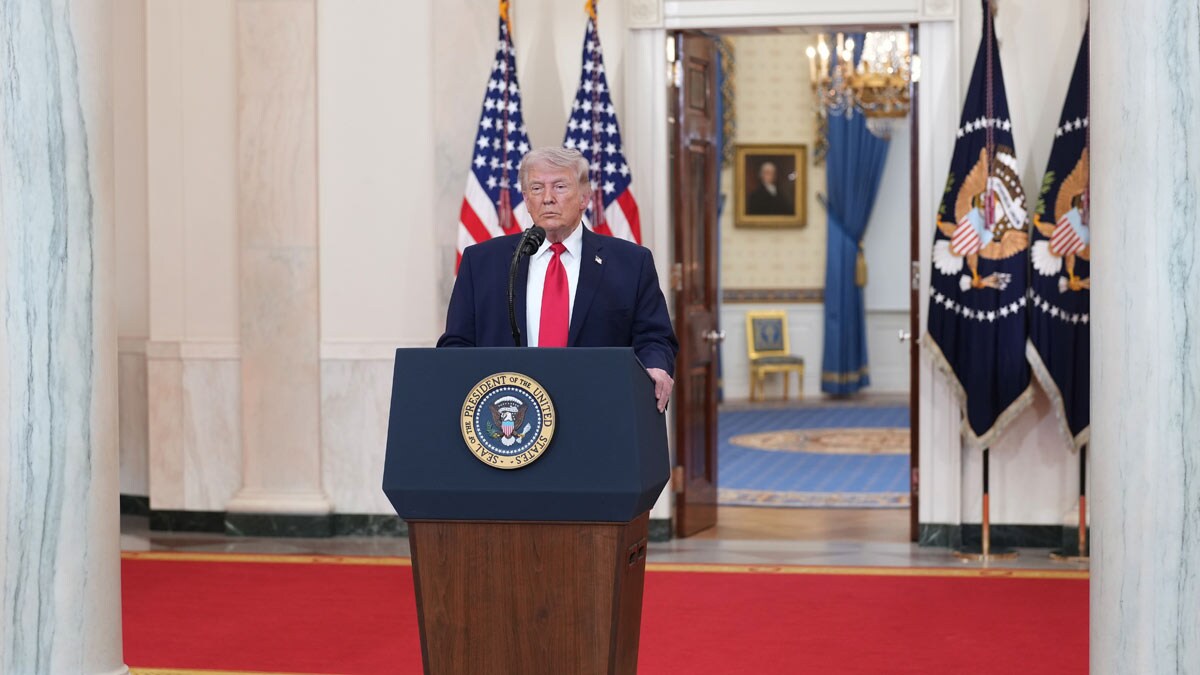
President Donald Trump delivered a primetime address from the White House last night, updating the US and the world on the 32-day-old American-Israeli war against Iran, officially dubbed "Operation Epic Fury." Equal parts progress report and sales pitch, the 19-minute speech sought to reassure an anxious public while making the case for a conflict he initiated the previous month. However, the speech failed to offer any clear path out of the war. Instead Trump threatened to bomb Iran “back to the Stone Ages where they belong.”
Trump opened by declaring that the military's "core strategic objectives are nearing completion," promising the United States would finish the job "very fast." To keep the operation's duration "in perspective," he drew comparisons to America's lengthy involvements in the First and Second World Wars, the Korean War, the Vietnam War and the Iraq War. Pleading for patience, he characterised the conflict as a "true investment" in the country's future.
The bulk of the speech was devoted to cataloguing what Trump described as overwhelming battlefield victories. Iran's navy is "gone," he claimed; its air force is "in ruins"; its missile capabilities have been either depleted or destroyed entirely. He went further, noting that while regime change was never the stated objective of the operation, it had effectively come about regardless, given that all of Iran's original leadership, whom he labelled terrorists, are now dead. Trump paused to honour the 13 American service members killed in the fighting, framing the ongoing mission as a moral imperative to prevent Tehran from acquiring a nuclear weapon. To justify the current campaign, he alleged that following last year's "Operation Midnight Hammer," in which the United States had "totally obliterated" Iranian nuclear facilities, the regime secretly rebuilt its programme at a new, undisclosed location.
Despite declaring the operation broadly successful, Trump projected that military involvement would continue for another two to three weeks. His language grew notably more aggressive on this point. He vowed to hit Iran "extremely hard". Should Iran refuse to reach a diplomatic agreement, he warned, the United States would simultaneously strike each of the country's electricity-generating plants. He added that while American forces had thus far avoided targeting Iran's oil infrastructure, that option remained on the table, and doing so would, in his words, eliminate any chance of survival or rebuilding for the regime.
On the diplomatic front, Trump acknowledged that talks were ongoing with Iran's new leadership, whom he described as "less radical and much more reasonable" than their predecessors. He claimed earlier in the day that Iran had formally requested a ceasefire, though he was firm that no truce would be considered until Tehran reopened the Strait of Hormuz, the critical global shipping lane that has been effectively closed since hostilities began. Curiously, even as he demanded the strait's reopening, Trump suggested that ensuring its security ought to be the responsibility of other nations that depend upon it for trade. The United States, he argued, is "totally independent" of Middle Eastern oil and is participating in the conflict purely to assist its allies.
The economic consequences of the war received comparatively little attention. The prolonged closure of the Strait of Hormuz has sent global energy markets into considerable turmoil, yet Trump largely brushed aside the fallout. Domestic petrol prices, which have risen above four dollars a gallon, were attributed entirely to what he called "deranged terror attacks" by the Iranian regime, and he dismissed the increases as a short-term inconvenience. Financial markets were unconvinced. Stock futures fell sharply in the immediate aftermath of the address, and global benchmark Brent crude climbed back above 104 dollars per barrel as investors absorbed the news that the war would drag on for several more weeks.
Critics were quick to highlight what the president left out. Trump offered no clear exit strategy, no articulation of a specific endgame, and no detail on whether he intends to deploy ground troops to seize Iranian territory or secure stockpiles of enriched uranium, despite a considerable Marine force already assembled in the region. Senate Minority Leader Chuck Schumer was particularly scathing, describing the speech as "rambling, disjointed, and pathetic" and labelling the war one of the greatest foreign policy blunders in American history.
Trump closed on an unexpected note of optimism, congratulating NASA on the successful launch of the Artemis II lunar mission, before returning to the war to assert that he had done "what no other president was willing to do" by dismantling the Obama-era nuclear agreement with Iran.
