



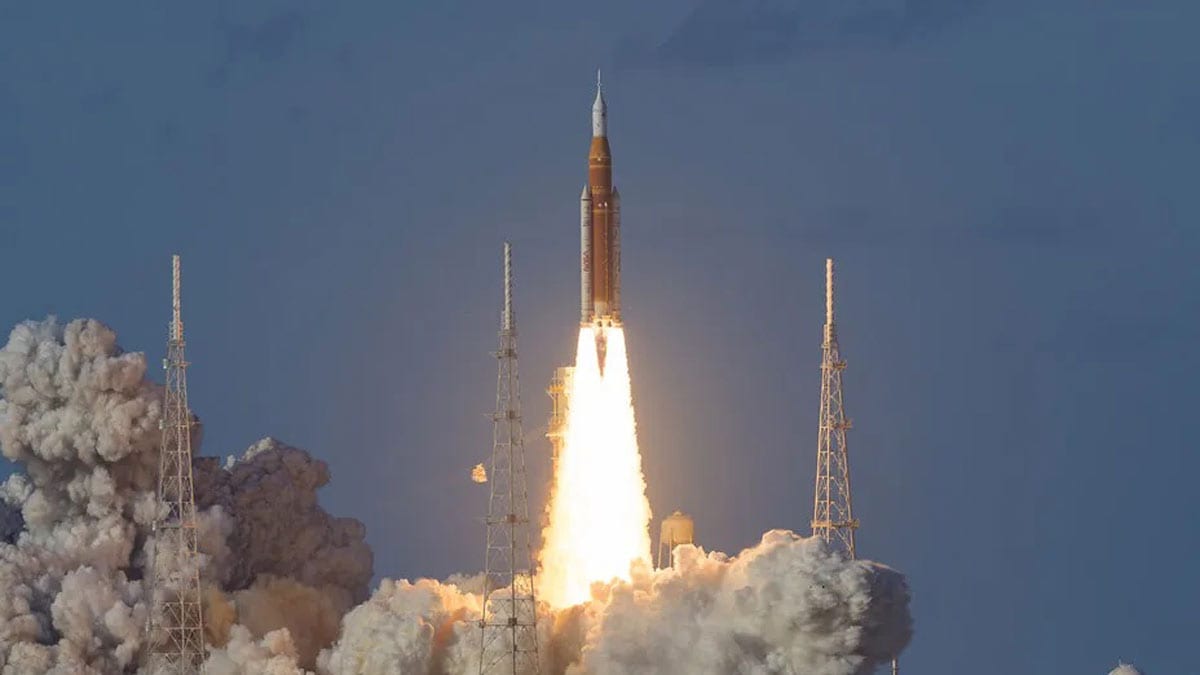
The four astronauts aboard the Artemis II, who embarked on a high-stakes flight around the moon in the world’s first lunar voyage in more than half a century, have reached orbit. They will circle the Earth for about 25 hours before catapulting toward the moon.
NASA’s SLS (Space Launch System) rocket lifted off from Launch Pad 39B at the agency’s Kennedy Space Center in Florida at 6:35 pm on Wednesday. Artemis II commander Reid Wiseman led the mission and is accompanied by pilot Victor Glover, Christina Koch and Canada's Jeremy Hansen.
The Orion spacecraft will demonstrate life support systems for the first time with crew and lay the foundation for an enduring presence on the Moon ahead of future missions to Mars.
After reaching space, Orion deployed its solar array wings, enabling the spacecraft to receive energy from the Sun, while the crew and engineers on the ground immediately began transitioning the spacecraft from launch to flight operations to start checking out key systems, the space agency said.
“Over the next 10 days, Reid, Victor, Christina, and Jeremy will put Orion through its paces so the crews who follow them can go to the Moon’s surface with confidence. We are one mission into a long campaign, and the work ahead of us is greater than the work behind us,” said NASA Associate Administrator Amit Kshatriya.
Mission Control's communication link with the orbiting capsule cut out after switching from one tracking and data relay satellite to another. But the problem was quickly resolved by resetting ground equipment.
Within 49 minutes after the test flight, the SLS rocket’s upper stage fired to put Orion into the Earth’s orbit. A second planned burn by the stage will propel Orion, which the crew named “Integrity,” into a high Earth orbit extending about 46,000 miles beyond Earth. After the burn, Orion will separate from the stage, flying free on its own.
The spacecraft will remain in high Earth orbit for about a day, where the crew will conduct a manual pilot demonstration to test Orion’s handling capabilities. The astronauts, with Mission Control Center teams at NASA’s Johnson Space Center in Houston, will continue checking spacecraft systems, NASA said.
