



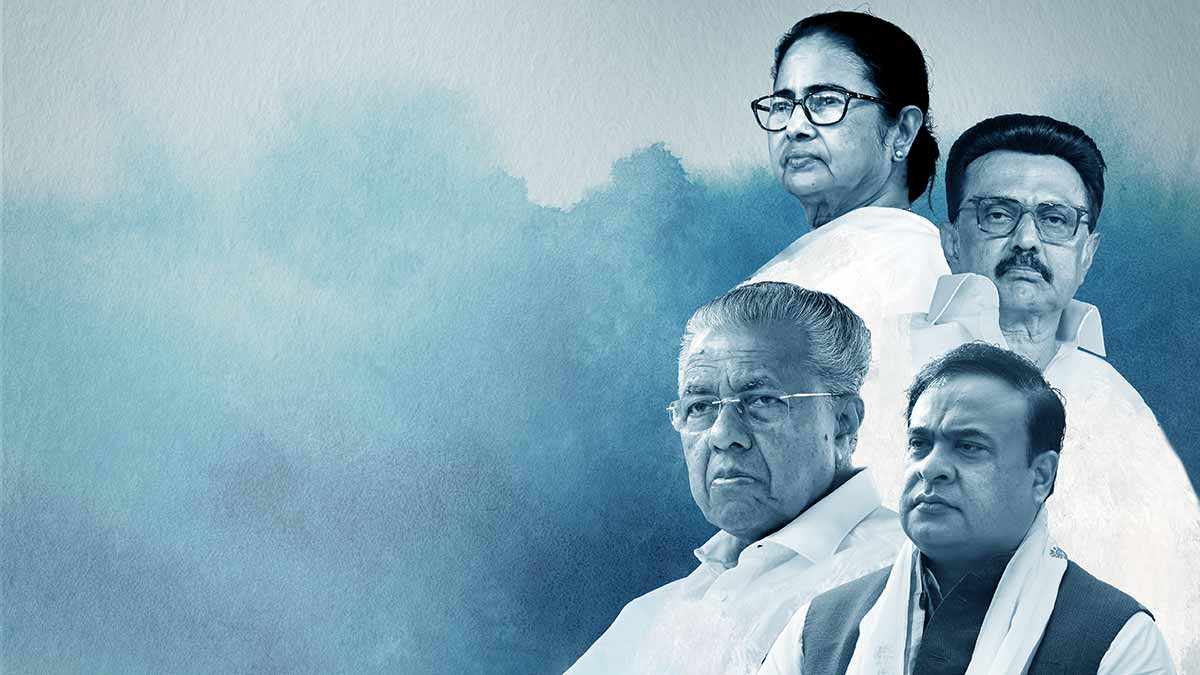
On March 6, Chief Minister Mamata Banerjee sat on a pavement in central Kolkata, protesting the Election Commission’s deletion of more than 60 lakh voters’ names during the special intensive revision. It might seem unusual to see a sitting chief minister behaving like an opposition leader, but for the 71-year-old Banerjee, it was familiar ground.
Nearly two decades ago, she had occupied the same spot for a 26-day hunger strike against the left government’s decision to set up the Tata Nano plant in Singur. Within two years, Tata Motors moved to Gujarat at the invitation of then chief minister Narendra Modi, and Banerjee rode the momentum of her protest to end 34 years of left rule in Bengal.
Banerjee has always operated best when the contest is direct and personal. She tends to gain ground when challenged. This February, she appeared in person before the Supreme Court to argue against SIR. And now, her fight for a consecutive fourth term has turned the state elections presidential. It is a referendum on her politics, style and governance.

This pattern is not confined to Bengal. Across Tamil Nadu, Assam and, to a lesser extent, Puducherry, campaigns are built around the image of dominant chief ministers who often dwarf the party machinery.
In each state, the chief minister has built a distinct political brand, sustained through a combination of welfare delivery and the mobilisation of sub-national identity. In Tamil Nadu, for instance, M.K. Stalin has consolidated the DMK’s position through welfare expansion. In Assam, Himanta Biswa Sarma has combined governance with assertive political messaging centred on identity.
“Leadership has become a key factor in many state elections, especially where regional parties dominate, as their popularity is closely tied to the leader,” said Prof Sanjay Kumar of Centre for the Study of Developing Societies. “There is a mix of pro- and anti-incumbency. Rather than clear pro-incumbency, it is better described as a broadly acceptable assessment of the ruling party in some states. In others, support persists without strong enthusiasm. This is often due to the absence of a credible alternative. In some states, the opposition is weak; in others, there is a degree of apprehension about the alternative.”

Kumar, who analyses data, argues that the leadership factor will be strongest in Bengal and not as strong in Kerala. This is interesting, as the left in Kerala is not pushing the image of Chief Minister Pinarayi Vijayan as strongly as it had during the last elections. In the past few years, there has been a distinct personality-centric narrative around him—unusual for a party that has historically resisted individual glorification.
Political observer A. Jayashankar noted that after the LDF’s strong performance in the 2020 local body polls, CPI(M) cadres had aggressively amplified the ‘Captain’ image. Vijayan’s government built its case on welfare schemes, infrastructure development and crisis response during Covid-19, which saw him retain power in 2021.
But now, the opposition, both the Congress and the BJP, says this record has been dented by allegations of corruption, a gold theft incident at Sabarimala and a governance slowdown.
The results of the 2025 local body elections were a shock for the Vijayan government, as the Congress-led UDF made handsome gains. The shift is now visible—the LDF’s approach this time seems to be on reinforcing the image and performance of individual MLAs, with a sense that a Vijayan-centric campaign alone could be detrimental. He is still the face, but that is not being projected as forcefully as last time.

The strategy marks a departure from 2021, when votes were sought for ‘Captain’ to continue. “This marks the biggest change in the CPI(M)’s electoral approach in recent times,” said political observer and social researcher Joel Thomas Mathews. Nevertheless, the LDF’s campaign slogan is “Who else but LDF?”, with Vijayan’s face next to it—in a way, it raises the question: “Who else but Vijayan?”
In 2021, because of the strongman image built around Vijayan, the CPI(M) had the flexibility to enforce a two-term limit on most senior leaders—Vijayan being the exception, of course. In contrast, the CPI(M) is now fielding 56 sitting MLAs, including the chief minister, with many contesting beyond the two-term norm.
In 51 of 140 constituencies, the LDF has not lost since 2011—a statistic that strengthens the case for retaining sitting MLAs, and one that reflects the anxiety around the results.
“Here, there is a clearer sense of anti-incumbency,” says Kumar. “There are concerns about corruption and expectations from a left government are higher. Even minor shortcomings generate stronger reactions because the benchmark for governance is stricter.”

The opposition is banking on this anti-incumbency, and it seems the UDF’s strategy is more centred on Pinarayi than the LDF’s own campaign. This could, however, be a double-edged sword, as voters have repeatedly shown that they prefer chief ministers who are in charge and available. It is on that count that Vijayan will be judged.
What the poll-bound chief ministers are also doing is doubling down on regional pride. Banerjee has done it through Bengali asmita, Vijayan tried it by renaming Kerala to Keralam, and Stalin has been pushing dravidian identity. He, in fact, announced a reward of $1 million to anyone who could decipher the Indus Valley script, which Tamil scholars are exploring for cultural linkages with the state. This has spurred archaeological discoveries at Keezhadi and Adichanallur, pushing back Tamil Nadu’s antiquity considerably.
Stalin has also opposed the Centre’s three-language formula and the politically sensitive delimitation process, which would stifle south India’s voice at the national level by allotting a lot more Lok Sabha seats to the north.
Stalin was the ‘heir-in-waiting’ for most of his political career, but his image began growing organically after he won the 2021 assembly elections. The first turning point came when he wore a PPE kit and walked into a Covid-19 ward in Coimbatore. The second was when he accepted the demand to extend the free bus ride scheme for women to the transgender community as well. “The decision was taken when someone placed the request via social media,” said DMK spokesperson S.K.P. Karuna. “He immediately consulted the authorities and made a quick decision. [His image] was organically built. It is because of his personal qualities and his nature. He is an inclusive leader. No one has ever heard him talk in a harsh tone or even express anger.”
What has also helped Stalin is his ability to maintain an alliance. This meant having to deal with Congress intermediaries and even dialling Sonia Gandhi and Congress president Mallikarjun Kharge in the presence of former Union minister P. Chidambaram. “This is not merely an alliance of arithmetic,” he had said. “It is an alliance of principles.”
Said author and political strategist Aspire K. Swaminathan: “A coalition that his opponents predicted would splinter has instead grown larger heading into the 2026 [elections]. In Tamil Nadu’s history, this is the first time a single alliance front is entering elections for the fourth consecutive time, still intact.”
But perhaps the biggest plus for Stalin is reliable and visible welfare delivery. The state government recently transferred Rs5,000 each to the accounts of more than 1.31 crore women and promised to increase the monthly incentive from Rs1,000 to Rs2,000 if the DMK-led alliance wins.
Then there is also the breakfast scheme for schoolchildren, monthly cash support for students and UPSC coaching under the Naan Mudhalvan scheme, which political analysts say could create ‘pro-incumbency’.
In Bihar, JD(U) president Nitish Kumar won because of his loyal constituency of women and extremely backward classes, whom he courted through targeted delivery. Voters tend to rely on those who are already delivering, even when the counter-offer seems attractive.
“In Tamil Nadu, the lack of a credible alternative plays a role,” said Kumar. “The DMK is relatively more popular compared with the ruling parties in some other states.”
Stalin has to face the NDA formation—primarily the AIADMK and BJP—and actor Vijay’s Tamilaga Vettri Kazhagam, which is an unknown quantity these elections. However, the DMK-led alliance seems to have an edge currently, thanks largely to the chief minister himself.
Puducherry Chief Minister N. Rangasamy also finds himself at the centre of the Union territory’s politics. But unlike the flamboyant leadership in Tamil Nadu, the All India NR Congress leader is known for his calm, understated style. He has had to navigate administrative tensions—including a powerful lieutenant governor and BJP-appointed members—while holding his ground within the NDA alliance.
He is Puducherry’s longest-serving chief minister, and his image is built on simplicity. He is seen as approachable and grounded, often cycling through the narrow lanes of the old French quarter, stopping at local eateries or playing tennis in the mornings. A close aide describes him as a leader who “reads the situation quickly and pushes for what is possible”.
Like Stalin, his welfare measures, including higher pensions, school breakfast schemes and education assistance, have helped build a durable support base.
His government had been criticised for administrative delays and a lack of internal party structure, which led to his defeat in 2016. Since then, he has recalibrated his politics, aligning with the BJP despite its limited base in Puducherry and playing a key role in the fall of the Congress government in 2021. In the past term, he has retained control within the alliance even as the BJP has sought a larger role.
Whether his personal appeal can once again outweigh structural challenges will decide if he continues in the chair. “In Puducherry, the NDA appears to have an edge, partly because of weak opposition alliances,” says Kumar.
The BJP has faced strong headwinds in its quest to expand in the south, but it has had more luck in the east and northeast. And the man the party has to thank for this is Himanta Biswa Sarma.
The Assam elections will be a referendum on his rule. He got the post after then chief minister Sarbananda Sonowal agreed to move to the Centre in 2021. Since then, Sarma—through his aggression and unrelenting attacks on ‘miyas’, a term for Bangladeshi Muslims—has foregrounded the demographic anxiety that has long been prevalent in the state. A key project in this narrative is the Shaheed Smarak Kshetra at Boragaon, on the outskirts of Guwahati, which is a memorial dedicated to the 860 martyrs of the Assam Agitation—a popular uprising in the 1980s that demanded that illegal immigrants be deported. Sarma has often used the monument to invoke memory and identity, urging people to “safeguard Assam’s identity” and to warn against “demographic aggression”. It remains to be seen if this line of campaigning bears fruit or ends up backfiring.
Sarma has coupled the identity issue with infrastructure development and popular schemes like Orunodoi, under which women receive 1,250 per month. Roads, bridges and urban projects have added to a sense of visible change.
Professor Dibyajyoti Dutta, head of the department of political science at Dibrugarh University, noted that Sarma has “worked to capture public imagination” across constituencies, particularly among women and welfare beneficiaries. His constant visibility and direct engagement, Dutta said, have helped build a perception of credibility.
However, welfare delivery, particularly among younger voters, does not automatically translate into loyalty. “There can be a gap between perception and actual voting behaviour,” said Dutta, noting that a more questioning electorate had begun to emerge, especially among the youth.
And that is where the elections could turn. There is an underlying discontent, but it has not yet consolidated into a unified movement.
Within the BJP, the framing remains clear. The campaign is centred on development, with Sarma as its face. Assam BJP vice-president Aparajita Bhuyan said the party’s confidence rests on “trust in leadership”. “The biggest change has been how the state is viewed,” she said. “Whenever we go out, people point out that Sarma is our chief minister. He is known across the country. He has made us all visible.”
On contentious issues such as illegal immigration, Bhuyan said the party’s stand reflected “a widely felt concern” rather than a polarising strategy against Muslims.
At the same time, the death of cultural icon Zubeen Garg, whose music has long been associated with Assamese identity, triggered a wave of mourning that cut across political lines. There has been criticism that the state government has not done enough to bring those responsible to justice. This visible concern among the youth has shifted the focus to state Congress president Gaurav Gogoi, said Dutta. Bhuyan, however, said: “From a distance, there may appear to be a contest between him and Gaurav Gogoi, but on the ground that perception does not hold.”
Except for Assam, where the BJP has a prominent face in Sarma, the party is relying mostly on Modi as a challenger to the regional leaders, especially in Bengal. After Banerjee ousted the left government, the state’s politics saw another disruption when Modi arrived on the scene. The BJP began targeting the same anti-left, aspirational and conservative voters who had once rallied behind Banerjee. It added a sharper layer of identity politics and an explicit pro-market appeal.
Banerjee did not move in that direction. Instead, she built a model based on welfare delivery and careful social balancing. That recalibration has been most visible in her focus on women voters. Schemes such as Lakshmir Bhandar and other forms of direct support have helped create a loyal base. This approach, seen in parts of Bihar and the southern states, has worked in her favour, especially as other segments of her earlier base have become more fluid.
“Mamata Banerjee is a leader who can face any kind of problem throughout Bengal,” said Trinamool Congress MLA Sobhandeb Chattopadhyay. “If a party worker is tortured, she is the first to reach [out]. She has been beaten so many times. People know that she is a real fighter, who fights for the people of West Bengal, from Darjeeling to Purulia. When she became chief minister, she started development projects. Even when the Centre stopped its projects, she did not stop hers. People of Bengal have benefited from these.”
Her highly centralised leadership style—holding multiple portfolios, depending heavily on bureaucratic execution and keeping decision-making tightly controlled—allows for speed and clarity, but also means that any anti-incumbency accumulates directly against her.
While she might still have an edge, the SIR issue adds a layer of uncertainty. Migrants and poor voters could face greater difficulty in staying on the rolls, which could affect turnout patterns in specific regions, including Muslim-dominated areas. However, the impact is unlikely to be one-sided.
For the BJP, the challenge is not just electoral but structural. Its sole focus on the Hindu vote and a singular narrative limits its ability to expand, and the absence of a strong, state-level leadership face remains a weakness.
The BJP had made impressive gains in the previous assembly elections, winning 77 seats and 38 per cent vote share, the latter even going up marginally in the 2024 Lok Sabha elections. The number of seats, however, fell from 18 to 12.
“[Banerjee’s] high appeasement politics did not benefit Muslims,” said BJP leader Suvendu Adhikari. “She did not give them jobs and there is no development.”
After 15 years, there is of course some anti-incumbency against the government. There are complaints about governance, welfare fatigue and local corruption. However, it does not seem strong enough to shift the balance. Unlike the final years of the left rule, the current government has shown visible change in infrastructure and welfare outreach.
Banerjee recently increased the monthly amount under Lakshmir Bhandar to Rs1,500, and announced an aid of Rs1,500 every month for the unemployed and an increase in monthly honoraria for priests and muezzins. All this, she hopes, would help her counter the fallout of the SIR and voter fatigue.
“The Trinamool Congress appears stronger than the BJP, but this is not necessarily because of widespread satisfaction with governance,” said Kumar. “Public sentiment is more moderate—neither strongly positive nor negative. A key factor is identity. There is a shared perception among voters that language, culture and regional identity are at stake. There is some anxiety that a BJP government could, over time, dilute Bengali identity. The Trinamool is seen as rooted in that identity, which explains its continued support.”
The results on May 4 will have an impact beyond these states, especially for the BJP and the Congress. How well the BJP does in Tamil Nadu, Kerala and Bengal will decide whether Modi can rival Jawaharlal Nehru’s pan-India appeal in the years after independence.
The bigger impact will be on the Congress and the internal dynamics of the INDIA bloc. The party is not a significant player in Bengal or Tamil Nadu, and only a marginal one in Puducherry. Its real stakes are in Kerala and Assam, and it has a stronger chance of winning the former. If it fails to do so, its position as the central pillar of the INDIA bloc would be under question.
—with inputs from Lakshmi Subramanian, Prema Rajaram and Nirmal Jovial
