


One of the most pivotal scenes in All The President’s Men unfolds in a dim underground parking space. Bob Woodward, a Washington Post reporter investigating the Watergate scandal, has come to meet his secret source—an influential FBI official known only as Deep Throat. Woodward is frustrated, chasing leads he cannot yet weave into a coherent story.
In the shadows, where words must be whispered because truth can be dangerous, Woodward confesses his desperation. He asks for something more concrete, promising not to quote Deep Throat—even anonymously. “The story is dry,” he says. The fragments he has are not enough.
Deep Throat offers two pieces of advice. First: stop assuming the White House is staffed by brilliant minds. “The truth is, these are not very bright guys,” he says. “And things got out of hand.” Then comes the line more famous than the film itself: “Follow the money.”
All The President’s Men was released in 1976, less than two years after Richard Nixon resigned in the wake of the Post exposés. Directed by Alan J. Pakula from a William Goldman screenplay, it was a commercial and critical triumph—winning four Oscars and cementing its place as a landmark of the New Hollywood era. In the 50 years since, “follow the money” has become cultural shorthand for a guiding principle: to uncover truth, look beyond personalities and events and trace the movement of money itself. Where it comes from, and where it goes.
That principle might well have resonated with anyone watching the Academy Awards at the Dolby Theatre in Los Angeles on March 15. The ceremony, though celebratory, underscored grim realities.
“I am honoured to be the last human host of the Academy Awards,” comedian Conan O’Brien quipped at the opening. “Next year, it’s going to be Waymo in a tux.” Waymo is the AI company that operates driverless taxis across parts of Los Angeles, including Hollywood. The joke landed because it tapped into something real.

In the months leading up to the Oscars, anxiety had been mounting about AI’s expanding role in filmmaking. The technology is already reshaping visual effects, sound design, animation and concept art. Tools like Runway and Midjourney can generate storyboards, de-age actors, fill backgrounds, and automate colour grading—and, crucially, reduce crew sizes and production costs.
That anxiety found strong expression when Will Arnett—known for voicing the cynical, alcoholic horse in BoJack Horseman—took the stage to present Best Animated Feature. “Tonight we are celebrating people, not AI,” he said. “Because animation is more than a prompt; it’s an art form and needs to be protected.”
The resistance was even sharper offstage. Director Guillermo del Toro, whose Frankenstein received nine nominations, said he would “rather die” than use generative AI in his films. Frankenstein, he said, was a celebration of handmade creation, with human artistry shining on “every single frame”.
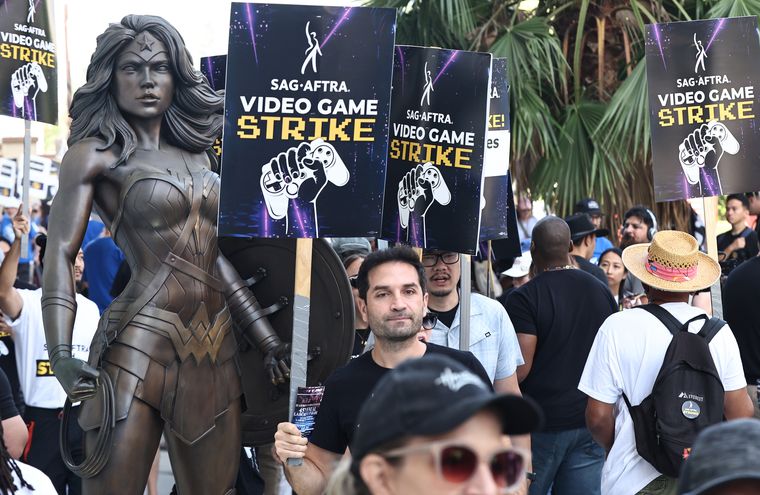 Power shift: SAG-AFTRA, which represents actors, writers, broadcasters and artists, says AI tools “undercut the ability of human talent to earn a livelihood” | Getty Images
The unease had intensified weeks earlier when an AI-generated video of a hyper-realistic rooftop fight between Tom Cruise and Brad Pitt went viral. Created by Irish filmmaker Ruairi Robinson using a model called Seedance 2.0, the clip rivalled Hollywood productions in motion, choreography and camera work. Robinson reportedly generated it from a two-line prompt.
The backlash was swift, with alarms raised over the unauthorised use of actors’ likenesses. The labour union SAG-AFTRA (Screen Actors Guild - American Federation of Television and Radio Artists) condemned it as “unacceptable”, saying tools like Seedance 2.0 “undercut the ability of human talent to earn a livelihood”.
Days after the Oscars, Congresswoman Laura Friedman noted that her Los Angeles County constituency had lost around 42,000 film and television jobs between 2022 and 2024, with working-class crew members losing an estimated 45 million work hours.
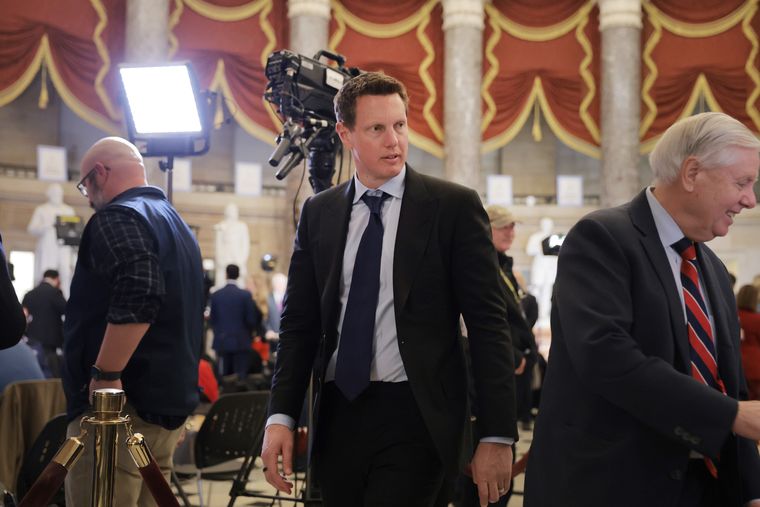 David Ellison of Paramount during Trump’s State of the Union address in Washington, DC, in February | Getty Images
Whether governments will act remains uncertain. For now, Hollywood finds itself not unlike Woodward in that parking space—frustrated, overwhelmed, chasing leads. Filmmakers are cautiously experimenting; studios are integrating AI to cut costs; actors are attempting to legally protect their likenesses; and technicians are racing to acquire new skills. But a coherent view of the future remains elusive. Everyone has fragments; no one has the full story.
Which is why Deep Throat’s advice feels newly relevant: follow the money.
Waymo offers an illustrative case. It began as a Google project called Chauffeur. In 2014, after years of limited progress, Google overhauled its neural network architecture to train AI models by making the shift from standard computers chips to GPUs—faster, more efficient and considerably more expensive. As the New York Times technology correspondent Cade Metz reported, Google purchased an initial batch of 40,000 GPUs for $130 million. Within a month, Metz wrote, “all 40,000 of them were running round the clock, training neural network after neural network after neural network”. Google rebranded Chauffeur as Waymo in 2016 and spun it off as an independent company. Four years later, it became the first in the world to offer driverless taxi services. Today, it provides 4,50,000 rides per week; tomorrow, as O’Brien noted, it could be “Waymo in a tux” hosting the Oscars.
Nvidia, which sold those GPUs to Google in 2014, has built a pervasive but largely invisible presence in Hollywood. For more than 15 years, every film nominated for the Academy Award for Best Visual Effects has used Nvidia-powered server farms and technologies. The company has also been actively championing AI in filmmaking—most recently sponsoring the India AI Film Festival at Qutb Minar in New Delhi in February.

The studios themselves are betting heavily on AI, many with deep financial ties to the companies driving it. Paramount, one of Hollywood’s Big Five, is controlled by David Ellison, whose father Larry Ellison owns Oracle and is a close ally of President Donald Trump. When Trump pressured ByteDance to divest TikTok’s US operations, it was Larry Ellison who acquired a significant stake. He also extended a substantial loan to his son to buy Paramount, which is now in talks to acquire Warner Bros.
This year’s Oscars proved a crowning moment for Warner Bros. Its 11 films earned more than 30 nominations—an all-time record. The two films that dominated the night—One Battle After Another and Sinners—were both Warner productions, and both were as ferociously political as All The President’s Men was. One Battle After Another offered a searing indictment of anti-immigrant politics; Sinners used a vampire story as an unexpectedly powerful parable about technologies that enter the bloodstream—and the humans who consent to let them in.
Yet, the flow of money—spent on technology used to cut costs, which drives further investment in technology—has Hollywood entering genuinely uncharted territory. “There was no mistaking the faintly elegiac cloud that hung over this year’s Oscars,” noted one review, “the sense of a ceremony, and of an entire industry, unable to stop memorialising itself.”
These upheavals unfold against the backdrop of what may be the largest wave of media consolidation in US history. In the 1980s, 50 companies controlled 90 per cent of the American media market. That number is now five. Last week, a Trump-backed deal to create a TV network reaching 80 per cent of US households was cleared by regulators—with authorities agreeing to waive a rule capping household reach at 39 per cent. The deal first drew wide attention last year when the network, Nextra, blocked a broadcast of Jimmy Kimmel’s talk show.
This year, Kimmel appeared at the Oscars as a presenter, saluting documentary filmmakers who tell dangerous stories. “Telling a story that could get you killed for telling it is real courage,” he said. “As you know, there are some countries whose leaders don’t support free speech. I am not at liberty to say which.”
Kimmel, it seems, knows exactly how the money flows.
The situation Hollywood find itself in may not be so different from the world depicted in All The President’s Men. In the film, a fellow journalist tells Woodward about Charles Colson—special counsel to Nixon, and one of the most powerful men in the US. “There is a cartoon on his wall,” the journalist says. “The caption reads: ‘When you’ve got them by the balls, their hearts and minds will follow.’” This year’s Oscars showed Hollywood firmly in that grip.