



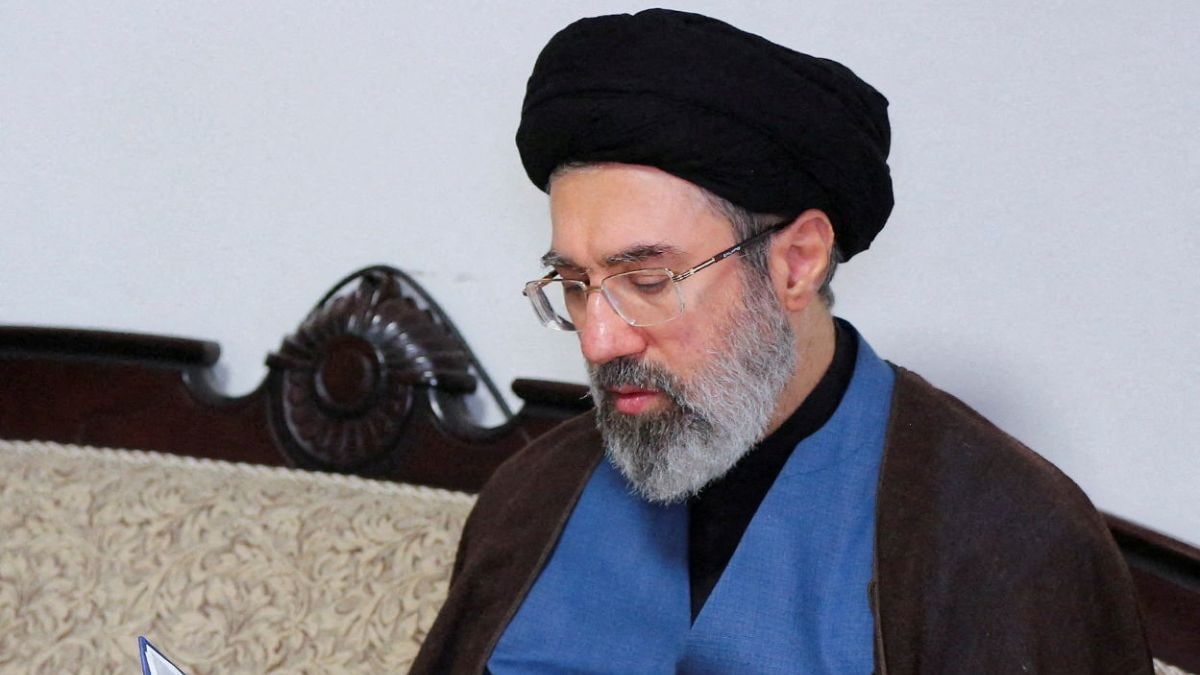
The 1979 Revolution aimed to overthrow the hereditary monarchy of the Shah, but the appointment of Mojtaba Khamenei as his father’s successor creates a notable irony for the Islamic Republic. For years, regarded by many as the heir apparent, Mojtaba, the second-born son of Ali Khamenei, has spent much of his life serving as a confidant, gatekeeper, and “power broker.”
Currently in his 50s, Mojtaba has never held an official government position and has maintained a very low profile, to the extent that, until recently, there was no publicly available footage of him speaking.
Although his visual presence has traditionally been understated, he is described as an “enigmatic but powerful figure”, mainly because of his closeness to his father and his role within the office of the Supreme Leader (Bayt-e Rahbari).
Mojtaba moved from Mashhad to Tehran for high school after his father took a position in the post-revolutionary government. After graduating in 1987, he joined the IRGC and briefly served in the Iran-Iraq War (1980-88) in non-combat roles. He was inducted into the Habib ibn Mazaher Battalion under the 27th Mohammad Rasulullah Division of the IRGC, but later transferred to the 10th Division of Seyyed al-Shohada (Karaj).
Mojtaba was 20 years old when his father became the Supreme Leader. Accounts of his activities over the following decade are somewhat contradictory. Some suggest he began working for his father, while other accounts say he turned to religious studies.
Nonetheless, in 1999, he moved to Qom to continue his clerical studies under the guidance of several prominent hardline clerics, including Ayatollah Mohammad-Taqi Mesbah Yazdi, Ayatollah Sayyed Mohsen Kharrazi, and Ayatollah Lotfollah Safi Golpayegani.
Not much was known about Mojtaba until the 2005 presidential elections, when he supported Mahmoud Ahmadinejad. Consequently, during the 2009 “stolen elections,” Mojtaba again backed Ahmadinejad. Noted reformist leader Mehdi Karroubi blamed Mojtaba personally for interfering in the voting process by providing money to religious groups in favour of Ahmadinejad.
What’s interesting to note is that while Mojtaba’s credentials as the Supreme Leader’s son helped him rise as a power broker, there were also structural factors that supported and later solidified his influence. Specifically, his time in the armed forces as a member of the IRGC’s Habib Battalion allowed him to build a close relationship with the security establishment.
His connection to Hossein Taeb, a fellow Habib Battalion member and the Commander of the Basij Forces (2007-09), allowed Mojtaba to play a key role in suppressing the 2009 Green Wave protests. Taeb later became the first head of the IRGC’s Intelligence Organisation (2009-2022), leading to speculation that Mojtaba may have helped him rise to power in exchange for his support during that time.
Ever since then, Mojtaba has maintained his shadow command and control alongside the security establishment. For example, in 2014, Mohammad Sarafraz, the director of state media, the Islamic Republic of Iran Broadcasting (IRIB), was dismissed under pressure from Mojtaba and Taeb in the IRGC.
On another occasion, the then-chief of the IRGC Aerospace Force, Amir Ali Hajizadeh, praised Mojtaba for his military insights and support for increased funding for missile and drone projects. Continuing his influence over the system, Mojtaba was sanctioned by the US Treasury Department in 2019.
Besides his political influence, his name has been linked to various financial scandals. A 2026 Bloomberg investigation alleged that Mojtaba was part of a £100 million offshore financial network that the regime used to move assets abroad, including high-value real estate in London and Dubai, as well as shipping and banking sectors.
Yet, despite this apparent influence, little is actually known about Mojtaba’s ideological positions. However, given his upbringing in a hardline environment, his views are generally believed to mirror and possibly expand upon Ali Khamenei’s perspectives. His teaching role in Qom, while comprising lectures reserved for senior clerics, has not yielded any major rulings or fatwas ascribed to him. In 2024, during his first publicly available message, Mojtaba announced the suspension of his seminary lectures due to personal issues. And much like his father, his elevation within the clerical hierarchy appears less an organic process than a top-down approach, with state media lately referring to him as an Ayatollah.
Mojtaba is also connected to Iran’s proxy networks, reportedly working closely with the IRGC’s Quds Force. In a rare public appearance in 2024, Mojtaba was photographed visiting a hospital in Tehran to meet Hezbollah operatives injured during the exploding Pager Attacks. He also met with Abdullah Safieddine, the brother of Hashem Safieddine(Deputy Secretary-General of Hezbollah, killed in an airstrike days after Hassan Nasrallah).
On the personal front, after two temporary marriages, Mojtaba married Zahra Haddad-Adel, the daughter of a senior regime loyalist and an advisor to Ali Khamenei, Gholam-Ali Hadad-Adel. Notably, his father-in-law visited India last year, advocating closer bilateral relations between India and Iran.
Mojtaba has three children, one of whom died along with his wife and father-in-law during the strikes on 28 February. Mojtaba was also reportedly injured and presumed dead before the establishment informed others of his survival.
Since the announcement, state media have been reporting widespread celebration of Mojtaba as the successor, but how long and how effective his tenure will be is hard to tell. Already, the US President Trump has said that Mojtaba as a successor would be “unacceptable” to the US, while Israel has warned of further strikes against the potential Supreme Leader.
While succession was a timely opportunity for Mojtaba, what lies ahead is neither easy nor convenient. Mojtaba will need to withstand the ongoing war. His close ties to IRGC and support from figures like Majles speaker Mohammad-Bagher Ghalibafare his strengths. However, the real challenge will be internal, as he inherits a country struggling with increasing political dissent, economic crises, and social divisions.
The author teaches at the Centre for Political Studies, Jawaharlal Nehru University, New Delhi.
