



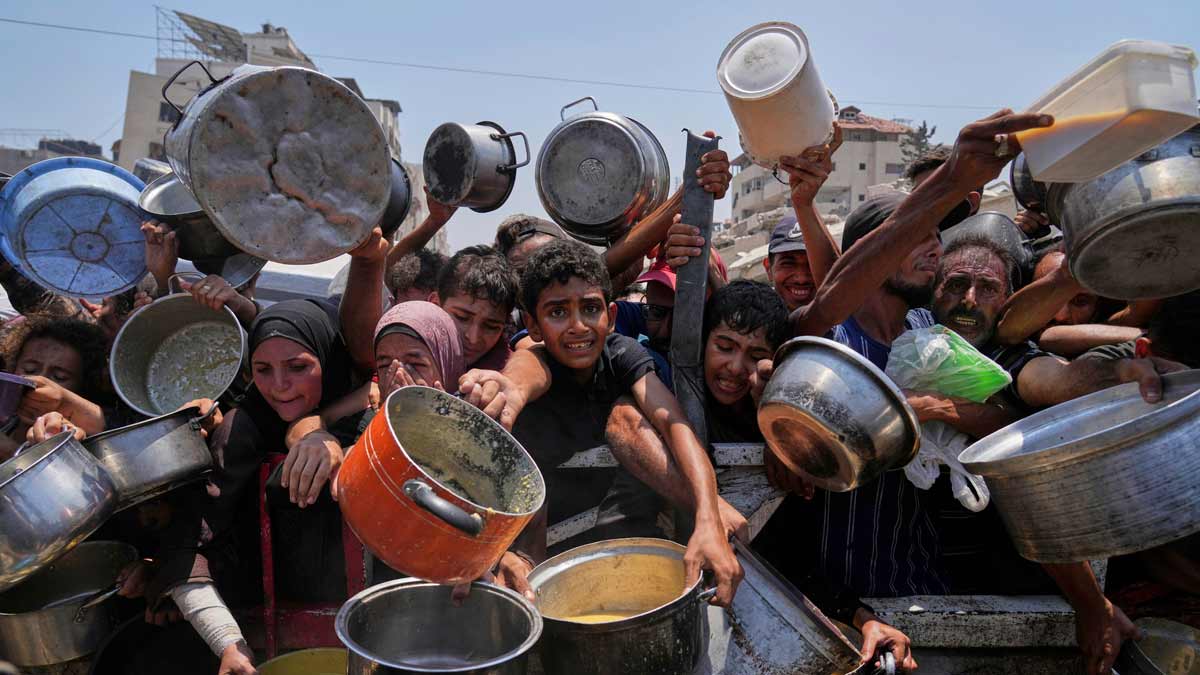
Food security experts authorised by the United Nations have announced last week that Gaza City and the surrounding area are officially suffering from famine. The decision was made by the Integrated Food Security Phase Classification (IPC), a group of international organisations that the UN uses to assess global hunger crises. This is the first time famine has been confirmed in the Middle East, highlighting the collapse of food security in Gaza.
The IPC issued its confirmation on August 22. It warned that famine is already under way in Gaza City, and could spread further south to Deir al-Balah and Khan Younis by the end of September unless there is an immediate ceasefire and unrestricted access for humanitarian aid.
More than five lakh people in Gaza, around a quarter of the population, are now facing catastrophic hunger. By late September the number experiencing the most severe levels of food insecurity is expected to rise beyond 6.4 lakh. The IPC noted that the deterioration in Gaza has been faster than in any other crisis it has monitored, describing an “unprecedented pace” of decline between July and mid-August. UN Secretary-General António Guterres condemned the famine as “a man-made disaster, a moral indictment and a failure of humanity itself”, calling it the deliberate collapse of systems essential for survival.
How famine is defined
A famine is not declared lightly. The IPC applies three strict criteria before making such a judgement. At least one fifth of households must be facing extreme food deprivation, meaning they are starving. Acute malnutrition must affect at least 30 per cent of children aged between six months and five years, or 15 per cent measured by the circumference of the upper arm. Finally, there must be evidence of a death rate of two people per 10,000 per day, or four children under five per 10,000 per day, due to hunger or its interaction with disease.
Collecting such data in Gaza has been extremely difficult because of Israel’s restrictions on access. Still, surveys carried out between July and mid-August confirmed that thresholds for starvation and malnutrition had been crossed. Mortality figures were less precise, but the IPC concluded that deaths from hunger and disease had most likely reached the required level. The Famine Review Committee, an independent panel of experts, endorsed these findings.
Israel has attacked the IPC’s methodology, claiming the agency manipulated its own rules by accepting the 15 per cent figure measured through the mid-upper arm circumference rather than the more complex weight-for-height standard. The IPC explained that the arm measurement was used because it is more practical in conflict zones. Analysts such as Alex de Waal have long noted that famine deaths rarely come from hunger alone but from a deadly combination of malnutrition, disease and deprivation.
Human responsibility
The causes of this famine are overwhelmingly linked to human action. Aid agencies and UN officials had warned for months that Israel’s blockade, coupled with its military campaign, was driving Gaza towards starvation. Guterres stated that as the occupying power Israel has clear obligations under international law to ensure food and medicine reach civilians. UN aid chief Tom Fletcher accused some Israeli leaders of openly using hunger as a weapon of war. Human rights commissioner Volker Türk declared that using starvation as a method of warfare is a war crime, and that the resulting deaths may also constitute wilful killing.
Food shortages have been deepened by the destruction of infrastructure, including bakeries and farms. Nine in ten residents are displaced and almost all of Gaza’s cropland is damaged or inaccessible. Local food production has virtually collapsed.
Denials and division
The declaration has produced starkly different reactions. Israel’s Prime Minister Benjamin Netanyahu dismissed it as “an outright lie” and “modern blood libel”. His office said Israel has no policy of starvation and insisted that authorities have gone to “unprecedented lengths” to facilitate aid. Israel’s Coordinator of Government Activities in the Territories, an agency responsible for allowing aid into Gaza, rejected the IPC’s findings. “ The report is based on partial and unreliable sources, many of them affiliated with Hamas, and blatantly ignores the facts and the extensive humanitarian efforts led by the State of Israel and its international partners,” said Maj. Gen. Ghassan Alian, the head of the agency. Israel pointed to the work of the Gaza Humanitarian Foundation, a body supported by Washington and Tel Aviv, as evidence of its commitment.
The United States initially echoed Israel’s scepticism. Although President Donald Trump had admitted starvation was taking place earlier in the conflict, his administration now cast doubt on the IPC’s findings. The State Department described the report as a matter of “semantics” and suggested Hamas was pushing a false narrative of mass starvation. US officials also questioned whether the IPC had recently altered its definitions. This alignment with Israel’s position reflects Washington’s reluctance to exert real pressure on its ally.
In contrast, there has been a wave of condemnation from the United Nations, European leaders, aid organisations and regional powers. UNRWA chief Philippe Lazzarini said repeated warnings had been ignored and urged immediate political action. Britain’s Foreign Secretary David Lammy called the famine a moral outrage and a man-made catastrophe, placing responsibility on Israel for blocking sufficient aid. Amnesty International described it as a scathing indictment of the international community’s failure to restrain Israel and accused the country of pursuing a deliberate campaign of starvation. The Red Cross, Oxfam, Islamic Relief, CAIR and Mercy Corps all issued statements underlining the preventable nature of the disaster. Oxfam reported that millions of dollars’ worth of its aid had been blocked by Israel.
Saudi Arabia, Kuwait and the Gulf Cooperation Council condemned what they called Israel’s policy of starvation and demanded urgent international intervention. Turkey’s First Lady, Emine Erdogan, made a personal appeal to her American counterpart Melania Trump, describing Gaza as a “children’s cemetery”.
Human cost
The suffering within Gaza is most visible among its youngest citizens. Malnutrition among children has risen at a catastrophic rate. More than 12,000 children were acutely malnourished by July, six times as many as at the start of the year. By June 2026 over 1.3 lakh children under five are expected to be threatened by malnutrition. Gaza’s health ministry has recorded 281 deaths from hunger, including 114 children. Families describe children wasting away in hospitals without proper food, while health workers report men so thin they appear to be teenagers. Contaminated water is spreading disease, which is more likely to prove fatal for those already weakened by lack of food.
The looming Israeli military operation in Gaza City threatens to make matters worse. Aid groups warn that hundreds of thousands could be displaced again. Many of the frailest, including sick and malnourished children, elderly people and those with disabilities, may be unable to flee. The IPC projects that by the end of September one in three Gazans could be facing catastrophic hunger.
The declaration of famine in Gaza City is a grim milestone in an avoidable tragedy. It reflects not only the destruction of basic systems of survival but also the deep political divisions among international actors.
